Monday, October 20, 2014

Fall Forest Ecology

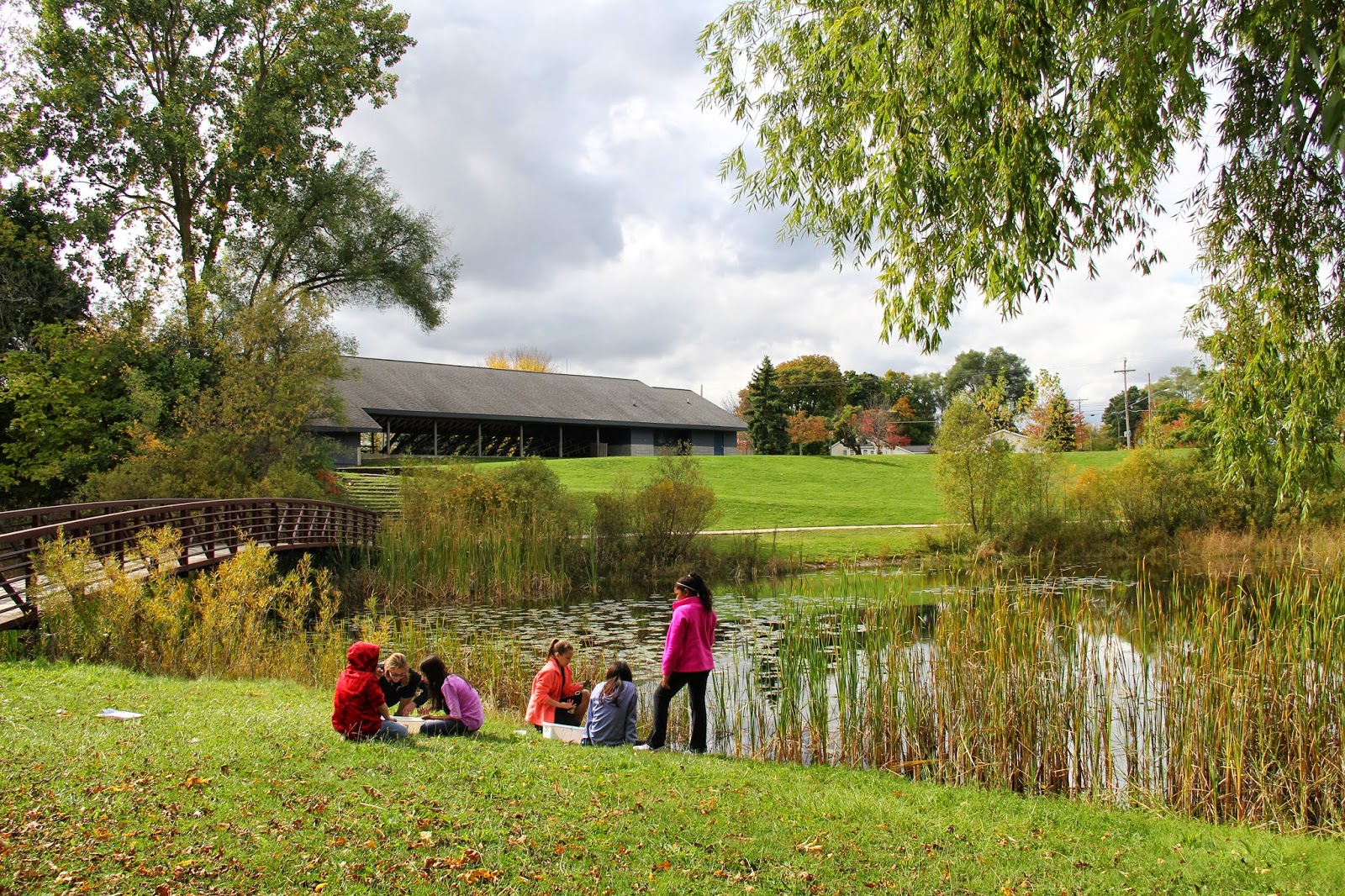
Each of the last three years, 3rd, 4th, and 5th grade students from Winn Elementary have met me at the Chippewa Watershed Conservancy's Audubon Woods Preserve to learn about forests.  This trip always takes place in the spring.  This year, we decided to have the 4th and 5th grade students do both the spring trip and (for the first time) a fall trip.  A major focus of this trip was to have the students identify, draw, and collect leaves for a classroom leaf collection.  Here are a few photos from the day.


Despite some early concerns with the weather, it ended being a beautiful fall day.  In addition to the colorful leaves, fall in Mid-Michigan is the prime time for fungi.


One pleasant surprise on the day was finding Sassafras trees growing in the forest understory.  Although this species is found in Mid-Michigan it is much more common further south. 


Friday, October 17, 2014

Earth Science Week - Friday

Happy Earth Science Week!

One of really interesting things to me about Earth Science is that from our point of view many things remain the same, but on a geologic time scale they are undergoing great changes.

Water cuts down through rock forming gorges and canyons.

Watkins Glen, NY

Canyon Falls, Sturgeon River, MI

Rocks crack and tumble becoming smaller and smaller.

Acadia National Park, ME

Acadia National Park, ME

Muskallonge Lake State Park, MI

Sediments build up, forming layers.  Given enough time and pressure those layers turn into rock.

Sleeping Bear Dunes National Lakeshore, MI

Pictured Rocks National Lakeshore, MI

Tectonic forces cause those layers to tilt and solid rock to bend.

Bonanza Falls, MI

LeMoyne State Park, ME

Glaciers carve valleys out of solid rock.
Lake of the Clouds, MI
Through it all, the seasons change.
 
Laingsburg, MI

Isabella County, MI

Mt. Pleasant, MI
 
Mission Creek Woodland Park, Mt. Pleasant, MI

Living things complete their annual cycles.
 
Mt. Peasant, MI

Sleeping Bear Dunes National Lakeshore, MI


And the sun rises and sets daily.

Old Mission Point, near Traverse City, MI

We observe these many changes, but our sense of time is different than that of the Earth and sky.  Earth Science looks at that long view and helps us understand how the many small things that we observe fit into the larger scale of geologic time.

Thursday, October 16, 2014

Earth Science Week - Thursday

Happy Earth Science Week!

A detail of Wagner Falls - one of the more than 200 named waterfalls in Michigan

Today I am going link to 25 different Earth Science posts I have written on this blog.

25 JAN 2013     Weather - Mackerel Skies

20 MAR 2013     Spring

21 JUN 2013     Summer Solstice

27 AUG 2013     Appreciating the Rain

23 SEP 2013     Fall

22 OCT 2013     Geology Photographs

23 OCT 2013     Geology Photographs - Great Lakes Dunes

24 OCT 2013     Waterfalls

30 OCT 2013     Five Science Things - Firsts in American Space Flight

16 DEC 2013     The Face of the Moon (15 December 2013)

21 DEC 2013     Winter Solstice

21 JAN 2014     Geology Concepts - Superposition

22 JAN 2014     Geology Concepts - Original Horizontality

23 JAN 2014     Geology Concepts - Cross-bedding

27 JAN 2014     The Space Shuttle Challenger - Twenty Eight Years Later 

30 JAN 2014     Snow Dunes

04 FEB 2014     Two boulders, both alike in dignity...

19 FEB 2014     Soil Particle Sizes

14 MAR 2014     Four Fossils

20 MAR 2014    Vernal Equinox

21 July 2014     One Small Step

05 SEP 2014     Rainbows

13 OCT 2014     Happy Earth Science Week - Monday

14 OCT 2014     Earth Science Week - Tuesday

15 OCT 2014     Earth Science Week - Wednesday


Wednesday, October 15, 2014

Earth Science Week - Wednesday

Happy Earth Science Week!

Today is National Fossil Day!  For today I thought I would share photos of some of the fossils in my collection.  Almost all of these fossils were purchased.  In many cases I do not know their origin.

Ammonites

Crinoid

Fern

Clams in a sandstone slab from the Mason Esker

Michigan fossil slab containing corals, shell fragments, bryozoa, crinoid stems, etc.

Cobble containing shells from the Mason Esker

Two trilobites and an ammonite

An unpolished Hexagonaria (Petoskey Stone)


Tuesday, October 14, 2014

Earth Science Week - Tuesday

Every day of Earth Science Week has a focus.  The focus today is "No Child Left Inside".  There is a lot of research that shows that the average child today spends less time playing outside that his/her parent's generation did.  While there are many reasons for this, the point is that kids need to spend more time outside.  What better way to spend time outside and learn about earth science than to go somewhere and pick up rocks.

Interesting rocks can be found throughout Mid-Michigan.  The glaciers that covered Michigan during the Ice Age picked up rocks from further north (Canada) and dumped them across Michigan.  Any time you did a hole in Mid-Michigan you are likely to come across rocks that are not only hundreds of millions of years old, but that have also traveled hundreds of miles from where they formed.

Rather than digging holes to search for rocks, I would rather go to a place where I can look over thousands of rocks at once.  There is no better place to do this than a rocky beach.  I have two favorite beaches where I like to search for rocks.  Unfortunately neither one is very close to Mid-Michigan.

Peterson Park Beach

Peterson Park Beach is located near the tip of the Leelanau Peninsula (Michigan's pinkie finger).  Unlike the sandy beaches that can be found along most of Northwest Michigan, the beach at Peterson Park is covered with rocks.  Most of the rocks range from fingernail to fist-size, but larger ones can be found in the water offshore.  The rocks are variety of igneous, sedimentary, and metamorphic types and represent the many types of bedrock found in the Canadian Shield and Michigan Basin.

Peterson Park Beach

The rocks extend out into the lake.

Sizes, shapes, and colors of Peterson Park Beach rocks

If you go to Peterson Park make sure that you bring a bucket to carry your treasures home.  You will want to limit how many rocks you collect - it's 114 stairs back up to the parking lot...

The stairway down to the beach.


Click here for directions to Peterson Park from Mt. Pleasant.

Peterson Park is my favorite place in the Lower Peninsula to pick up beach rocks, but my favorite place in Michigan to look for rocks is in the Upper peninsula.

Muskallonge Lake State Park Beach.

Muskallonge Lake is located about 4 1/2 hours from Mt. Pleasant, Muskallonge Lake State Park is located in Luce County in Michigan's Upper Peninsula.  The park is situated between Muskallonge Lake and Lake Superior and includes two miles of Lake Superior Beach.  Storms and waves constantly bring a new supply of rocks to the beach.  The rocks here are concentrated along the edge of the water with sand higher up the beach.  Again, the rocks come mainly from bedrock types found in the Canadian Shield - lucky searchers find Lake Superior Agates.  There is no stairway to climb back up here so you can easily collect as many rocks as you want to carry.  On our last trip to the park we brought back about 3 gallons of rocks.
 
The Lake Superior Beach at Muskallonge Lake State Park

A closer view of the beach rocks

Lake Superior's waves constantly bring new rocks toward shore.

The campground at Muskallonge Lake State Park is one of my favorites in Michigan.  On one clear night we spent about an hour lying on a picnic table staring up at the innumerable stars. 

Click here for directions to Muskallonge Lake from Mt. Pleasant.

Monday, October 13, 2014

Happy Earth Science Week - Monday

Happy Earth Science Week 2014!

What is Earth Science?  The short answer is that Earth Science is the study of the Earth and its neighbors in space.

Earth Science is generally divided into four disciplines:

Geology (the study of the earth) is a science that deals with the study of the Earth's materials, structures, and processes.

Lichen covered granite - Cadillac Mountain, Acadia NP, Maine

Meteorology is a science that deals with the study of atmosphere and how processes in the atmosphere affect weather and climate (long term weather patterns).

Early morning clouds - Mt. Pleasant, Michigan

Oceanography is a science that involves the study of Earth's oceans and seas and their composition, patterns, and processes.  This science also includes the study of the organisms that inhabit the oceans.

Atlantic Ocean shoreline - Acadia NP, Maine

Astronomy is the study of the universe.  It includes the study of how nearby celestial bodies influence the Earth.

Night Sky (20 July 2007) - Munising, Michigan

To learn more about Earth Science please check out this series of videos produced by the American Geosciences Institute.

Thursday, October 9, 2014

Wetland Exploration with Fancher SIxth Graders

On Tuesday (07 OCT) I spent the day exploring Mill Pond Park with three classes of 6th Grade students from Fancher Elementary.  I had previously visited each of these classes to talk about wetland habitats.  This field trip enabled the student to get a hands-on experience with something that they were learning about in class.  Each class visited the park for a little over an hour.  During that time we talked about the different zones found in wetlands(upland plants/emergant plants/floating leaf plants/submersed plants), looked at wetland soil, and searched for aquatic invertebrates.

Here are a few photos from the day.

Me explaining the zones of plant life found in a wetland

Me trying to fall down.

A big thank you to Brooke Friesen for taking the photographs of me.  Brooke is a Central Michigan University student studying environmental and outdoor education.  In her spare time she has started volunteering time with our Environmental Education Program.


The absolute best thing of the day for me was having a student tell me that, after learning about wetlands from me over the past two weeks, she thinks she wants to be a wetlands ecologist.  That is awesome...

A future wetlands ecologist holding a water scorpion


As I was photographing the reflection of the sun and clouds among some water lily leaves, a student asked what I was taking a picture of.  So I showed him.  His reaction was "cool".

The trees are starting to turn, but the water is still warm.

Students cataloging their finds.