Showing posts with label berries. Show all posts

Monday, November 19, 2018

Of scattering abroad...

This morning I had a little bit of time free after giving a program at Fancher Elementary.  I hadn't been out in the woods for a few days do I decided to head to Chipp-A-Waters Park and walk the trails.  I didn't have plan, I just wanted to get outdoors and take a few pictures.  Almost immediately I noticed a Common Milkweed (Asclepias syriaca) with a few seeds still hanging to its dried out pods and nearby was Bitter Dock (Rumex obtusifolius) with its flattened seeds.  When I a bit further I noticed the fluffy seeds of a Canada Goldenrod (Solidago canadensis) and a Boxelder's (Acer negundo) winged samara.  At that point I had an idea - how many different fruits, seeds, or nuts could I find?

#1 - Common Milkweed (Asclepias syriaca)

#2 - Bee Balm (Monarda fistulosa)

#3 - Bitter Dock (Rumex obtusifolius)

#4 - Canada Goldenrod (Solidago canadensis)


#5 - Boxelder (Acer negundo)

#6 Queen Anne's Lace (Daucus carota)

#7 - Multiflora Rose (Rosa multiflora)

#8 - Buckthorn (Rhamnus sp.)

#9 - Common Burdock (Arctium minus)

#10 - Virginia Creeper (Parthenocissus quinquefolia)

#11 - Honeysuckle (Lonicera sp.)

#12 - Aster (Symphyotrichum sp.)

#13 - Eastern Poison Ivy (Toxicodendrom radicans)

#14 Blue Cohosh (Caulophyllum thalictroides)

#15 - Orange-fruited Horse-Gentian (Triosteum aurantiacum)

#16 - Buttonbush (Cephalanthus occidentalis)

#17 - Japanese Barberry (Berberis thunbergii)

#18 - American Bladdernut (Staphylea trifolia)

#19 - Black Locust (Robina pseudoacacia)

I spent barely thirty minutes in the park.  My first photograph was taken at 10:46AM and my final photograph was at 11:16AM.  Of the nineteen species that I photographed, seven are not native to Michigan.  Of those seven, five are considered invasive species.  To say that Chipp-A-Waters Park has an invasive species problem would be an understatement.  Birds readily consume the fruit of Buckthorn, Honeysuckle, Multiflora Rose, and Japanese Barberry helping the species spread further.  Eventually, if nothing is done to stop their spread the wooded areas at Chipp-A-Waters Park will be completely overgrown with these species and many of the native species found there now will be choked out.

Is the situation hopeless?  No, of course not.  However it will take planning and effort to reduce and control the invasive species and encourage the native species found there.  

Monday, November 21, 2016

The woods of November

Last Friday (18 November), I took some time to walk around at Chipp-A-Waters Park and take a few photographs.  Most of the leaves are gone from the trees, but there is still plenty to see if you look closely.  Here are a few of the highlights.

Chippewa River in November

Common Milkweed seed


Fleabane flowers (last flowers of the year?)

American Beech woods

Beech leaves
 
Beech trunks


Lichen on a Beech stump

White Oak leaves

American Beech trunk
 
Mallard drake

Honeysuckle berries

Tuesday, August 16, 2016

An Evening Walk at Forest Hill Nature Area (15 August 2016)

Yesterday, for the third time in a week, Shara and I went walking at Forest Hill Nature Area.  Although the sky was grey and the light was poor, I brought my camera along.  Here are a dozen photos from our walk.

Milkweed in a restored grassland area

Dueling Monarchs

Mountain Mint

Queen Anne's Lace

Honeybee on Mountain Mint

Grey-headed Coneflower

Sparrow in the restored grassland

Queen Anne's Lace

Early color change

Lack of rain means small berries

Black and Yellow Argiope

Red-osier Dogwood berries

Wednesday, September 9, 2015

Fresh Fruits of Island Park - Edible, Inedible, and Toxic

Between the light rain yesterday morning and the heavy rain yesterday afternoon I was able to take a short stroll along the Chippewa River at Island Park in Mt. Pleasant.  I went there with the intent of taking photographs of several different species of grasses and sedges for a presentation.  Along the way I started noticing the great variety of berries and fruits along the riverbank and decided to photograph those too.

All of these fruits are eaten by wildlife.  This does not mean that they can or should be eaten by people.  Three of the species shown are edible.  The other four are either inedible or even toxic.

This first photograph shows the possible dangers of foraging for wild fruits.  In the center of the photo is an elongated cluster of Riverbank Grapes (Vitis riparia), but along the left side of the photograph is a rounded cluster of Virginia Creeper (Parthenocissus quinquefolia) berries which are toxic to humans.

Riverbank Grape (Vitis riparia) - Edible

The second photograph shows just Virginia Creeper berries and leaves.

Virginia Creeper (Parthenocissus quinquefolia) berries - TOXIC

The third photograph shows the fruits from a Common Buckthorn (Rhamnus cathartica).  The fruits from this species are toxic to humans and other mammals, but birds regularly eat them.
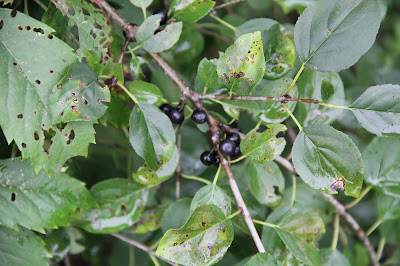
Common Buckthorn (Rhamnus cathartica) fruit - TOXIC

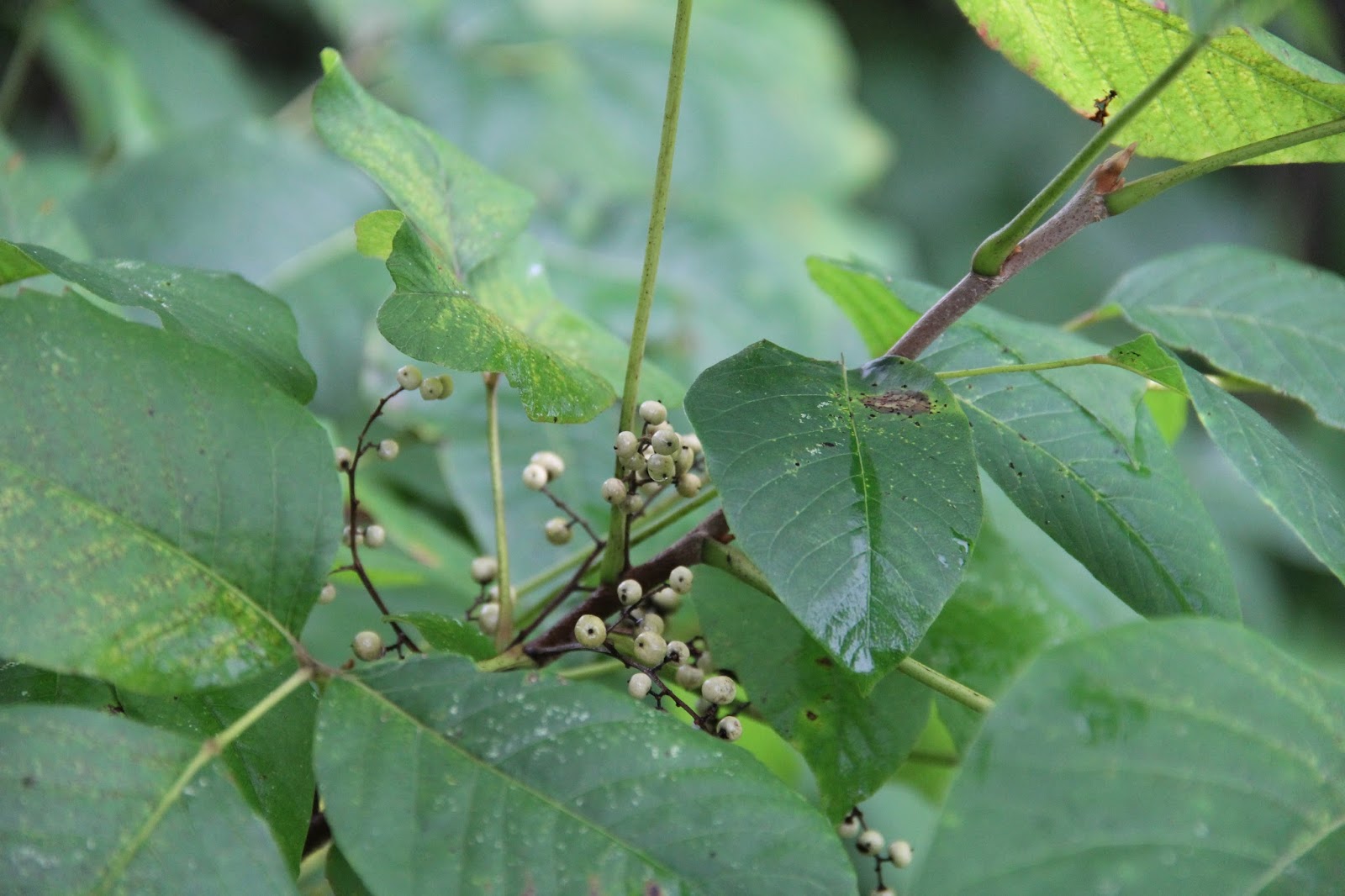
This photo shows the berries from Western Poison Ivy (Toxicodendron rydbergii).  This species is less common in Michigan than Eastern Poison Ivy (T. radicans).  Unlike the Eastern form which typically from climbing vines, Western poison Ivy grows as a low shrub.  The berries from both species are toxic to humans.

Western Poison Ivy (Toxicodendron rydbergii) berries - TOXIC

The fifth photograph shows the fruit of American Highbush Cranberry (Viburnum trilobum).  There is a closely related species European Highbush Cranberry (V. opulus) that is distinguished only by a difference in the shape of glands at the base of the leaf.  The fruit from both species is edible, but it is very tart and may not appeal to all people.

American Highbush Cranberry (Virburnum trilobum) fruit - Edible


The next photograph shows fruit from a rose, known as "hips".  All species of rose hips are edible, but not all are palatable.   I did not identify the species of rose on site, but from the photograph it appears to be Smooth Rose (Rosa blanda). 

Rose hips (fruit), probably a Smooth Rose (Rosa blanda) - Edible

The next two photographs show drupes (fruit) from two different species of dogwood.  The first photograph shows Silky Dogwood (Cornus amomum) fruits.  The second shows Red-Osier Dogwood (Cornus sericea).  Some sources list dogwood fruits as edible, others as inedible.  Some may cause nausea if eaten.  In general, even though you may be able to eat dogwood fruits you probably wouldn't want to do so.
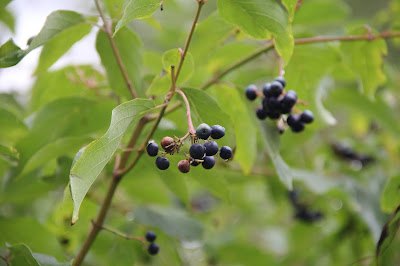
Silky Dogwood (Cornus amomum) - inedible

Red-Osier Dogwood (Cornus sericea) - inedible

It was very interesting to me to find this many different fruits/berries in such a small space - less than 200 yards of riverbank.  It looks like the birds will eat well this fall and winter.

On a side note, if you visit Island Park on Thursdays between June 1st and October 31st you will find the Mt. Pleasant Farmers' Market with lots of fresh edible fruits when they are in season.