A rare Saturday post...
As of right now I am slightly ahead of my Wildflowers of 2014 pace. On Tuesday (28 June 2016) I went to
Mission Creek Woodland Park and increased my tally to one hundred seventy-seven species for 2016. In 2014, I didn't photograph #177 until July 9th.
Wildflowers of 2016 - #169 Clustered-leaved Tick-trefoil (Hylodesmum glutinosum)
My first flower of the day was a new one for me. Along the Creek Upland trail loop. I discovered a flower that based on appearance belonged in the Legume family (
Fabaceae). It closely resembled the flowers of a several species of Tick-trefoil, but the plant was not one that I recognized. I took several photographs of diagnostic features (leaves, flowers, stems, etc.) and continued on my way with the plan to research it once I returned to the office.
 |
| Clustered-leaved Tick-trefoil - note whorl of compound leaves and tall flower stalk |
There are fourteen different "Tick-trefoil" species found in Michigan. These species belong to two different genera:
Desmodium and
Hylodesmum. All of these species can be found in the southern half of the Lower Peninsula. Some are widely distributed, others are found in only a few counties. I could eliminate about six species, either because I already knew what they looked like or because their ranges did not come close to Isabella County.
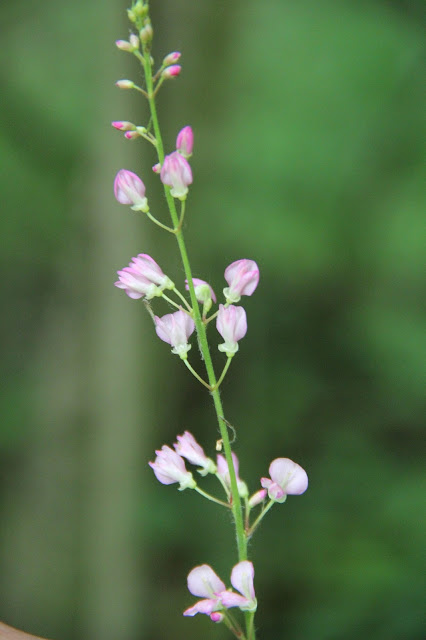 |
| Clustered-leaved Tick-trefoil - small flowers are pink, white, or purple |
Normally, I try to use features such a flower color and size, leaf arrangement, etc. to key out the plants. In this case I went to
Michiganflora.net and began going down through each of the tick-trefoil species to look at photographs and try to make a match. Finally, I found two that seemed to match up, both in the
Hylodesmum genus.
 |
| Clusterered-leaved Tick Trefoil - note stalk rising from center of leaf whorl |
Both species have leaves divided into three leaflets. Both species have small (1/4 inch) pink flowers arranged on an upright stalk that rises over the leaves to a height of 1 to 3 feet. The major difference between the species is that in Naked Tick-trefoil (
Hylodesmum nudiflorum) the flower stalk is separate from the leaf stalk while on Clustered-leaved Tick-trefoil (
Hylodesmum glutinosum) the flower stalk has leaves on it. Because the flower stalk of this plant rose from the center of a whorl of leaves, this had to be Cluster-leaved Tick Trefoil (
Hylodesmum glutinosum). This species is also sometimes called Point-leaved Tick Trefoil.
Wildflowers of 2016 - #170 Northern Bush Honeysuckle (Diervilla lonicera)
I found my second species of the day near the bottom of the west stairway down to Mission Creek. Here the trail is bordered by a large stand of low-growing
Northern Bush Honeysuckle (
Diervilla lonicera). While people are probably most familiar with introduced species of
Honeysuckle there are seven native species that can be found in
Michigan. Bush-honeysuckle is the only one in the
Diervilla genus; all of the remaining species are in the
Lonicera genus (the same genus as the exotic species that are found in the state).
 |
| Northern Bush-honeysuckle - note opposite leaves and flowers at tip of branch |
Northern Bush-honeysuckle is a low growing shrub (6 to 36 inches tall)
with oblong shaped leaves with pointed tips and finely toothed margins.
The leaves are arranged in opposite pairs along the round woody stems.
This is the only honeysuckle with toothed leaves.
The flowers of Northern Bush-honeysuckle are funnel shaped with five
petals. The petals curl backwards revealing the flower's pistil and
stamen. The flowers are are a pale lemon yellow color, but after
pollination fade to a darker yellow-orange or red color. The flowers
are pollinated by bees.
 |
| Northern Bush-honeysuckle - not yellow flowers fading to red and toothed leaf margins |
Northern Bush-honeysuckle typically grows in dry rocky soils. It is
found in woodlands throughout eastern North America as far west as
Saskatchewan and as far south as the Appalachians of northern Georgia
and Alabama.
Wildflowers of 2016 - #171 Self-heal (Prunella vulgaris)
The next flower is a native member of the Mint family (
Lamiaceae).
Self-heal (
Prunella vulgaris),
which is also known as Heal-all, is found across the Northern
Hemisphere in both North America and Eurasia. It grows in a variety of wet and dry habitats and has been recorded in all but three of Michigan's counties. I found it growing along the trail that borders Mission Creek, but have found it in many other locations throughout Mt. Pleasant.
 |
| Self-heal surrounded by Skunk Cabbage, horsetails, and ferns |
The flowers of this species grow in a spike above the
leaves. The flowers may be purple, violet-blue, or even white. Individual flowers may be 3/8 to 3/4 inch long and the flowering spike meaures up to 2 inches long. The petals on this species are fused into a tubular shape with a pair of lips - the upper lip functions as a hood over the flower opening. The flowers are typically pollinated by long-tongued bumblebees that can reach into the tube, but smaller bee species may crawl entirely into the tube to collect nectar.
 |
| Self-heal - note tubular flowers |
Like other members of the Lamiaceae, the leaves of Self-heal are arranged in opposite pairs along the plant's stem. The leaves are usually about 3/4 inch wide can can be up to 4 inches long. Plants
grow up to 20 inches tall.
Wildflowers of 2016 - #172 Tall Agrimony (Agrimonia gryposepala)
The next flower on the list could easily be overlooked. Although
Tall Agrimony (
Agrimonia gryposepala)
may grow up to 5 feet, its yellow flowers are small. Each flower is
only 1/8 to 1/4 inch across. The flowers have five petals and grow on
racemes (spikes) that branch off from the main stem of the plant.
 |
| Tall Agrimony - note flower raceme and toothed compound leaves |
Even with the small size of the flowers, Agrimony plants are easy to
identify. At this time of year there is no other flowering plant in the
woods that resembles Agrimony. There are seven different Agrimony
species found in Michigan of which Tall Agrimony has the widest
distribution. In addition to its yellow flowering raceme, Tall Agrimony
can be identified by its hairy stems and compound leaves (5 - 9 large
toothed leaflets, with small leaflets in between the large leaflets).
At the base of each compound leaf is a pair of kidney shaped leaves.
 |
| Tall Agrimony - note hairy stems and small yellow flowers with 5 petals and 5 sepal |
Tall Agrimony is most commonly found in upland habitats such as
deciduous and mixed forests, but will also grow in wetter soil. I found
this plant growing along the trail through the cedar swamp at Mission
Creek. Tall Agrimony can be found in widely scattered locations across
North America, but the core of its range appears to be the Great Lakes
and Northeast. This leads me to believe that many of its disconnected
populations are probably introduced.
Wildflowers of 2016 - #173 Fringed Loosestrife (Lysimachia ciliata)
Earlier this week I wrote about the
invasive plant Purple Loosestrife and how it should be removed anywhere it is found in the landscape. However, not all Loosestrife species are bad. For example,
Fringed Loosestrife (
Lysimachia ciliata) is one of
seven native Lysimachia species that can be found in Michigan. Like the
majority of those species, this plant is a wetland resident. Fringed
Loosestrife can be found in wet locations such as floodplains,
shorelines, streamside, swamps, and wet meadows. It is more commonly
found in shaded locations than sunny ones. Fringed Loosestrife can be
found across much of North America (45 states and 9 Canadian
provinces/territories).
 |
| Fringed Loosestrife - I didn't notice the spider until I looked at the picture on the computer |
The leaves of Fringed Loosestrife are oval shaped, measure up to six
inches long and arranged in pairs. The stems of the leaves (petioles)
are conspicuously hairy or fringed - giving the species its name. The
flowers grow on individual stalks from the leaf axils. The flowers are
yellow with red centers and have five petals. The edges of the petals
have irregular serrations or teeth. The flowers nod slightly.
Wildflowers of 2016 - #174 Michigan Lily (Lilium michiganense)
I have been watching and waiting impatiently for the blooms of my next species. In 2014, I discovered a healthy colony of Michigan Lily (Lilium michiganense) plants at Mission Creek. In the past I had found individual plants here and there in other parks, but had somehow never noticed these plants. It is not easy to overlook Michigan Lily. Large specimens may grow to a
height of nearly ten feet! However, they are more likely to grow to
heights of 1 1/2 to 4 feet. Leaves are arranged in whorls or rings
along the stem. Each whorl may consist of 3 to 7 leaves.
 |
| Michigan Lily - note whorls of leaves |
The flowers of Michigan Lily dangle from long stalks at the top of the
plants. Plants may have one or more (as many as six) flowers. Mature
plants will typically have more flowers than younger ones. The flowers
have six tepals (a term used to describe petals and sepals that can not
be distinguished) that are yellow-orange to red-orange in color. Each
tepal is dotted with purple spots. The tepals curve strongly upward
upon opening, exposing the flower's six long stamen and single pistel.
 |
| Michigan Lily - note curved tepals and dangling pistel and stamen |
Michigan Lily prefers high quality, undisturbed sites with abundant soil
moisture such as swamps, bogs, floodplains, wet prairies, etc. It will
grow in both sun and shade. In Michigan it is found in scattered
locations throughout the state, but is most common in the southern Lower
Peninsula. Overall it can be found in 20 states centered on the
tallgrass prairie region. It grows as far west as a line running from
eastern South Dakota to eastern Oklahoma. In the east its range is
restricted by the Appalachian Mountains. It can be found as far north
as Minnesota, Michigan's Upper Peninsula, and Ontario. In the south the
species' range extend to northern Mississippi, Alabama, and Georgia
Wildflowers of 2016 - #175 Wood Nettle (Laportea canadensis)
Anyone who has ever encountered the next species is not likely to forget it.
Wood Nettle (
Laportea canadensis)
plants are covered with fine needle-like hairs that break off on
contact. The needles are filled with a combination of chemicals
(including acid) that cause and itching burning sensation anywhere the
hairs puncture the skin. This delightful sensation can be found
throughout the eastern half of the United States and Canada. Wood
Nettle prefers moist habitats such as shorelines, moist woodlands,
floodplains, and swamps.
 |
| Wood Nettle - note alternate leaves and flowers in leaf axils |
Wood Nettle can be distinguished from non-native Stinging Nettle (Urtica
dioica) by the placements of its leaves. The leaves of Stinging Nettle
are arranged in opposite pairs while those of Wood Nettle are arranged
alternately.
 |
| Wood Nettle - note small white flowers and needles on stems |
The flowers of Wood Nettle are inconspicuous. They are small,
greenish-white, and grow from the leaf axils. The plants do not have to
be conspicuous because they rely on wind instead of insect pollination.
Wildflowers of 2016 - #176 Hairy Wood Mint (Blephilia hirsuta)
I first found
Hairy Wood Mint (
Blephilia hirsuta) growing in the Red Maple swamp at Mission
Creek Park during my 2014 wildflower search. Unsurprisingly, I found it this year growing in the exact same locations - it pays to have a good memory sometimes.
In Michigan, Isabella County is at the
northern limit of Hairy Wood Mint's current range. Nationally, the plant is found in
as far west as Nebraska and Kansas and as far south as Alabama and
Georgia. To the north its range extends from Minnesota eastward to
Quebec. This plant can be found in both upland and wetland habitats.
 |
| Hairy Wood Mint - note opposite leaves and flowering spike |
Like other mints, the leaves of Hairy Wood Mint are arranged in opposite
pairs along the stem. The leaves are oval shaped and serrated around
their margins. The flowers of Hairy Wood Mint are white with purple
spots. They are arranged in whorls on a spike above the plants leaves
(and occasionally between the upper pairs of leaves). The tiered whorls
of flowers resemble the tiered rooftops of Asian pagodas, giving this
plant another common name - Pagoda Plant. Hairy Wood Mint plants may
grow up to 3.5 feet tall.
 |
| Hairy Wood Mint - note whorls of flowers, opposite leaves, and hairs covering all parts of the plant |
Wildflowers of 2016 - #177 Common Enchanter's-nightshade (Circaea canadensis)
My final species of the day was
Common Enchanter's-nightshade (
Circaea canadensis). When I think of woodland wildflowers, I typically think of plants that
bloom early in the Spring and disappear once the overhead canopy has
fully leafed out. Common Enchanter's-nightshade is an exception. It is a woodland wildflower that blooms in Mid-Summer.
 |
| Common Enchanter's-nightshade growing amid Skunk Cabbage |
Also known as
Circaea lutetiana ssp. canadensis, Common
Enchanter's-nightshade has small white flowers that grow on a branched
spike which rises above the plants leaves. The flowers are unusual
because they only have two petals and two sepals. The leaves of Common
Enchanter's-nightshade are oblong or oval with pointed tips and margins
with shallow teeth.
 |
| Common Enchanter's-nightshade - note small white flowers |
Although it is most common in the deciduous woodlands of the Great Lakes
and Northeast, Common Enchanter's-nightshade can be found as far west
as Wyoming and as far south as Louisiana.


