Showing posts with label feathers. Show all posts

Friday, August 31, 2018

The Days of Summer - Day Fifty-nine through Day Sixty-five

Here is installment nine of my Days of Summer photo project - I am trying to catch up, but I have been very busy with scheduling school program  I started this project on the Summer Solstice (21 June 2018) with a photo from a sunrise hike at the Chippewa Watershed Conservancy's Bundy Hill Preserve.  My plan is to photograph something every day until the Fall Equinox (22 September 2018) and share one image from each day.  I am currently in week ten of the project.  To see the previous installments click here.
 
Day 59 (18 August 2018) - American Robin feathers


This image was photographed at my parent's home in Clinton County.  While searching for something to photograph, I found a dead American Robin lying on the ground on a mowed path through the woods.  This picture shows some of the feathers on its back and wings, with just a tiny bit of orange from its neck at the bottom left of the image.


Day 60 (19 August 2018) - Woodpecker holes in a birch trunk


This picture was taken at the Chippewa Watershed Conservancy's Hall's Lake Natural Area during a stewardship outing.  I noticed this log while searching the woods for Autumn Olive (an invasive species) and went back to photograph it later.  These holes were probably originally created by a Yellow-bellied Sapsucker.  Now a Hairy Woodpecker was taking advantage of the easy access to search for insects in the rotting trunk.


Day 61 (20 August 2018) - Goldenrod Soldier Beetles on Rosinweed


This image was taken in our home native pollinator garden.  At any given time (especially during late summer) I can find dozens pollinators in our garden.  This year, for the first time, I noticed an influx of Goldenrod Soldier Beetles.  This mating pair was crawling around on one of the Rosinweed plants.  This image has been cropped from a horizontal to a vertical format.


Day 62 (21 August 2018) - Bombus impatiens on Purple Coneflower


I love bees, especially bumble bees!  This image of a Common Eastern Bumble Bee (Bombus impatiens) was taken at the Forest Hill Nature Area.  I cropped the image to a square just because I thought it looked best in this format.


Day 63 (22 August 2018) - Storm clouds


This picture was taken at Chipp-A-Waters Park in Mt. Pleasant late in the day.  This image reminds me of the froth created by waves crashing on a beach.


Day 64 (23 August 2018) - Monarch caterpillar


This Monarch (Danaus plexippus) on a Common Milkweed (Asclepias syriaca) was photographed in the field next to the Isabella Conservation District office.  On days that I spend a lot of time in the office, sometimes I just need to go outside for a few minutes.

Day 65 (24 August 2018) - Native Pollinator Garden at Winn Elementary


The Isabella Conservation District planted and currently helps maintain native pollinator gardens at two local schools and the Mt. Pleasant Discovery Museum.  With school starting, I spent a couple hours pulling weeds and moving "volunteer" plants from pathways at the Winn Elementary School Garden.  The Leopold bench in the picture was one of six constructed with students back in 2013.  They were all recently repainted in the school colors.


Sunday, August 5, 2018

The Days of Summer - Day Thirty-eight through Day Forty-four

This is part six of my current photography project - The Days of Summer.

In the past, I have had times where I have gone days or even weeks without taking photographs.  This summer I set out to change that tendency.  I gave myself the task of recording images every single day between the Summer Solstice and the Fall Equinox.  Not only do I need to photograph something every day, but I am also sharing a single photo from each day on this blog.

To see the previous installment (part four) check out this link.

Day 38 (28 July 2018) - Lights! Camera! Moths...


The week of 21 - 29 July was National Moth Week.  In celebration, I hosted two mothing events on the nights of 27 July (for the Chippewa Watershed Conservancy) and 28 July (for the Chippewa Valley Audubon Club).  This image is from the latter event at Mission Creek Woodland Park in Mt. Pleasant.  This image was taken shortly after the sun went down as the moths had barely started to come in.  Lots of moths were drawn to the lights, but this image was my favorite of the night.

Day 39 (29 July 2018) - Woodpecker Feather


This picture of a woodpecker flight feather was taken during a hike to the top of Bundy Hill.  This feather belongs to either a Downy Woodpecker or a Hairy Woodpecker.  Although these two species look very much alike, they are not closely related.  The current theory is that the Downy evolved to look more like the Hairy so it wouldn't be harassed by the larger bird.

My general philosophy in regards to photo editing is that "Less is More."  This picture is probably the most heavily edited image I have ever posted on this blog.  It has been rotated 180 degrees from the original - I liked the quill better in the lower left of the image than in the upper right.  The image has also been cropped to better focus on the feather.  Even though I prefer to "crop with my feet" (move closer to the subject), I am usually okay with cropping an image down to better focus on the main subject.   I have also adjusted the brightness of this image.  The picture was taken in direct sunlight and the colors were rather washed out in the original.

Day 40 (30 July 2018) - Oh, Hello!


This picture of a Goldenrod Soldier Beetle (Chauliognathus pensylvanicus) on a Queen Anne's Lace (Daucus carota) was photographed at Forest Hill Nature Area.  The beetle was feeding on pollen and nectar on the small individual flowers.  To highlight the beetle against the sky, I lay on my back in the middle of a trail, leaned against my camera bag for support and, and aimed the camera upward.  I probably shot two dozen images of this beetle as it crawled around the flower, but the pose in this picture made it my favorite.  This image has been cropped slightly to reduce the amount of open space at the top and left of the picture.

 Day 41 (31 July 2018) - Carolina Locust


Unlike the previous two pictures.  This image has not been edited at all.  I photographed this Carolina Locust (Dissosteira carolina) at Chipp-A-Waters Park in Mt. Pleasant.  To get this picture I lay on a slab of limestone along the edge of the Chippewa River and focused tightly on the grasshopper.  I was at the minimum focus distance for the lens on my camera.  By working so close, I lost a little bit of detail on the legs, but check out the veining on the wings and the pattern on the head, thorax, and abdomen!

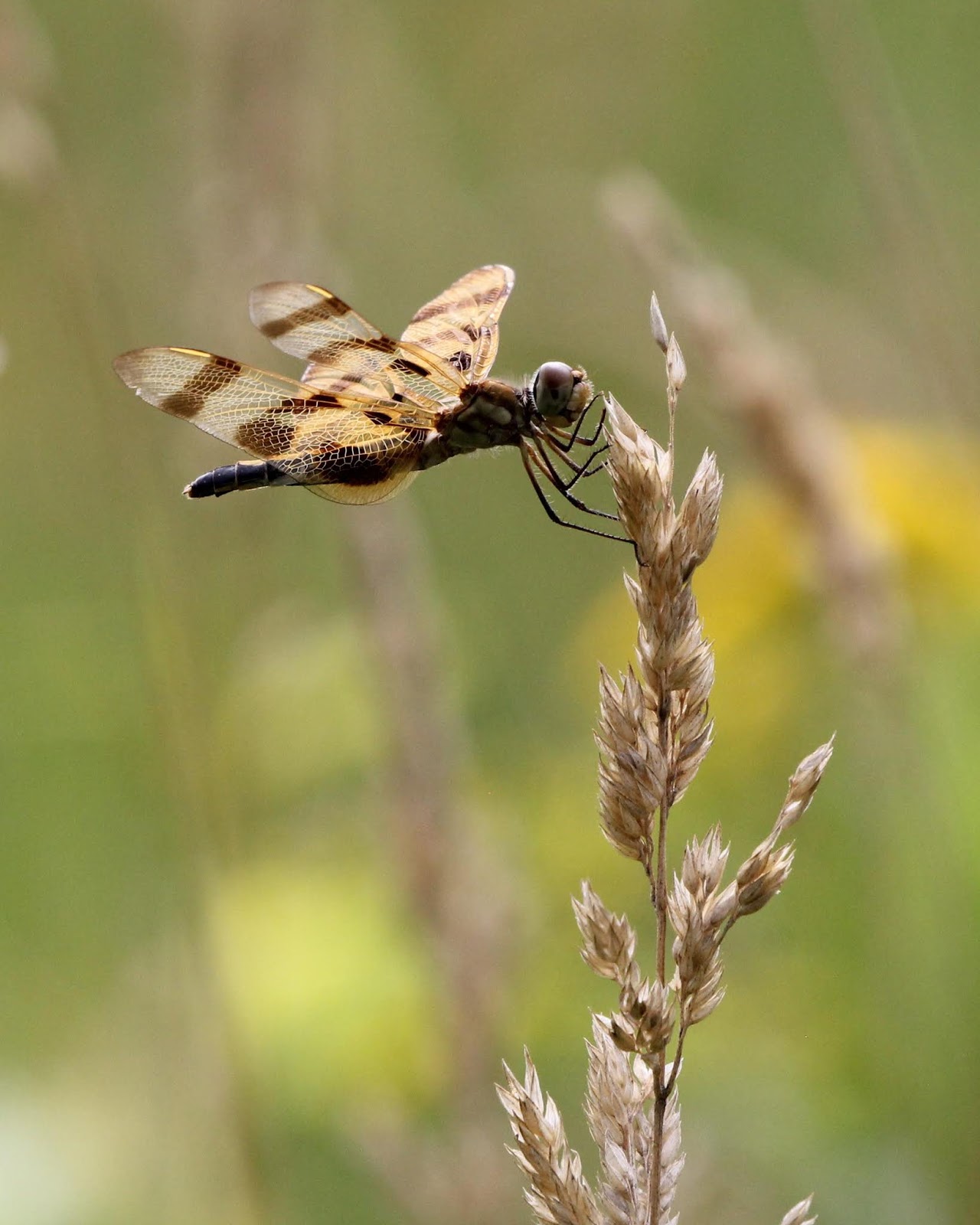
Day 42 (01 August 2018) - Halloween Pennant


This image was also photographed at Chipp-A-Waters Park.  After photographing the Carolina Locust on the 31st, I noticed a Halloween Pennant (Celithemis eponina) hunting in a grassy area along the riverbank.  Despite repeated attempts, I was never able to get a picture that I made me happy.  I went back the next morning to try again.  I actually arrived too early and had to wait for insects to begin flying.  Eventually this Pennant showed up and I was able to get several photos.  I cropped this from a horizontal to a vertical image.  I liked the original, but I liked the vertical crop just a little bit more.

Day 43 (02 August 2018)


This picture was taken at North Higgins Lake State Park.  I spent the day doing a pair of activities for a summer camp being held by the Saginaw Chippewa Indian Tribe.  Due to stormy weather, we adjusted the schedule a little bit.  This left me with some time before my morning activity.  Although this is not the greatest image, I like the repetition of the spherical water droplets throughout the picture.

Day 44 (03 August 2018)


My final photo for the week was taken at Mission Creek Woodland Park.  Although sometimes I have a plan I go out to take photos (like with the Halloween Pennant pictured above), at other times it pays to just wander and see what happens.  I found these Crown Coral (Clavicorona pyxidata or Artomyces pyxidatus) growing on a rotten log in the middle of the woods.  If I hadn't wandered away from the trail I never would have discovered them.  Coral fungi are some of the coolest looking fungi that grow in Mid-Michigan, but I sometimes find them a challenge to photograph because they are such a start contrast to the dark wood.  I decided to crop this picture as a square eliminating another clump of fungus to the left of the picture.

Wednesday, January 25, 2017

The structure of a feather

One of the programs that I teach is Michigan Birds.  Part of this program focuses on feathers and their functions.  Most students (and adults) have played with a feather at some point.  One of the things that almost everyone has done with a feather is to peel it apart and then "zip" it back together.

Have you ever wondered why and how a feather can do this?

It all has to do with structure.

The larger feathers have a stiff central structure called a rachis


One opposite sides of the rachis are flat structures called vanes.  The vane are composed of stiff parallel structures called barbs.  Each barb grows out from the rachis.


Each barb is further divided into smaller parts.  Growing from opposite sides of a bard are small parallel growths called barbules.  The barbules that emerge from one barb grow toward and interlock with the barbules from the next-door barb.


The barbuless are not the smallest part of the feather.  On the sides of each barbule are even smaller structures called barbicels.  These structures act like hooks and interlock with the barbicels on the adjacent barbule.  When you feel the barbs of a feather apart, the barbicles become unlocked; when you "zip" the feather back together again, the barbicels lock back together.


Friday, November 20, 2015

Birds of a feather...

Right now I am doing lots of presentations about birds and their adaptations.  The first thing I do during this presentation is ask the students "How do we know if an animal is a bird?"  This gets a bunch of different responses.

A bird has wings!

I have wings, but I am not a bird...

A bird has a beak!

I have a beak, but I am not a bird...
A bird can fly!

I can fly, but I am not a bird...

Sooner or later, someone will say that a bird has feathers.  I challenge students to come up with an animal that has feathers that is not a bird - the responses are interesting.  Yesterday alone I heard the following answers: a duck (bird), a penguin (bird), an ostrich (bird), a bear (not a bird - does not have feathers).

Every living creature that has feathers a bird.  Let me say that again.  Every single living creature that has feathers is a bird - every single one.

Once we have figured out that a bird is an animal with feathers, we finally start to discuss the different roles that feathers are adapted for.  We usually come up with five different roles.

1)  Feathers give birds the ability to fly. Although not every bird has this ability - no birds would be capable of flight without feathers.

A Herring Gull flying over Lake Superior

An Osprey soaring over Lake Champlain

2)  Feathers keep birds warm.  Fluffy down feathers trap heated air close to a bird's body, allowing them to retain much of their body heat.  In cold conditions, micro-muscles attached to each feather will fluff up the feathers to trap even more air.

This Junco doesn't mind the cold

Snowy Owls don't migrate south to avoid the cold - they come south to find more food.


3) Feathers keep birds (mostly) dry.  The structure of outer contour and flight feathers prevents most water from reaching the fluffy down feathers underneath.  Aquatic birds such as ducks and geese have glands that produce oils.  The birds spread these oils on their feathers through the process of grooming - making themselves even more waterproof.

A Mallard's waterproof feathers keep it warm and dry even on the edge of a frozen river.

A Common Loon dives below the surface after fish.

4)  Feathers help birds stay hidden.  Many birds use their feathers as camouflage.  Sometimes all birds of a particular species will use their feathers as camouflage.  In other species only the females will have dull-colored feathers that help them blend in.

This Barred Owl blends in with the bark of this Eastern Hemlock tree.

Female Red-winged Blackbirds use their dull colors to avoid predators

5)  Birds use their feathers to show off.  In may species, male birds use brightly colored feathers to intimidate rivals and show off to potential mates. 

Male Scarlet Tanagers are shockingly bright red.
 
A large patch of red and yellow on the shoulder of this Red-Winged Blackbird announces his health to rivals and potential mates.

Can you think of any other roles that a bird's feathers are adapted for?

Wednesday, December 3, 2014

Textures

I take many close-up photos of things that I find in nature without being entirely sure of what I am going to use the pictures for.  One thing the images have in common is that they often show something that has an interesting texture or combination of textures.

Along the banks of Mission Creek
 
Paper Birch

Feathers and beach rocks
 
Ripple Marks
 
Lichen

Beach rocks

Bark and lichen

Melting snow

Frosty spruce needles

Snow-covered rocks

Entangling vines and ash bark

Ice crystals

Shells along Lake Michigan