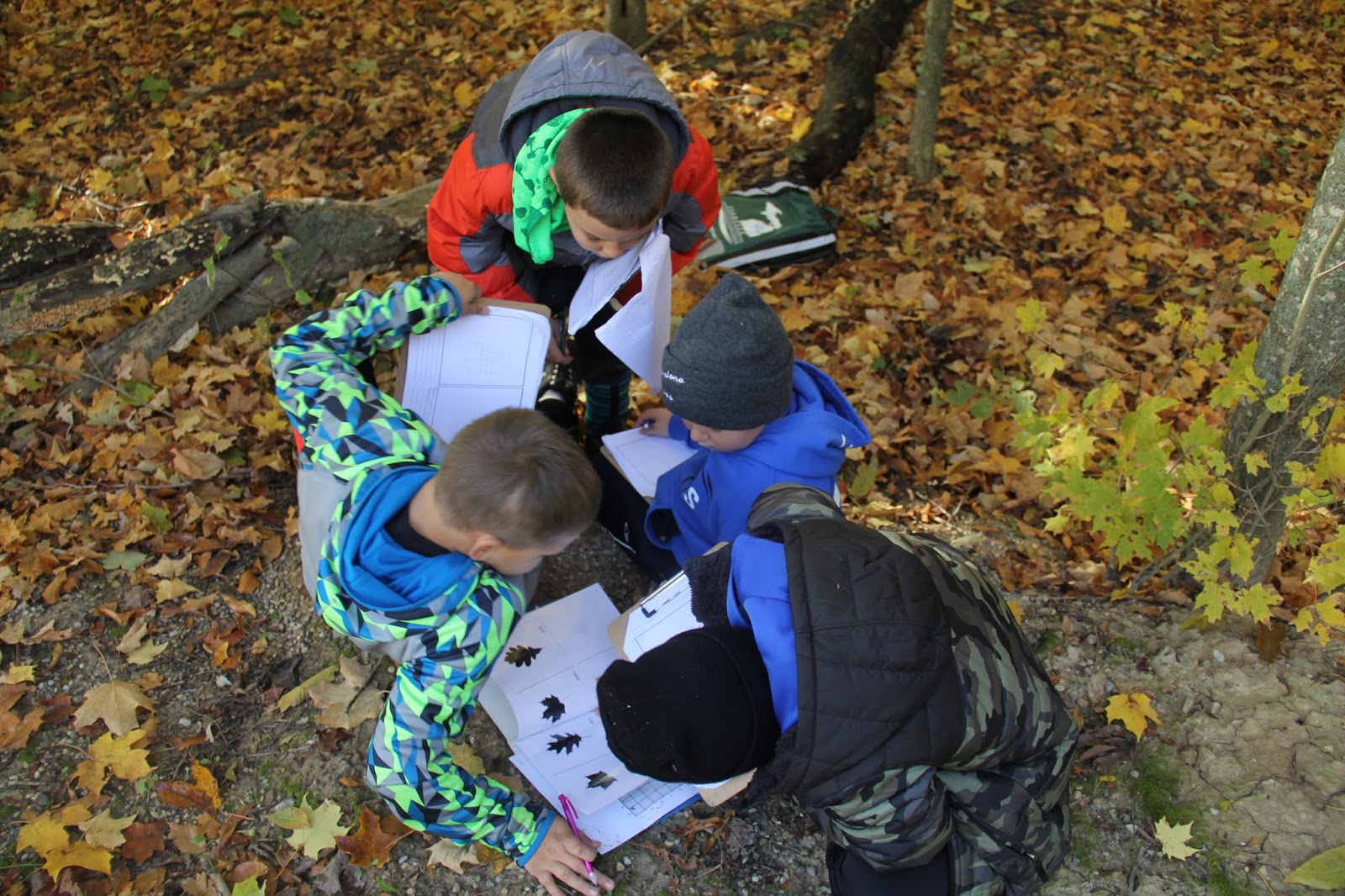
The best part of my job is getting students outdoors. I especially enjoy getting them into the woods to study forestry and forest ecology
Want to make a kid's jaw drop? Tell them that they are going to count how many trees are in a forest. Even better is to tell them that they have to find out how many leaves can be found on the forest floor or that they have to find out how the leaves weigh!
I always manage to get lots of students outdoors in the spring, but this year I made an effort to schedule more field explorations for the fall. Over the past three weeks, I was able to get eleven classrooms from four different schools out into the woods. Two of the classrooms have been out in the woods with me before, but for the other nine classes it was a completely new experience. It's always interesting to see how the students (and their teachers) react to the independence.
Here are a few pictures from three of the schools. (Unfortunately, it looks like I did not take any photos of the two classrooms from the fourth school.) The students in these photos are counting leaves in a square foot plot (or quadrat), collecting leaves to weigh, measuring the forest canopy using a clear grid, and identifying leaves using a guide.
12 October 2018 - Winn Elementary at Audubon Woods
16 October 2018 and 19 October 2018 - Mary McGuire Elementary at Mission Creek Park
25 October 2018 - Beal City Elementary at Beal City School woodlot
Showing posts with label schools. Show all posts
Sunday, October 28, 2018
Friday, March 23, 2018
Schoolyard Waxwing
On Wednesday (21 March), after completing a program at Pullen Elementary School, I noticed a flock of Cedar Waxwings (Bombycilla cedrorum) flitting through the trees along the parking lot. There are several ornamental crab apples along the north side of the school building; earlier in the day I had noticed several Waxwings feeding on fruit in those trees. Now those birds were just feet from my truck. Most of the birds were flitting around too much for me to have any hope of getting a picture. However, there was one bird sitting still. I was able to switch lenses on my camera and move into position to get several photos before the bird flew away. This vertical image was my favorite of the bunch.
Tuesday, September 5, 2017
Happy 2017-18 School Year!
| Smile! It's time for school! |
Welcome back students and staff!
Today is the first day of school for many local school districts. Other schools started their year last week. I am excited to begin the new school year. Many teachers have already contacted me about scheduling programs. As of this morning, I have 339 program scheduled for this school year. My first program is this Friday.
Friday, July 28, 2017
A Jay, or not a Jay - that is the question:
I like mascots, but one of my pet peeves is the improper use of mascots. It especially bothers me when a team uses an animal as a mascot, but the name of the team and the animal mascot do not match. If you are going to use an animal as a mascot, you should at least use the correct animal! One of our local school districts uses the Blue Jay as its mascot. However, it does not consistently use the same version of a Blue Jay. One of the versions that it uses is not a Blue Jays at all!
This is the version on the sign outside the high school. That is a correct body shape and markings for a Blue Jay, but the colors are a little off. It should have a white face and white chest/belly. The feet and beak should be black not yellow, but overall this is pretty good compared to one of the other versions. I think everyone seeing this would recognize that this is supposed to be a Blue Jay.
The next version appears on the sign outside the school district's central offices. This "fighting" version seems to be a combination of a Blue Jay and Uncle Sam. Other than the blue Uncle Sam beard, the markings on this Jay are pretty good. There is no question that this mascot is a Blue Jay.
| "Uncle Jay"wants you... |
Here is yet another version of the "fighting" Blue Jay. This version is used on the sign for the district's elementary school. It is not unusual for elementary schools to use a simplified cartoon version of the high school mascot. The yellow beak and feet are wrong. The bird lacks any black markings or white underparts. (And what's up with the blue scarf?) Despite these points, I'm actually okay with this as an elementary school mascot - it conveys the point that this is a Jay. It's a "fighting" jay, but its also a friendly jay - look at the smile and happy eyes.
Despite what the sign says, this is not a Blue Jay. That is a Northern Cardinal that has been painted blue. This non-jay adorns the sign for the middle school. Shame on the sign company for printing this...
From the worst "Jay" to the best. This final version adorns a sign at the school's athletic complex. Blue crest - check. Black collar - check. White face and underparts - check and check. Black beak and feet - check. Blue tail and wing feathers with black bars - check. This is definitely "Blue Jay Country"! I think John James Audubon himself would approve of this Blue Jay.
Thursday, July 20, 2017
Native Pollinator Garden Updates (19 & 20 July 2017)
Since 2011, the Isabella Conservation District has helped design, plant, and maintain four native pollinator gardens. These gardens are located at the Saginaw Chippewa Academy, Winn Elementary, the Mt. Pleasant Discovery Museum, and the Morey Public School Academy. On June 19th, a decision was made to close the Morey PSA, effective immediately.
What does that mean for the garden at the school?
Once the school announced it closure, we made the decision to rescue and transplant as many of the plants from the garden as possible. This means that for the past four days I have been digging up plants from that garden, placing them into totes, and transporting them elsewhere for replanting.
Here is what the Morey PSA pollinator garden looked like on Monday (17 July) morning.
This is what the garden looked like as of this morning. You can see a lot of plants have been removed, but many still remain.
Here a view from the opposite side of the garden. This photo was taken yesterday - the grasses on the left are now gone, as are many of the plants in the background.
It may not seem like much has been removed, but so far I have dug up four full pick-up truck loads of plants and removed them from the site.
So what is happening to all the plants that I remove from the Morey native pollinator garden?
Some of them went to Winn Elementary. The garden at Winn was planted in 2012 and is full of mature plants at this stage. However there are some areas of the garden where plants have failed to thrive or even died out completely. This garden is on a challenging site - compacted clay soil, full morning shade and full afternoon sun, lots of roof runoff but most of the water draining away from the site.
I have already added more than a truck load of plants to the Winn Elementary garden, but you would hardly know it unless you know what to look for - these plants are just being used to fill in the blanks. I will be visiting this garden daily for about a week to make sure the new plants are well watered as they establish roots in their new soil; then they are on their own.
Could you tell where plants have been added to the garden at Winn Elementary?
No? That's sort of the point. Remember this is just filling in the blanks, not starting from scratch.
Obviously, not all of the plants from the Morey PSA garden have gone to Winn Elementary. The rest of them are going the Mt. Pleasant Discovery Museum. The Discovery Museum already has a native pollinator garden. It was planted in 2013, with plants left over from planting the Morey garden. The garden itself doesn't need a lot more plants.
There are blank spaces in this garden, but the plants are doing a good job of filling in those spaces on their own. Barring a die-off, in just a couple more years, I expect this garden to be almost completely filled with plants.
So instead of using the plants in the garden, they are going to be used here...
The west side of the Discovery Museum property is bordered by a series of retention ponds. These ponds hold water that drains from the museum's parking lot. The ponds are home to a surprising variety of wildlife species - frogs, dragonflies and other aquatic insects, Red-winged Blackbirds, and (as of this spring) a muskrat. The ponds support a number of aquatic plant species including cattails, rushes, sedges, willows, and a many wildflower species.
The museum is committed to using more of its outdoor space. Last fall I helped them design a series of interpretive signs (seen in the picture above) so visitors can learn more about the wetlands. The museum director also expressed a desire to create a more natural border along the wetlands. Previously the lawn was mowed all the way to the edge of the wetland - the first step to creating a natural border was simply to stop mowing. Second, the museum scattered wildflower seed in the unmown area - unfortunately I don't see a lot of evidence that this was successful.
To speed the process of naturalization along, many of the plants from the Morey PSA garden are going to end up here.
While it is disappointing to have to dig up a garden just as it was maturing, I am glad that we have a ready home for the plants.
What does that mean for the garden at the school?
Once the school announced it closure, we made the decision to rescue and transplant as many of the plants from the garden as possible. This means that for the past four days I have been digging up plants from that garden, placing them into totes, and transporting them elsewhere for replanting.
Here is what the Morey PSA pollinator garden looked like on Monday (17 July) morning.
| Morey native pollinator garden (17 July 2017) |
This is what the garden looked like as of this morning. You can see a lot of plants have been removed, but many still remain.
| Morey native pollinator garden (20 July 2017) |
Here a view from the opposite side of the garden. This photo was taken yesterday - the grasses on the left are now gone, as are many of the plants in the background.
| The second of three truck loads removed so far. |
Some of them went to Winn Elementary. The garden at Winn was planted in 2012 and is full of mature plants at this stage. However there are some areas of the garden where plants have failed to thrive or even died out completely. This garden is on a challenging site - compacted clay soil, full morning shade and full afternoon sun, lots of roof runoff but most of the water draining away from the site.
I have already added more than a truck load of plants to the Winn Elementary garden, but you would hardly know it unless you know what to look for - these plants are just being used to fill in the blanks. I will be visiting this garden daily for about a week to make sure the new plants are well watered as they establish roots in their new soil; then they are on their own.
| Winn Elementary native pollinator garden (19 July 2017) |
| A second view of the Winn Elementary Garden |
| More of the Winn Elementary garden - lots of weeding was done in this section to remove Canada Tick-trefoil |
Could you tell where plants have been added to the garden at Winn Elementary?
No? That's sort of the point. Remember this is just filling in the blanks, not starting from scratch.
Obviously, not all of the plants from the Morey PSA garden have gone to Winn Elementary. The rest of them are going the Mt. Pleasant Discovery Museum. The Discovery Museum already has a native pollinator garden. It was planted in 2013, with plants left over from planting the Morey garden. The garden itself doesn't need a lot more plants.
| Mt. Pleasant Discovery Museum native pollinator garden |
| Mt. Pleasant Discovery Museum native pollinator garden - not Rattlesnake Master, Black-eyed Susan, and Hoary Vervain |
There are blank spaces in this garden, but the plants are doing a good job of filling in those spaces on their own. Barring a die-off, in just a couple more years, I expect this garden to be almost completely filled with plants.
So instead of using the plants in the garden, they are going to be used here...
| The new home for most of the plants from the Morey Pollinator Garden |
The west side of the Discovery Museum property is bordered by a series of retention ponds. These ponds hold water that drains from the museum's parking lot. The ponds are home to a surprising variety of wildlife species - frogs, dragonflies and other aquatic insects, Red-winged Blackbirds, and (as of this spring) a muskrat. The ponds support a number of aquatic plant species including cattails, rushes, sedges, willows, and a many wildflower species.
The museum is committed to using more of its outdoor space. Last fall I helped them design a series of interpretive signs (seen in the picture above) so visitors can learn more about the wetlands. The museum director also expressed a desire to create a more natural border along the wetlands. Previously the lawn was mowed all the way to the edge of the wetland - the first step to creating a natural border was simply to stop mowing. Second, the museum scattered wildflower seed in the unmown area - unfortunately I don't see a lot of evidence that this was successful.
To speed the process of naturalization along, many of the plants from the Morey PSA garden are going to end up here.
| Awaiting trnsplant |
While it is disappointing to have to dig up a garden just as it was maturing, I am glad that we have a ready home for the plants.
Monday, May 15, 2017
Aquatic Ecology with Shepherd Elementary students
Last week I spent two days at the Little Salt River with students from Shepherd Elementary students.
Why were we at the river?
The students were collecting and identifying aquatic macroinvertebrates.
What exactly is an aquatic macroinvertebrate?
Let's break that into parts. Aquatic means that a plant or animal lives in or around water. It comes from the Latin word aqua which means "water". The word invertebrate comes from the Latin root word vertebra which means "joint" - normally refering to the joints of the spine. Invertebrate means that an animal lacks a spine. The prefix macro- means large or large scale. It comes from the Greek word makros meaning "large or long". Therefore, a macroinvertebrate is a large animal that lacks a spine - large in the sense that it is big enough to see without magnification. Add it all together and an aquatic macroinvertebrate is an animal that lives in water, lacks a spine, and is large enough to see with the naked eye.
Why were students trying to collect aquatic macroinvertebrates?
Many aquatic macroinvertebrate species have varying tolerances for water pollution. The absence of certain species may indicate low water quality. The presence of a wide range of species usually indicates higher water quality.
Overall the students found a wide variety of aquatic macroinvertebrates including mayfly larvae, caddisfly larvae, gilled and pouch snails, damselfly larvae, dragonfly larvae, scuds or amphipods, crayfish, freshwater clams and mussels, leaches, and midge larvae. Vertebrate lifeforms collected included fish and tadpoles. The wide variety (and number) of animals collected indicated that at this site, the Little Salt River has excellent water quality.
Here are a few more photos of the students sampling...
Why were we at the river?
The students were collecting and identifying aquatic macroinvertebrates.
| Shepherd 5th graders use a dip net to sample aquatic macroinvertebrates from the Little Salt River |
What exactly is an aquatic macroinvertebrate?
Let's break that into parts. Aquatic means that a plant or animal lives in or around water. It comes from the Latin word aqua which means "water". The word invertebrate comes from the Latin root word vertebra which means "joint" - normally refering to the joints of the spine. Invertebrate means that an animal lacks a spine. The prefix macro- means large or large scale. It comes from the Greek word makros meaning "large or long". Therefore, a macroinvertebrate is a large animal that lacks a spine - large in the sense that it is big enough to see without magnification. Add it all together and an aquatic macroinvertebrate is an animal that lives in water, lacks a spine, and is large enough to see with the naked eye.
| This crayfish is an aquatic macroinvertebrate. |
| So is this gilled snail. |
Why were students trying to collect aquatic macroinvertebrates?
Many aquatic macroinvertebrate species have varying tolerances for water pollution. The absence of certain species may indicate low water quality. The presence of a wide range of species usually indicates higher water quality.
| Students complete a biological monitoring sheet to determine water quality |
Overall the students found a wide variety of aquatic macroinvertebrates including mayfly larvae, caddisfly larvae, gilled and pouch snails, damselfly larvae, dragonfly larvae, scuds or amphipods, crayfish, freshwater clams and mussels, leaches, and midge larvae. Vertebrate lifeforms collected included fish and tadpoles. The wide variety (and number) of animals collected indicated that at this site, the Little Salt River has excellent water quality.
Here are a few more photos of the students sampling...
Thursday, January 12, 2017
Snow Day!
![]() |
| Ice storm photo from lat 2005 or early 2006 |
Today marked the third day in a row that most local schools were cancelled due to poor road conditions. I hope that all of the students (and teachers) have enjoyed this unplanned mini-vacation.
Thursday, September 15, 2016
Native Pollinator Garden Update (14 and 15 SEP 2016)
Yesterday afternoon I photographed the Native Pollinator Garden at the Saginaw Chippewa Academy. This year was a transition year for this garden. The portable classroom that bordered it on the west was removed this spring. This meant that the garden no longer gets water running off the roof and it is exposed to full sun for the entire day. I was not sure how it would react to the changes.
Native plants are tough. Most of them took the changes in stride, with no obvious ill effects. A few plants were noticeably shorter than in previous years, but everything survived. Here are some pictures.
This morning (15 September), I stopped at the Mt. Pleasant Discovery Museum to take a few photographs of their Native Pollinator Garden. This garden is wild looking right now! I love seeing how these gardens evolve from year to year.
Native plants are tough. Most of them took the changes in stride, with no obvious ill effects. A few plants were noticeably shorter than in previous years, but everything survived. Here are some pictures.
| Looking north into the garden - the portable classroom used to be on the left |
| Honey bees were very abundant |
| Looking east toward the school - the bright yellow flower is Cup Plant |
| Butterflyweed explodes into seeds |
| Blue Vervain flowers |
| A wasp with a millipede it has captured |
| Culver's Root leaves |
| Cup Plant leaves |
This morning (15 September), I stopped at the Mt. Pleasant Discovery Museum to take a few photographs of their Native Pollinator Garden. This garden is wild looking right now! I love seeing how these gardens evolve from year to year.
| Native Pollinator Garden at the Mt. Pleasant Discovery Museum |
| Stiff Goldenrod is in bloom |
| Native grasses sprawl into the walkway |
| Prairie Dock silhouetted against the sky |
| A few Prairie Dock flowers remain in bloom |
| Horsemint |
| The tall plants to the right are Evening Primrose which is threatening to take over the garden |
| Asters are just beginning to bloom |
Subscribe to:
Posts (Atom)