Here's the next Michigan species card that I promised - the Downy Woodpecker (Picoides pubescens). This small woodpecker is a common sight around Michigan and visits bird feeders regularly. I have written several times about this species including a species profile from January 2016.
Tomorrow I will share one of the ways that I use cards such as this in the classroom.
Showing posts with label woodpeckers. Show all posts
Tuesday, October 9, 2018
Tuesday, April 4, 2017
A walk through Mission Creek Woodland Park (01 April 2017)
On Saturday (01 April) I spent a little time tromping around the wetlands at Mission Creek Woodland Park. I had no particular objective in mind. I just wanted to be out in the nice weather. Here is some of what I saw.
Birch wood tends to decay quite rapidly. Birch bark on the other hand is extremely resistant to rot. It is not uncommon to find birch logs lying on the ground in which the bark is still intact, but the wood inside has rotted away to mush. The waterproof bark hold moisture in the log, creating a perfect environment for fungi and bacteria to work on the wood. Here's a little tip: if you want to use birch as a firewood, it has to be split to allow the moisture to escape.
More tussocks!
I do love the Skunk Cabbage.
No matter how many times I see them, I just can't get enough.
Perhaps its just the craving for something blooming,
But this time of year I am drawn again and again back into the swamp to see the Skunk Cabbage.
I didn't spend all of my time looking down at the ground. I did manage to see a flock of Wild Turkeys sneaking through the woods ahead of me. There were at least six birds in the flock and probably more that I couldn't see because of the trees.
After the turkeys passed through, I managed to find some "evidence" of their passing. Yes, that is a pile of turkey scat.
Maybe I do spend a lot of time looking at the ground. FYI this is not the first photo of animal scat to appear on this blog. A quick search for "scat" in the search box to the right will reveal at least six other photos.
But life is not all Skunk Cabbage and turkey scat...
It is also full of Downy Woodpeckers.
And mosses...
Life is especially full of mosses.
On a side note, I am currently reading the book Gathering Moss by Robin Wall Kimmerer. It is a thoroughly enjoyable book about science written for the average reader. I highly recommend it to anyone interested in learning more about natural history. I also heartily recommend her more recent book Braiding Sweetgrass: Indigenous Wisdom, Scientific Knowledge and the Teachings of Plants.
Birch wood tends to decay quite rapidly. Birch bark on the other hand is extremely resistant to rot. It is not uncommon to find birch logs lying on the ground in which the bark is still intact, but the wood inside has rotted away to mush. The waterproof bark hold moisture in the log, creating a perfect environment for fungi and bacteria to work on the wood. Here's a little tip: if you want to use birch as a firewood, it has to be split to allow the moisture to escape.
More tussocks!
I do love the Skunk Cabbage.
No matter how many times I see them, I just can't get enough.
Perhaps its just the craving for something blooming,
But this time of year I am drawn again and again back into the swamp to see the Skunk Cabbage.
I didn't spend all of my time looking down at the ground. I did manage to see a flock of Wild Turkeys sneaking through the woods ahead of me. There were at least six birds in the flock and probably more that I couldn't see because of the trees.
After the turkeys passed through, I managed to find some "evidence" of their passing. Yes, that is a pile of turkey scat.
Maybe I do spend a lot of time looking at the ground. FYI this is not the first photo of animal scat to appear on this blog. A quick search for "scat" in the search box to the right will reveal at least six other photos.
But life is not all Skunk Cabbage and turkey scat...
It is also full of Downy Woodpeckers.
And mosses...
Life is especially full of mosses.
On a side note, I am currently reading the book Gathering Moss by Robin Wall Kimmerer. It is a thoroughly enjoyable book about science written for the average reader. I highly recommend it to anyone interested in learning more about natural history. I also heartily recommend her more recent book Braiding Sweetgrass: Indigenous Wisdom, Scientific Knowledge and the Teachings of Plants.
Labels:
birds,
color,
green,
habitats,
moss,
native plants,
trees,
turkey,
wetlands,
wildflowers,
woodpeckers
Wednesday, March 8, 2017
Trail camera pictures (23 Feb through 06 Mar)
It's been three weeks since I have posted any photos from my trail cameras. About 10 days ago I placed both cameras out in one of the local parks along wildlife trails. Yesterday I went out and switched out the memory cards for the cameras (while leaving the cameras in place).
Camera #1
This camera is located in the same place as my first set of images from late January. I already knew from the first set of pictures that a lot of wildlife uses this area and hoped to get some good pictures. The camera is just far enough from the trail that animals don't seem to be bother by it, although I did have a opossum or raccoon check it out at night from close range. Species diversity was about the same as the first set of pics.
Virginia Opossums (Didelphus virginiana) showed up several different nights. One night a pair showed up on the camera together.
Northern Raccoon (Procyon lotor) also showed up on the camera several times...
As did several leaping squirrels.
White-tailed Deer (Odocoileus virginianus) showed up every day on the camera, either as individuals or in small groups. The most to appear on the camera at one time was six deer.
I did have one new species show up on this camera. This species was one that I was hoping to get images of and I was not disappointed. What is this mystery species?
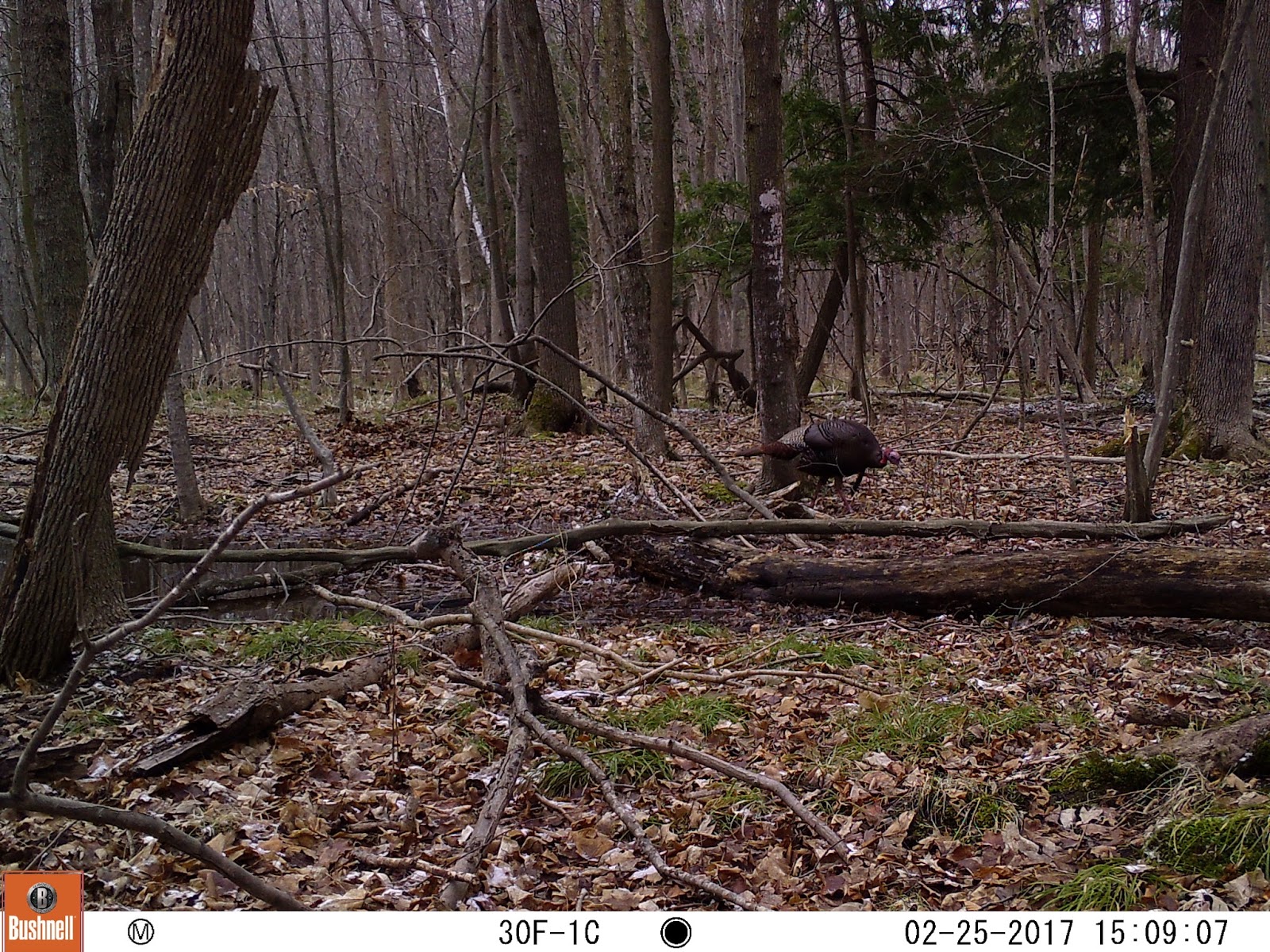
It's the Wild Turkey (Meleagris gallopavo) of course! I have seen numerous turkeys in this park but have never been close enough to get a clear photograph. This is where trail cameras are awesome! I had turkeys show up several times.
A lone tom showed up once...
So did a pair of toms...
And a flock of hens and last year's chicks. A young male would be known as a jake, and (I just learned this) a young female is a jenny.
Camera #2
My second camera was placed along a trail about 50 yards from the first camera. While it is possible that an animal might show up on one camera and then appear on the other camera a short time later, it is more likely that each camera will record distinct animals as the cameras are set along parallel trails.
The first camera is set up to record pictures in three shot bursts (spaced one second apart). This second camera does not have that option and only records on image at a time. Therefore, there were a lot less pictures on this camera
This camera recorded many of the same species as the other camera.
Northern Raccoons appeared on two separate nights; one night as an individual and another night as a pair.
A couple of squirrels showed up on this camera too...
As did several deer...
Including one small buck that is still holding on to its antlers.
For me the best image captured on this camera was the first one it recorded. That's a Pileated Woodpecker (Dryocopus pileatus) in the picture below. I don't necessarily have a favorite bird, but if I did the Pileated Woodpecker would be in the running. I get excited every time I see one. A close encounter with a Pileated Woodpecker is one of my all-time favorite bird sightings.
The cameras are still in place. Who knows what will show up on them the next time I check...
Camera #1
This camera is located in the same place as my first set of images from late January. I already knew from the first set of pictures that a lot of wildlife uses this area and hoped to get some good pictures. The camera is just far enough from the trail that animals don't seem to be bother by it, although I did have a opossum or raccoon check it out at night from close range. Species diversity was about the same as the first set of pics.
Virginia Opossums (Didelphus virginiana) showed up several different nights. One night a pair showed up on the camera together.
Northern Raccoon (Procyon lotor) also showed up on the camera several times...
As did several leaping squirrels.
White-tailed Deer (Odocoileus virginianus) showed up every day on the camera, either as individuals or in small groups. The most to appear on the camera at one time was six deer.
I did have one new species show up on this camera. This species was one that I was hoping to get images of and I was not disappointed. What is this mystery species?
It's the Wild Turkey (Meleagris gallopavo) of course! I have seen numerous turkeys in this park but have never been close enough to get a clear photograph. This is where trail cameras are awesome! I had turkeys show up several times.
A lone tom showed up once...
So did a pair of toms...
And a flock of hens and last year's chicks. A young male would be known as a jake, and (I just learned this) a young female is a jenny.
My second camera was placed along a trail about 50 yards from the first camera. While it is possible that an animal might show up on one camera and then appear on the other camera a short time later, it is more likely that each camera will record distinct animals as the cameras are set along parallel trails.
The first camera is set up to record pictures in three shot bursts (spaced one second apart). This second camera does not have that option and only records on image at a time. Therefore, there were a lot less pictures on this camera
This camera recorded many of the same species as the other camera.
Northern Raccoons appeared on two separate nights; one night as an individual and another night as a pair.
A couple of squirrels showed up on this camera too...
As did several deer...
Including one small buck that is still holding on to its antlers.
For me the best image captured on this camera was the first one it recorded. That's a Pileated Woodpecker (Dryocopus pileatus) in the picture below. I don't necessarily have a favorite bird, but if I did the Pileated Woodpecker would be in the running. I get excited every time I see one. A close encounter with a Pileated Woodpecker is one of my all-time favorite bird sightings.
The cameras are still in place. Who knows what will show up on them the next time I check...
Friday, January 27, 2017
First trail camera pictures
One of my 2016 Christmas gifts was a trail/game camera. Over the weekend I put it out for the first time in a secluded area of one of the local parks. This morning I went to retrieve it. Here are a few of the images it recorded. Nothing too exciting, but I have high hopes that I will see more in the future.
Each of the animals in the photos were seen on multiple dates, with the exception of the woodpecker. The two squirrels appeared every day, but never together. The raccoon and opossum both showed up on two separate nights. The pair of deer showed up on three separate days, but only in low light. A solo deer (not shown in any of the pictures) appeared once during the daytime.
Overall the camera was triggered more than forty times over the five days it was set up and recorded more than one hundred twenty images - the camera was set up to take a three-image burst any time it was triggered. The five species above were the only ones recorded.
| Grey Squirrel (center) and Downy Woodpecker (right, on log) |
| Grey Squirrel (black-phase) |
| Northern Raccoon |
| Virginia Opossum |
| White-tailed Deer |
Each of the animals in the photos were seen on multiple dates, with the exception of the woodpecker. The two squirrels appeared every day, but never together. The raccoon and opossum both showed up on two separate nights. The pair of deer showed up on three separate days, but only in low light. A solo deer (not shown in any of the pictures) appeared once during the daytime.
Overall the camera was triggered more than forty times over the five days it was set up and recorded more than one hundred twenty images - the camera was set up to take a three-image burst any time it was triggered. The five species above were the only ones recorded.
Wednesday, April 13, 2016
Mrs. LeValley's Woodpeckers
Part of a phone conversation that I had yesterday...
Shara (Mrs. LeValley): "There's a giant thingy... a giant woodpecker... on one of the thingies!"
Me: "A Pileated Woodpecker?"
Shara: "Yeah!"
Me: "Well, go take a picture."
Shara: "Okay, I have to put the phone down."
a minute or so of silence
" Okay, I got it."
(In her defense, Shara is a 2nd grade teacher and it was a very long day...)
Shara (Mrs. LeValley): "There's a giant thingy... a giant woodpecker... on one of the thingies!"
Me: "A Pileated Woodpecker?"
Shara: "Yeah!"
Me: "Well, go take a picture."
Shara: "Okay, I have to put the phone down."
a minute or so of silence
" Okay, I got it."
(In her defense, Shara is a 2nd grade teacher and it was a very long day...)
| Pileated Woodpecker outside a classroom window (#1) - photo by Shara LeValley |
| Pileated Woodpecker outside a classroom window (#2) - photo by Shara LeValley |
Tuesday, March 8, 2016
Into the woods - A walk at Mission Creek (Part 1)
After spending much of the past four days inside listening to speakers, I am getting a little stir-crazy. So this morning, after completing two classroom presentations, I decided to head to the woods at Mission Creek Woodland Park for some needed "nature time". Because i took so many photos during this walk, I am going to break this down into two separate posts. Expect part two to be posted tomorrow (09 March 2016)
Before I even entered the park, I found something that I wanted to look at closer.
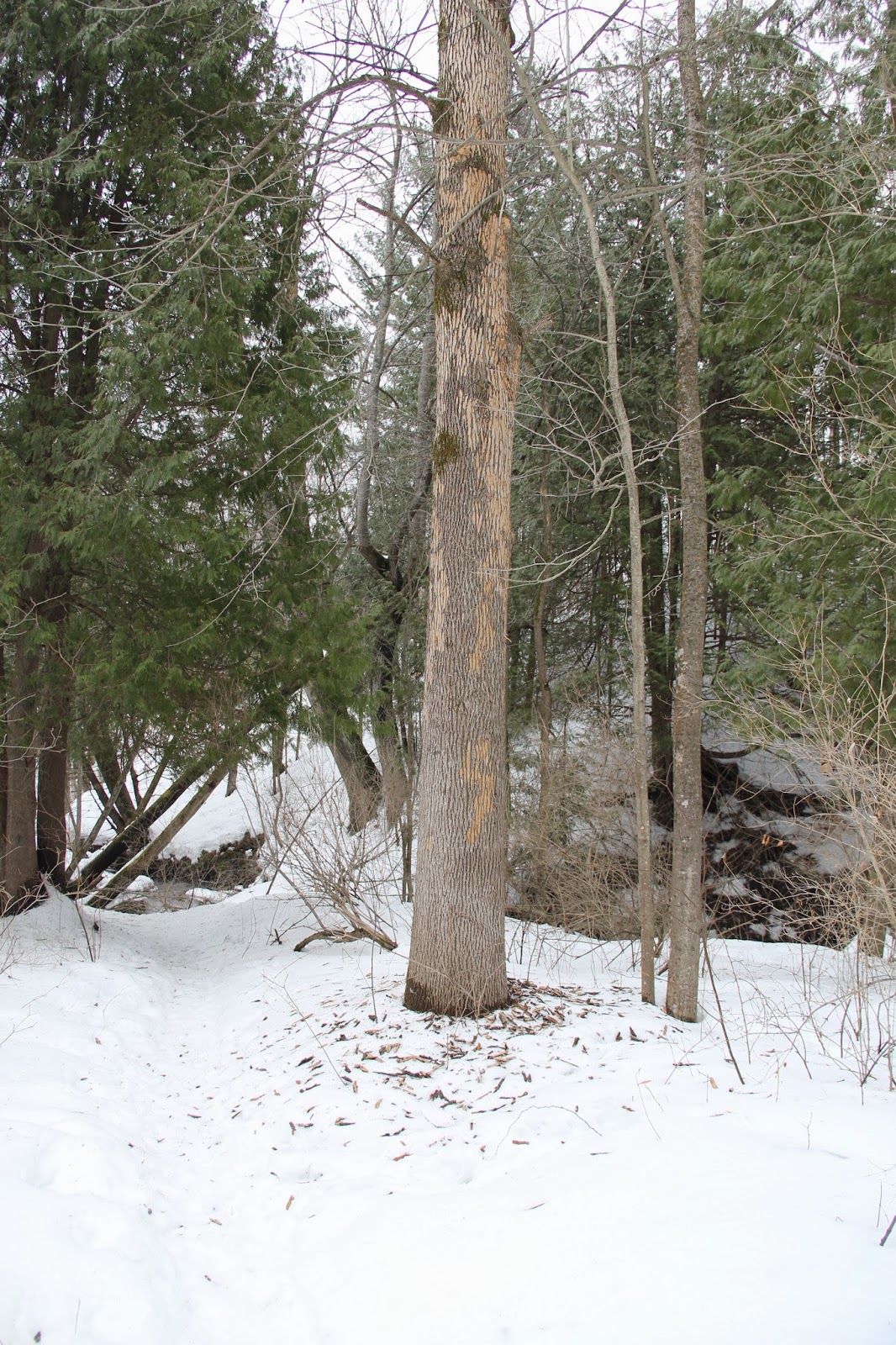
| The woodchips at the base of this Eastern Hemlock trunk are the result of Pileated Woodpeckers searching for ants and other insects within the trunk |
Monday, January 11, 2016
Surprise! It's a woodpecker! A huge woodpecker!
Yesterday while I was on our enclosed back porch, working on materials for a school presentation, I kept hearing a loud banging noise coming from somewhere outside. To my surprise, when I looked out the window I saw a Pileated Woodpecker (Dryocopus pileatus)! It was busy prying at the thick bark of a Honey Locust tree (Gleditsia triacanthos) only about eight feet from our back door. I took a few blurry photos through the window glass and then cracked open the door to take several more - this was the best photo of the bunch.
This is the first time I have ever seen a Pileated Woodpecker near our house in Alma. This individual was a female - identifiable by the gray forehead and black stripe from the corner of the beak (moustache). On male Pileated Woodpeckers the moustache and the entire crest (including the forehead) are red.
The woodpecker disappeared around the opposite side of the tree after realizing it was being watched, but it remained in our yard for quite some time. It only flew away 15-20 minutes later when I had to go out the back door
This is actually the closest I have ever been to a Pileated Woodpecker, but I have better photos from an encounter in March 2013. That woodpecker let me photograph it from about a dozen feet for more than 10 minutes and remained hard at work digging ants out of a tree even as I walked away.
This is the first time I have ever seen a Pileated Woodpecker near our house in Alma. This individual was a female - identifiable by the gray forehead and black stripe from the corner of the beak (moustache). On male Pileated Woodpeckers the moustache and the entire crest (including the forehead) are red.
The woodpecker disappeared around the opposite side of the tree after realizing it was being watched, but it remained in our yard for quite some time. It only flew away 15-20 minutes later when I had to go out the back door
This is actually the closest I have ever been to a Pileated Woodpecker, but I have better photos from an encounter in March 2013. That woodpecker let me photograph it from about a dozen feet for more than 10 minutes and remained hard at work digging ants out of a tree even as I walked away.
Tuesday, January 5, 2016
Native Species Profile - Downy Woodpecker
Visit a woodland in Mid-Michigan during the right time of year and it is not uncommon to see six different species of woodpeckers that call the area home: the Pileated Woodpecker, Red-Bellied Woodpecker , Hairy Woodpecker, Northern Flicker, Yellow-bellied Sapsucker, and the most common of all, the Downy Woodpecker. The Downy Woodpecker (Picoides pubescens) is the smallest woodpecker species in North America. It typically measures 5.5 to 7 inches long and has a wingspan of 10 to 12 inches. This small size allows it to live in a wide range of habitats across North America, being absent only in the desert Southwest and the arctic tundra.
The Downy Woodpecker is easy to identify. They have a two-toned color scheme, with white on the underparts (chest and belly) and mostly black above. The wings are black with white checkering. Most of the tail feathers are black, with white feathers (with black checkering) on the outer edges of the tail. There is a white stripe down the center of its back. A Downy Woodpeckers head has a broad black stripe running over the top of its head, another broad black stripe that looks like a mask, and a narrower black stripe running downward from the corners of the beak. With the exception of this stripe, the feathers at the base of the beak are white. Males can be distinguished from females by a red patch on the back of their head - this is known as an occipital patch. Downy Woodpeckers have a short stubby black beak. The larger Hairy Woodpecker (P. villosus) has similar markings but is larger (8.5-10 inches long, 15-17.5 inch wingspan) and a longer beak.
Like most other woodpeckers, Downy Woodpeckers use their short beak as chisel to probe into dead or decaying wood for their favorite food source - insects and their larvae. A large proportion of their diet consists of ants, beetles, and other woodboring insects. They also consume spider and other invertebrates. In addition, Downy Woodpeckers eat berries, seeds, and acorns. They will rarely drink tree sap or nectar to supplement their diet. Most of their foraging is done in trees, but they will feed on the ground.
Downy Woodpeckers are well adapted for their foraging style. In addition to their chisel-like beak, they have a thick skull to cushion their skull when they use their beak to hammer at trees, and a long barbed tongue used to pull insects from tunnels in the wood. Unlike perching birds (such as sparrows), the toes on woodpeckers are arranged with two pointing forward and two pointing backward. This adaptation, known as zygodactylism, allows the woodpecker to climb easily up the trunks of trees and even hang upside down on branches that are beyond vertical. Their stiff tail feathers are pushed against the tree's surface, acting as a counterbalance.
Downy Woodpeckers are a cavity nesting bird. Because of their strong beak, they are able to excavate their own nesting cavities in decaying trees. They typically use these homes for one nesting season before abandoning them. These abandoned cavities provide nesting sites for other small birds such as bluebirds and swallows that are unable to excavate their own cavities. Rarely, Downy Woodpeckers will nest in man-made nest boxes. It attempting to attract woodpeckers to nest boxes, the box should be packed with woodshaving so that the woodpeckers can "excavate" the box tot heir satisfaction.
Habitat: woodlands (mainly deciduous), fencerows, wetlands, suburban areas
Eats: insects, spiders, insect and spider eggs, other invertebrates, berries, seeds, acorns, rarely tree sap and nectar
Nest: in tree cavity, rarely in a nesting box
The Downy Woodpecker is easy to identify. They have a two-toned color scheme, with white on the underparts (chest and belly) and mostly black above. The wings are black with white checkering. Most of the tail feathers are black, with white feathers (with black checkering) on the outer edges of the tail. There is a white stripe down the center of its back. A Downy Woodpeckers head has a broad black stripe running over the top of its head, another broad black stripe that looks like a mask, and a narrower black stripe running downward from the corners of the beak. With the exception of this stripe, the feathers at the base of the beak are white. Males can be distinguished from females by a red patch on the back of their head - this is known as an occipital patch. Downy Woodpeckers have a short stubby black beak. The larger Hairy Woodpecker (P. villosus) has similar markings but is larger (8.5-10 inches long, 15-17.5 inch wingspan) and a longer beak.
| Male Downy Woodpecker - note checkered wings, white back, striped face, and red occipital patch |
Like most other woodpeckers, Downy Woodpeckers use their short beak as chisel to probe into dead or decaying wood for their favorite food source - insects and their larvae. A large proportion of their diet consists of ants, beetles, and other woodboring insects. They also consume spider and other invertebrates. In addition, Downy Woodpeckers eat berries, seeds, and acorns. They will rarely drink tree sap or nectar to supplement their diet. Most of their foraging is done in trees, but they will feed on the ground.
Downy Woodpeckers are well adapted for their foraging style. In addition to their chisel-like beak, they have a thick skull to cushion their skull when they use their beak to hammer at trees, and a long barbed tongue used to pull insects from tunnels in the wood. Unlike perching birds (such as sparrows), the toes on woodpeckers are arranged with two pointing forward and two pointing backward. This adaptation, known as zygodactylism, allows the woodpecker to climb easily up the trunks of trees and even hang upside down on branches that are beyond vertical. Their stiff tail feathers are pushed against the tree's surface, acting as a counterbalance.
| A Downy Woodpecker searches for insects and other invertebrates on a sumac tree |
Downy Woodpeckers are a cavity nesting bird. Because of their strong beak, they are able to excavate their own nesting cavities in decaying trees. They typically use these homes for one nesting season before abandoning them. These abandoned cavities provide nesting sites for other small birds such as bluebirds and swallows that are unable to excavate their own cavities. Rarely, Downy Woodpeckers will nest in man-made nest boxes. It attempting to attract woodpeckers to nest boxes, the box should be packed with woodshaving so that the woodpeckers can "excavate" the box tot heir satisfaction.
| A female Downy Woodpecker works on a nesting cavity - note the lack of red on the back of the head |
Basic Information
Downy Woodpecker
Picoides pubescens
Downy Woodpecker
Picoides pubescens
Size: 5 ½-7” long,
10-12” wingspan
Tuesday, September 9, 2014
Downy Woodpecker on Staghorn Sumac
| Downy Woodpecker (Picoides pubescens) |
Tuesday, March 11, 2014
Late Winter Woods - Mission Creek Woodland Park
Last year on March 11th, I wrote a blog post about the ability of Skunk Cabbage flowers to melt the snow around them - a process called thermogenesis. This ability makes them the first flower of Spring in Mid-Michigan.
Today, after finishing two school presentations, I was able to spend a little time in the woods at Mission Creek Woodland Park in Mt. Pleasant. I was hoping to find Skunk Cabbage poking up through the snow and ice. This was not to be... The snow and ice cover in the swamp along Mission Creek is still too thick for any emerging Skunk Cabbage blooms to melt. With temperatures over the last two day reaching as high as 50 degrees Fahrenheit, the snow is very slushy, but it is still nearly two feet deep in some areas. (More snow is in the forecast for tonight!)
Despite my disappointment at not finding and blooming skunk cabbage it was still a nice day to be in the woods.
Today, after finishing two school presentations, I was able to spend a little time in the woods at Mission Creek Woodland Park in Mt. Pleasant. I was hoping to find Skunk Cabbage poking up through the snow and ice. This was not to be... The snow and ice cover in the swamp along Mission Creek is still too thick for any emerging Skunk Cabbage blooms to melt. With temperatures over the last two day reaching as high as 50 degrees Fahrenheit, the snow is very slushy, but it is still nearly two feet deep in some areas. (More snow is in the forecast for tonight!)
Despite my disappointment at not finding and blooming skunk cabbage it was still a nice day to be in the woods.
| Poplar at Mission Creek Woodland Park |
| North Hiking Trail at Mission Creek Woodland Park |
| Cow Parsnip seeds |
| Green Ash - killed by Emerald Ash Borer |
| Bark at the base of dead Green Ash - the bark is being stripped by woodpeckers to access insect larvae (including Emeral Ash Borer) |
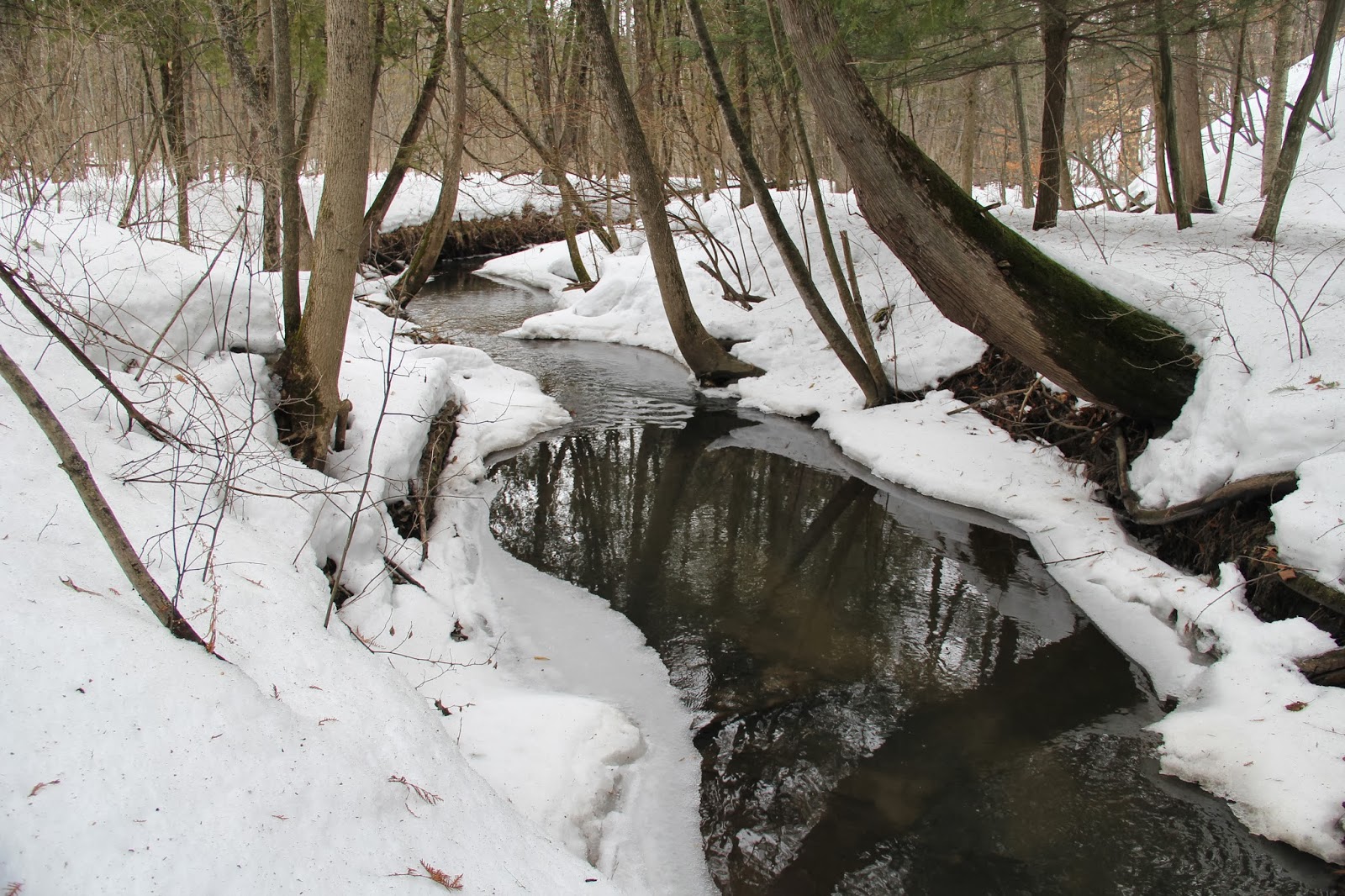
| Mission Creek |
| Cedar leaf on ice at Mission Creek |
| Forest reflections |
| Mission Creek flows through a Northern Hardwood-Conifer Swamp |
| Woodpecker holes in Northern White Cedar |
| Eastern Cottonwood bark |
| Raccoon tracks in snow |
| American Beech leaves - these leaves stay on the tree throughout winter |
Subscribe to:
Posts (Atom)