Showing posts with label color. Show all posts

Thursday, November 8, 2018

Early November in the (mostly) native pollinator garden

The growing season is almost over for the year.  Most of the native plants in our home gardens have begun to go dormant.  However, a few are still green - packing away more sugars in their roots to get a jump on next year .  One or two plants are still throwing up a bloom now and then.  The gardens are still a riot of colors, but now they are the subdued colors of fall and not the brilliant flowers of summer.  The biggest theme of the season though is "seeds" - pretty much every species is covered with seeds waiting to be dispersed by animals or by the wind. 

Over the next few months most of the plants will be knocked down by a combination of decay and heavy snows.  The plants that remain in the spring will be trimmed down near ground level.  I don't trim plants in the fall because they provide cover for hibernating insects and the seeds provide food for birds.  Those seeds that the birds don't get will be deposited into the soil to grow into more plants.  The leaves and stalks that fall to the ground form a natural mulch and eventually decay back into the soil - adding a healthy layer of rich organic humus.  I also allow all the leaves that fall into the gardens to remain and don't rake away the leaves that fall on the lawn.  I mulch those up with the mower and allow them to stay on the lawn - it's free fertilizer!

My work in the garden is not entirely done for the year.  I still need to plant a couple hundred tulip and crocus bulbs before the ground freezes.  I love the spring flowering bulbs - they're why I refer to the garden as a (mostly) native pollinator garden.

Here's a few pictures from this evening.

The garden at the back of the house

High-bush cranberries

Blue-stemmed Goldenrod seeds


Tall Coreopsis leaves turn a deep red

Rudbeckia triloba isn't doon yet!

Big-leaf Aster seeds

New England Aster seedheads surround our Monarch Waystation sign

Butterflyweed seeds
 
The view from the street corner

Northern Maidenhair Fern surrounded by fall leaves

Fertile fronds from one of several species of ferns

Japanese maples have finally started to drop their deep red leaves

Friday, November 2, 2018

Fall colors explained (repost from October 2016)

This is post was originally published in October 2016.  I like providing original content on this blog (and not just reposting thing I have previously written), but I have spent a lot of time in recent weeks explaining why leaves change color in the fall so I thought it was worth sharing again.

Fall colors at Sleeping Bear Dunes National Lakeshore
Have you ever wondered why leaves change colors?

It's a simple question with a complex biological answer involving masking, sugars, and pigments.

Normally the leaves of most plants appear green to people with normal color perception.  They are green because they are filled with a pigment called chlorophyll.  Chlorophyll is responsible for photosynthesis - the sugar production in plants and some bacteria (and one weird sea slug that incorporates chlorophyll into its body from an algae - although the mechanism has been called into question by some more recent research). It is also responsible for releasing oxygen in a form that we can use.

When leaves change color in the fall, they do so because the tree stops production of chlorophyll.  During the growing season, chlorophyll is so abundant in leaves that it masks all other colors found in the leaves.  As the level of chlorophyll decreases, the other colors begin to show through the mask.

Leaves, unmasked!

Yellow and orange colors are caused by a group of pigments known as carotenoids.  These colors were present throughout the growing season, but couldn't be seen because of the abundance of chlorophyll.

Thank carotenoids for the golden fall color of Quaking Aspen

Red and purple colors are different.  They are caused by by a group of pigments known as anthocyanins.  These chemicals are produced in the fall when chlorophyll production ceases.  The sugars that are produced by chlorophyll require the presence of several groups of chemicals to help break them down so they can be used as fuel at the cellular level - one of these groups is known as phosphates.  Phosphates are molecules that form around an atom of phosphorus, an important micronutrient.  Because phosphorus is present in limited quantities in the soil, trees can't afford to lose their phosphates when they drop their leaves - instead they transfer the phosphates back into the branches, trunk, and roots. 

The red in these Sumac leaves comes from anthocyanins

When the phosphates are shuffled away from the leaves, the leaves have to use a different process to break down the sugars - this process results in the production of anthocyanins.  When the level of anthocyanins becomes high enough, and the level of chlorophyll low enough, the leaves will appear red or purple.

Sometimes leaves appear red in the early spring.  This happens because the tree also produces anthocyanins in the spring before chlorophyll production ramps up to summer levels.  Once chlorophyll production begins at full scale the anthocyanin production ceases and the chlorophyll masks the reds and purples.

Anthocyanins at work - fall color in a spring leaf of Red Oak

Brown leaves are produced by an entirely different process.  The brown is the color of the cell walls within the leaves - some trees do not produce large quantities of either carotenoids or anthycyanins, so we see the brown of the cell walls instead.  This also the reason why all fallen leaves eventually turn brown - the pigments fade away and we are left seeing the brown cell walls of the leaf.

Tuesday, January 23, 2018

Trash and art

A trip to Mission Creek Woodland Park on 03 January 2018 resulted in several photos that I shared in the posts Red Oak in Winter and Northern White Cedar - An important winter food source for White-tailed Deer.

One of the features of this park is a sledding hill.  This hill is partially natural and partially man-made.  The sledding hill is actually the highest point within the city limits of Mt. Pleasant.  After snowstorms this park is heavily used by families, teens, and college students.  The hill was empty the day I visited, but as I walked past I saw something that I couldn't resist photographing.


Siting next to a full trash can was a loose pile of broken plastic sleds covered in a dusting of light snow.  It was obvious that someone had tried to clean up the sledding hill, but lacked room in the trash can for these sled fragments.  I love the abstract look of these colorful pieces against the pure white background of the snow.


Tuesday, October 31, 2017

Visiting four CWC preserves in one day (Part Two)


Yesterday I started to share a bunch of photographs from my Sunday (29 October 2017) trip to four Chippewa Watershed Conservancy Preserves.  I entered the first preserve (Sylvan Solace) at approximately 9:00AM and left the final preserve (Audubon Woods) at 3:45PM.  Add in driving to and from my home in Alma and the trip took nearly eight hours and covered 78 miles by car and (probably) 10 miles on foot.

Here are the photos from the second half of my trip.


Hall's Lake Natural Area


The Hall's Lake Natural Area is actually comprised of three connected preserves (the Schaftenaar, Kabana, and Neely Preserves) on the north and east sides of Hall's Lake.  A fourth, unconnected, Preserve (Fox Run) is located on the southwest side of the lake.  My trip took me mostly through the Schaftenaar and Kabana Preserves, with a short dip into the Neely Preserve.  Hall's Lake Natural Area is only three miles (as the crow flies) from Bundy Hill.  However, it takes six miles of driving to get from one preserve to the other.

Small American Beech sapling grows along the edge of a shrub swamp.

Lycopodium (a relative of ferns) will remain green throughout the winter.

A Tamarack sapling turns golden yellow before losing its needles.  It is the onlylocal conifer to lose its needles every fall.

In the previous post I mentioned that I found deer scrapes at every preserve I visited.  I probably found a dozen scrapes in total.  This scrape at Hall's Lake was the only one that I photographed with its overhead "licking branch".  Located directly over a heavily used trail, deer will both lick this branch and rub it with scent glands located on their nose and forehead.  The scrape acts like a sign drawing attention to the overhead branch.

A deer scrape located underneath an overhanging branch provides a place for deer to leave scent signals.

Located just a few short feet away, I found another type of deer sign known as a "rub'.  Rubs are formed by bucks scraping their antlers against a small tree.  Early in the fall, rubs are used to scrape velvet off the deer's fully developed antlers.  Later in the fall they are used much like the licking branch as a place to leave scent information for other deer.

A freshly rubbed sapling shows that one or more bucks has passed this way.

In this image both a scrape (left) and rub (right) can be seen. 

Green pine saplings and drying ferns add their own colors to the fall leaf palette.

Amanita mushrooms are toxic to humans.

Paper Birch trunks stand out in any fall forest.

Several benches provide a place to sit and view Hall's Lake.

Birch trunks rot within only a few years - the watertight bark holds moisture in!

Bronze American Beech leaves against a slowly decaying tree trunk

Winterberry (Ilex verticillata) adds its own color to the woods.

A miniature forest of Ground Pine sprouts in the larger forest.

 
Bittersweet Nightshade (Solanum dulcamara) leaves can turn a shocking shade of purple in the fall.

Water flows north out of Hall's lake into Pony Creek.

An old shelf fungus slowly decays, as does the log it grew on.

A bolete mushroom rises from the forest floor.

The bark on this tree formed an interesting pattern of cracks and fissures.

The preserve boundaries at Hall's Lake are well marked.

A large wetland divides the Schaftenaar and Kabana preserves.  An osprey nest platform can be seen in the distance.

Sometime in the recent past, beavers felled a large number of aspen trees at the northern edge of the preserve.

Red Oak leaves living up to their name for once.

Most of the canopy has fallen by now.

Audubon Woods Preserve

Audubon Woods Preserve is approximately 10 miles from the Hall's Lake Natural Area.  Audubon Woods is definitely the CWC preserve that I am most familiar with.  I have made many trips to Audubon Woods with school groups over the past few years and have written about that experience  several times.  Audubon Woods is a mature hardwood forest located on the banks of the Chippewa River.  The entire preserve slopes downhill toward the river's high banks.  Because I have spent so much time at this preserve, I decided to spend most of my time wandering off trail in hopes of finding something new.

Looking down the trail toward the river.

A small intermittent stream divided the property.

Northern Maidenhair Fern grows along the stream.
 
A pile of scat shows that a White-tailed Deer passed this way.


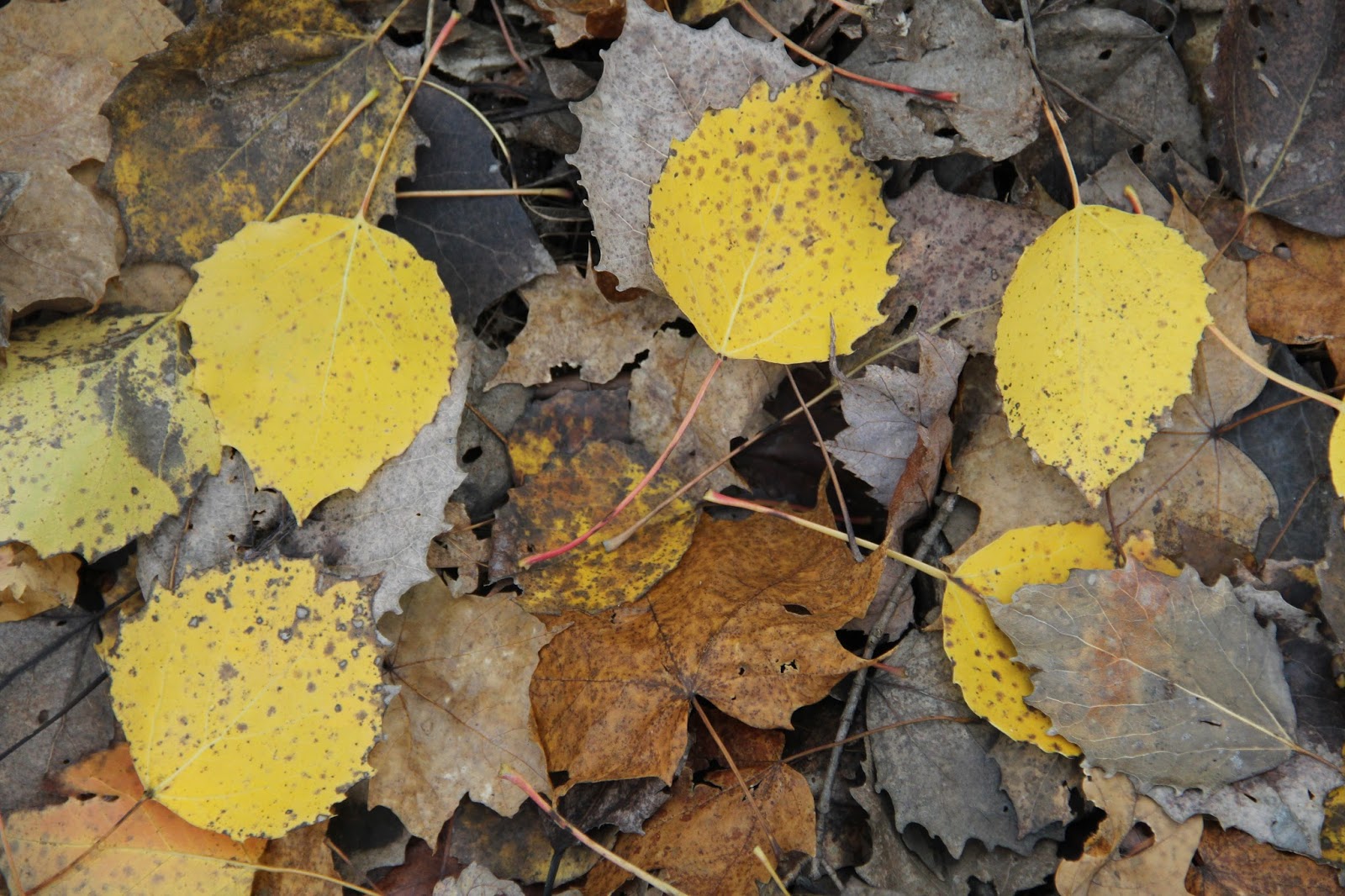
Bigtooth Aspen leaves turn golden yellow, but quickly fade to brown.

Looking up at Bigtooth Aspen leaves caught in an Eastern Hemlock.

A small fern grows deep in Audubon Woods.


Eastern hemlock forms several groves within Audubon Woods

Burls are irregular growths caused by damage to the tree.

Wild Grapes climb an Eastern Hemlock to the canopy.

This Sassafras seedling is near the northern limit of its range in Michigan.


Was it worth it?  I spent an entire day driving between preserves and hiking around.  I could have probably spent all day at any one of the preserves and still came away with the same number of photographs.  I did this mostly for the challenge - maybe other people have done something like this in the CWC preserves, but if they have I'm not aware of it.  I already have a more ambitious round of preserve visits mapped out in my mind, but that will have to wait until next summer when there is more available daylight.

Hopefully someone will see this and be inspired to challenge themselves to a similar photography project.