After a mild December, Winter has arrived in Mid-Michigan with a vengeance. Projected temperatures for the next twenty-four hours are set to dip down to -1 degree Fahrenheit (-18 Celsius).
In addition to the cold temperatures, over the past week Mid-Michigan has also received several inches of snow and a day of freezing rain. The snow and cold pose survival challenges for animals that remain in Michigan during the Winter.
Life during the Winter seems to occur at a much slower pace than it does during the
other eight or nine months of the year. Most of the birds that called
the region home during the warmer months have migrated to warmer
climates. Insects seem to have disappeared - some lie dormant as
adults, others spend the cold months as eggs, larvae, or pupae. Reptiles, amphibians, and a few mammals lie still in hibernation until the weather improves. Even
most of the trees and other plants sit dormant and await the return of Spring.
For each animal that remains active here during the Winter survival
comes down to two factors; can it find enough food (and avoid becoming
food for another animal) and can they stay warm. While part of staying
warm is staying sheltered from wind and moisture, a big part of staying
warm is being able to metabolize at a high enough rate to stay warm. So
in reality the ability to survive Winter in the northern United States
comes down to finding enough food (and avoiding avoiding becoming food).
Thursday, January 8, 2015

Monday, January 5, 2015
First Snows of 2015
Happy 2015!
After a very mild December, the new year has started off with some wintry weather. Snow on Saturday morning followed by rain during the day and night and more snow on Sunday morning.
Here are a few photographs of the Pine River in Alma from yesterday (04 JAN 2015) morning.
Finally, my favorite photo of the day...
Tomorrow, look for an article on whether animals in Mid-Michigan survive the Winter better if there is no snow or lots of snow.
After a very mild December, the new year has started off with some wintry weather. Snow on Saturday morning followed by rain during the day and night and more snow on Sunday morning.
Here are a few photographs of the Pine River in Alma from yesterday (04 JAN 2015) morning.
 |
| Waterfowl appreciate that the river remains open. |
 |
| Soft spongy ice has formed outside the main channel of the river. |
 |
| Pedestrian bridge over the Pine River |
 |
| The river isn't in this photo - it's immediately behind the trees to the right |
Finally, my favorite photo of the day...
 |
| Canada Geese coming in to land on the river. |
Tomorrow, look for an article on whether animals in Mid-Michigan survive the Winter better if there is no snow or lots of snow.
Tuesday, December 23, 2014
Dreaming of a White Christmas - A Non-Scientific Study of Holiday Snow Cover Since 2007
It doesn't look like Mid-Michigan will be enjoying a White Christmas this year.
What a contrast to last December... This photo was taken one year ago today (23 DEC 2013) looking down the street from my house.
Looking at that photo got me thinking about the previous year...
What a contrast to last December... This photo was taken one year ago today (23 DEC 2013) looking down the street from my house.
 | |
| Hey look! A squirrel! |
Looking at that photo got me thinking about the previous year...
Monday, December 22, 2014
Happy Solar New year!
Happy New Year!
No, not the calendar "new year". Yesterday marked the Solar New Year.
Yesterday 21 DEC 2014 at 6:03PM Eastern Standard Time, Mid-Michigan (and the rest of Earth's Northern Hemisphere) celebrated the annual Winter Solstice. On our current calendar the Winter Solstice marks the end of Fall and the beginning of Winter. Many ancient societies (in the Northern Hemisphere) marked the Winter Solstice as the beginning of a new year.
The word Solstice comes from the Latin words sol (sun) and sistere (to stand still). Yesterday the sun will have reached its lowest position in the southern Sky, giving us our shortest day of the year. On the Summer Solstice, Mid-Michigan received approximately 15 hours and 24 minutes of sunlight. Today Mid-Michigan will see only 8 hours and 58 minutes of sunlight, but from now until the Summer Solstice each day will grow longer.
The Earth rotates around its axis approximately once every 24 hours. However this axis is tilted at 23.5 degrees from the vertical. The points on the globe that the axis revolves around are referred to as the North and South Poles. The axis is always pointed toward the same location in the sky. The North Pole points toward the "North Star" - Polaris.
As the earth revolves around the sun, sometimes the North Pole is closer to the sun, sometimes the South Pole is closer to the sun. When the North Pole is at its closest, we experience Summer in Mid-Michigan and the Southern Hemisphere experiences Winter. When the North Pole is at its furthest, we experience Winter and the Southern Hemisphere experiences Summer.
If you were to arise at dawn every day of the year and record at which point on the horizon the sun rises from you would be able to track the progression from the Summer solstice (in which the sun rises furthest North) to the Winter Solstice (in which the sun rises furthest South) and back again. Tracking the postion of the rising sun was one of the earliest astronomical observations. Many ancient monuments were constructed to act as solar observatories, recording the longest and shortest days of the year.
Friday, December 19, 2014
Favorite Photos from 2014
With the end of the year almost upon us, it's time to look back on past 12 months.
2014 was a busy year for me. The Environmental Education Program expanded beyond anything I would have imagined when I started working for the Conservation District - I did 336 classroom presentations during the calendar year. Add in programs for the local library district and local Audubon club, participating in a get-kids-outside program for the county parks department, supporting Mother Earth Week activities at the Ziibiwing Center, and manning a booth at the Isabella County Fair; my presentation schedule kept me hopping for much of the year.
My year was also busy because of things that I took on myself. I became much more involved with the Chippewa Watershed Conservancy this year, helping to survey plants at several of its preserves and leading a couple of nature walks. Of course my Wildflowers of 2014 project also took up a lot of my time.
Lucky for me my job often gets me outside. Even when I am busy I always manage to find at least a little time almost every week to get outside and take photographs. In no particular order, here are some of my favorite photos from the past year.
The first photo is from my March 6th post titled "Hoarfrost and Horned Larks" and was photographed along the roadside about a half mile from my office.

This photograph of an Indigo Bunting was photographed in May at Mission Creek Woodland Park. I just really like the bird's facial expression - for a closer look here is the original posting.

The next photo of oak leaves was taken at Mill Pond Park on April 14th. This photo was originally posted on May 1st. I like the brown tones of the leaves and the decaying log. It is just a moody photograph that immediately became one of my favorites for the year.

This photograph of Skunk Cabbage leaves appears nowhere else on this blog. It was taken on April 29th. Skunk Cabbage is probably my favorite wildflower. I like this photo because of the contrast between the vibrant green leaves and the drab background of swampy soils and dead leaves.

The next three photographs show people interacting with nature.
This photograph was taken during the Chippewa Valley Audubon Club's moth hunt on June 21st at Mission Creek Woodland Park. At this stage we were waiting for species to show up at our lights. I wrote about this outing in post on June 23rd.

The next photograph was taken during a wetland plant survey on June 13th at the Chippewa Watershed Conservancy's Hall's Lake preserves. This photo shows CWC Director Stan Lilley photographing a Wild Calla plant.

The next photograph was also taken during a plant survey - this time at the CWC's Alyce J. Peterson Natural Area on August 16th. Just for your information, the plant that they are looking up is the Cut-leaved Coneflower (Rudbeckia laciniata) For more photos from this field trip please look here.

The next picture came about when a couple brought an ice cream bucket into the Conservation District. I love surprises of this kind. This photograph was originally posted on June 27th. I love how this little 12-inch Eastern Hognose Snake puffed up and acted like a rattlesnake in an effort to be intimidating.

This Fistulous Goat's Beard seed head was also photographed on June 26th. This is the first time this photo has been posted. I like the delicate look of the "parachutes" contrasted against the barbed edges of the seeds.

The next two photographs were taken during my vacation along the Lake Michigan shoreline. The first photograph shows the S.S. Badger car ferry passing the Ludington breakwater light on August 10th. The second photo shows "Big Red" (the Holland, MI lighthouse) being passed by a small boat at sunset on August 11th.


I like the next photograph because of the interesting clouds. This photo was taken on September 3rd at a property on the west side of Isabella County. I have not posted this photograph before, but other photos from this property can be found on this post about the Milbert's Tortoiseshell Butterfly. This was the site where I found more than 40 Monarch caterpillars this year.

I took lots of photographs of insects this year. It wasn't intentional like the wildflower photos, I just happened to see lots of insects when I had a camera in my hand. Here are my two favorite insect photos of the year.
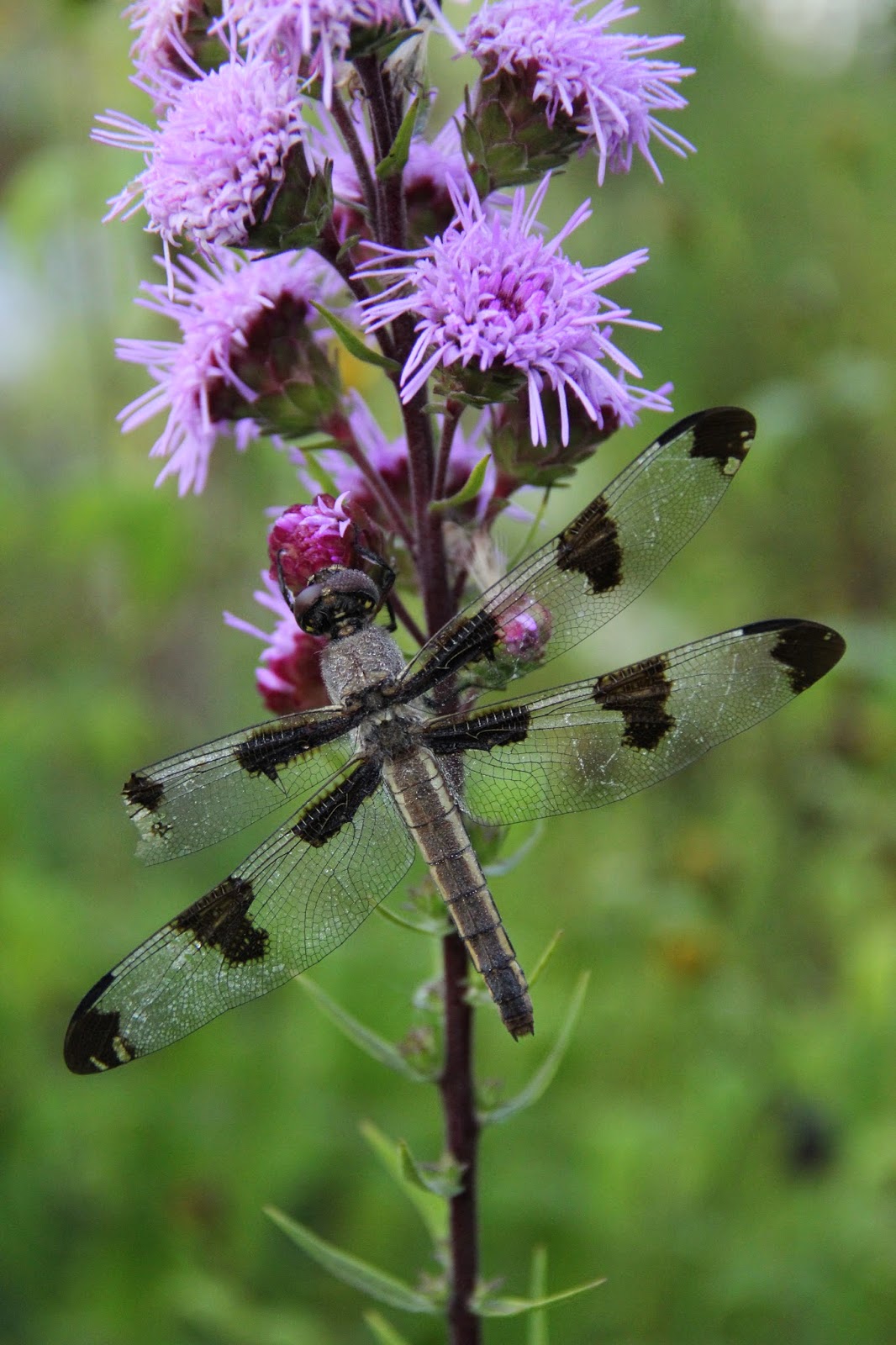
This picture of a female Twelve-spotted Skimmer was taken on September 8th at the Saginaw Chippewa Academy Native Pollinator Garden.
This preying mantis was photographed on September 2nd in the field behind the District office while I was searching for Monarch caterpillars.

In 2013, I shared my favorite photograph from each month. This year I noticed that I had a couple of months, that due to time constraints and weather conditions, for which I really didn't have any photographs that I liked. For other months I had lots of photos that I liked. I had a hard time choosing which pictures to include here, but some photos made my "favorites" list as soon as I took them. This photograph from the CWC's Quigley Creek Natural Area was taken on July 31st. I thought I had posted pictures from Quigley Creek, but it looks the only one that made it online was one of a Lesser Purple-fringed Orchid.

The final photograph was taken at Mill Pond Park in Mt. Pleasant on November 20th. I like how the sunlight filters through the clouds in this photo.

2014 was a busy year for me. The Environmental Education Program expanded beyond anything I would have imagined when I started working for the Conservation District - I did 336 classroom presentations during the calendar year. Add in programs for the local library district and local Audubon club, participating in a get-kids-outside program for the county parks department, supporting Mother Earth Week activities at the Ziibiwing Center, and manning a booth at the Isabella County Fair; my presentation schedule kept me hopping for much of the year.
My year was also busy because of things that I took on myself. I became much more involved with the Chippewa Watershed Conservancy this year, helping to survey plants at several of its preserves and leading a couple of nature walks. Of course my Wildflowers of 2014 project also took up a lot of my time.
Lucky for me my job often gets me outside. Even when I am busy I always manage to find at least a little time almost every week to get outside and take photographs. In no particular order, here are some of my favorite photos from the past year.
The first photo is from my March 6th post titled "Hoarfrost and Horned Larks" and was photographed along the roadside about a half mile from my office.
This photograph of an Indigo Bunting was photographed in May at Mission Creek Woodland Park. I just really like the bird's facial expression - for a closer look here is the original posting.
The next photo of oak leaves was taken at Mill Pond Park on April 14th. This photo was originally posted on May 1st. I like the brown tones of the leaves and the decaying log. It is just a moody photograph that immediately became one of my favorites for the year.
This photograph of Skunk Cabbage leaves appears nowhere else on this blog. It was taken on April 29th. Skunk Cabbage is probably my favorite wildflower. I like this photo because of the contrast between the vibrant green leaves and the drab background of swampy soils and dead leaves.
The next three photographs show people interacting with nature.
This photograph was taken during the Chippewa Valley Audubon Club's moth hunt on June 21st at Mission Creek Woodland Park. At this stage we were waiting for species to show up at our lights. I wrote about this outing in post on June 23rd.
The next photograph was taken during a wetland plant survey on June 13th at the Chippewa Watershed Conservancy's Hall's Lake preserves. This photo shows CWC Director Stan Lilley photographing a Wild Calla plant.
The next photograph was also taken during a plant survey - this time at the CWC's Alyce J. Peterson Natural Area on August 16th. Just for your information, the plant that they are looking up is the Cut-leaved Coneflower (Rudbeckia laciniata) For more photos from this field trip please look here.
The next picture came about when a couple brought an ice cream bucket into the Conservation District. I love surprises of this kind. This photograph was originally posted on June 27th. I love how this little 12-inch Eastern Hognose Snake puffed up and acted like a rattlesnake in an effort to be intimidating.
This Fistulous Goat's Beard seed head was also photographed on June 26th. This is the first time this photo has been posted. I like the delicate look of the "parachutes" contrasted against the barbed edges of the seeds.
The next two photographs were taken during my vacation along the Lake Michigan shoreline. The first photograph shows the S.S. Badger car ferry passing the Ludington breakwater light on August 10th. The second photo shows "Big Red" (the Holland, MI lighthouse) being passed by a small boat at sunset on August 11th.
I like the next photograph because of the interesting clouds. This photo was taken on September 3rd at a property on the west side of Isabella County. I have not posted this photograph before, but other photos from this property can be found on this post about the Milbert's Tortoiseshell Butterfly. This was the site where I found more than 40 Monarch caterpillars this year.
I took lots of photographs of insects this year. It wasn't intentional like the wildflower photos, I just happened to see lots of insects when I had a camera in my hand. Here are my two favorite insect photos of the year.
This picture of a female Twelve-spotted Skimmer was taken on September 8th at the Saginaw Chippewa Academy Native Pollinator Garden.
This preying mantis was photographed on September 2nd in the field behind the District office while I was searching for Monarch caterpillars.
In 2013, I shared my favorite photograph from each month. This year I noticed that I had a couple of months, that due to time constraints and weather conditions, for which I really didn't have any photographs that I liked. For other months I had lots of photos that I liked. I had a hard time choosing which pictures to include here, but some photos made my "favorites" list as soon as I took them. This photograph from the CWC's Quigley Creek Natural Area was taken on July 31st. I thought I had posted pictures from Quigley Creek, but it looks the only one that made it online was one of a Lesser Purple-fringed Orchid.
The final photograph was taken at Mill Pond Park in Mt. Pleasant on November 20th. I like how the sunlight filters through the clouds in this photo.
Thursday, December 18, 2014
The Ghosts of Caribou Past
Christmas is just on week away. The reindeer are ready, are you?
Reindeer (Rangifer tarandus) can be found across the Northern Hemisphere in Scandinavia, Siberia, and North America - in North America the species is known as Caribou.
While the species is not currently found in Michigan, it was probably very common during the last Ice Age. During this period, Caribou were an import food source for the paleo-indians that populated the Great Lakes region. Because so much of world's water was frozen in glaciers, migratory herds of caribou were able to cross a land bridge called the Alpena-Amberly Ridge across what is today Lake Huron. The people of the time probably followed migratory caribou herds as the land bridge. Since 2008, archaeologists have been using sonar to scan this ridge and have found numerous stacked stone structures that were probably used to ambush migrating herds.
Caribou are still found in the Canadian forests north of Lake Superior. They were found on Isle Royale as late as the 1920s. I remember reading somewhere that Caribou occasionally ventured south of the Straits of Mackinaw as late as the 1870s(?). Today, the only Caribou that can be found in Michigan are in zoos or captive herds. The reindeer in the photo above are from the Rooftop Landing Reindeer Farm in Clare, MI. They just happened to escape from a parked trailer during transport on a snowy night in December 2008. I had taken one of our dogs outside and ran back in to tell Shara that she needed to come outside immediately. It is not everyday that you see caribou/reindeer running around next to your house in Mid-Michigan.
 | ||
| These reindeer escaped from a trailer and were running around a gas station parking lot (photographed December 2009) |
Reindeer (Rangifer tarandus) can be found across the Northern Hemisphere in Scandinavia, Siberia, and North America - in North America the species is known as Caribou.
While the species is not currently found in Michigan, it was probably very common during the last Ice Age. During this period, Caribou were an import food source for the paleo-indians that populated the Great Lakes region. Because so much of world's water was frozen in glaciers, migratory herds of caribou were able to cross a land bridge called the Alpena-Amberly Ridge across what is today Lake Huron. The people of the time probably followed migratory caribou herds as the land bridge. Since 2008, archaeologists have been using sonar to scan this ridge and have found numerous stacked stone structures that were probably used to ambush migrating herds.
Caribou are still found in the Canadian forests north of Lake Superior. They were found on Isle Royale as late as the 1920s. I remember reading somewhere that Caribou occasionally ventured south of the Straits of Mackinaw as late as the 1870s(?). Today, the only Caribou that can be found in Michigan are in zoos or captive herds. The reindeer in the photo above are from the Rooftop Landing Reindeer Farm in Clare, MI. They just happened to escape from a parked trailer during transport on a snowy night in December 2008. I had taken one of our dogs outside and ran back in to tell Shara that she needed to come outside immediately. It is not everyday that you see caribou/reindeer running around next to your house in Mid-Michigan.
Wednesday, December 17, 2014
Insect Photos
Yesterday I posted a worksheet that I use during a presentation on Michigan's Insects. Today I am going to share the Powerpoint slides that I use during the same presentation. I use these photos to show Third Grade students the diversity of insect species that can be found in the local habitats and to illustrate the various adaptations that insects have developed including warning coloration, mimicry, false eyespots, etc..
As before, if you can use these images for an academic purpose please feel free to borrow them. Many of these photos appear elsewhere on this blog.


 There are 57 more slides below the break...
As before, if you can use these images for an academic purpose please feel free to borrow them. Many of these photos appear elsewhere on this blog.
Subscribe to:
Posts (Atom)