Sunday, May 13, 2018

Ducks in Trees?

Ducks in trees?

A pair of Wood Ducks at Audubon Woods Preserve

Absolutely!  Several species of Michigan ducks can commonly be found in trees - not only do they perch in trees, but they also nest in cavities in trees!. 

Cavity-nesting duck species include the Bufflehead (Bucephala albeola), Common Goldeneye (Bucephala clangula), Common Merganser (Mergus merganser), Hooded Merganser (Lophodytes cucullatus) and Wood Duck (Aix sponsa).  Of these five species, only the final two species are year round residents.  The first three species are migrants and winter visitors to Mid-Michigan, but migrate further north to nest.   

Of the two year-round residents, I have never seen a Hooded Merganser in a tree.  I have seen Wood Ducks in trees many times, including last week at Audubon Woods Preserve.  While waiting for students to arrive I observed a pair of Wood Ducks landing in a nearby tree.  The ducks were aware of me, but didn't startle and fly away immediately. 
 
Instead, they remained in the tree for several minutes.  Long enough for me to retrieve my camera and photograph them for nearly two minutes.  There were many tree branches in the way, but I still managed to get several clear shots of both the male and female before they startled and flew deeper into the woods.

A Wood Duck drake is much more colorful than the drab colored hen.
 
The hen's dull colors help camouflage it much better than the bright plumage of the drake.

These two Wood Ducks were probably searching for a nesting site such as an old woodpecker hole.

Friday, May 11, 2018

Green-striped Trilliums

While working with the Shepherd fifth graders at Audubon Woods Preserve earlier this week I noticed dozens of Large-Flowered Trillium blooms.  Most of these were the standard white variety.


But, there were a few flowers with a green stripe down the center of each white petal.

The green stripe is a sign of mycoplasma infection

These flowers have been infected by something called a mycoplasma.  A mycoplasma is a form of bacteria that lacks a cell wall.  This infection will first be noted as a green stripe near the center of each petal.  As the infection spreads in successive years the stripe widens until the whole petal may be green.  This infection can also cause deformed petals or even double blooms (so each flower would have six instead of three petals).  This infection eventually impairs the reproductive ability of the infected plant and prevents successful seed production.

This Trillium bloom is almost entirely green and its leaves also show signs of infection.

A mycoplasma infected Trillium


Tuesday, May 8, 2018

Forestry for Fifth Graders (07 & 08 May 2018)

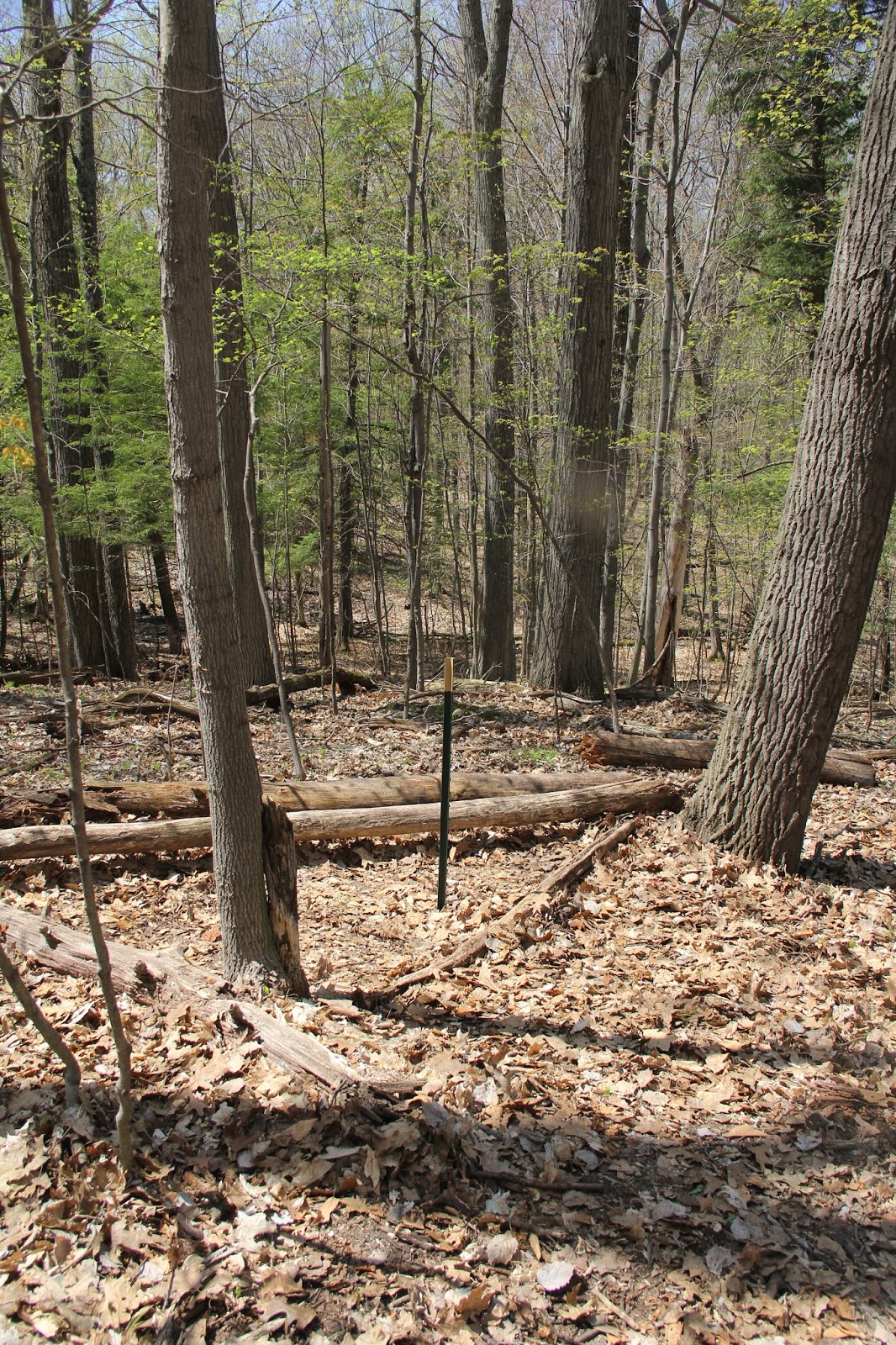
If you have visited the Chippewa Watershed Conservancy's Audubon Woods Preserve in the past week you may have noticed some metal T-posts that weren't there before.

A metal T-post standing alone at Audubon Woods Preserve

Why are these posts at Audubon Woods?  What are they for?

For the past seven years, I have used Audubon Woods as an outdoor science classroom for local elementary students.  The T-posts are meant to be semi-permanent education stations.  In the past, every time I took students to Audubon Woods I would set up temporary stations at somewhat random points in the woods.  There is a lot that can be done by using temporary points, but more can be learned long term if students use the same locations time after time.

With permission, I set about placing posts along a series of transects (lines) throughout the woods.  I set up three transects at regularly spaced intervals in the woods and placed six evenly-spaced posts along each transect.  Now with semi-permanent locations, data that the students collect can be compared over time.

So what kinds of data are the students collecting?

Over the past two day (07 & 08 MAY 2018) I have been working with fifth grade students from Shepherd Elementary.  These classes were able to travel to Audubon Woods because last fall their teachers applied for and received a Wheels To Woods field trip grant. 

Students are measuring the circumference of trees in their study plot and using that to calculate diameter.

Measuring a tree's circumference

Measuring large trees takes teamwork


Students are also counting trees at their study plot to determine the number of trees in one acre of forest and in the entire forest.  Audubon Woods is 40 acres in size - at 43,560 sq. ft/acre, that means Audubon Woods is 1,742,400 sq. ft!  Counting all of the trees in an area this size would be an impossible task.  Luckily, it is easy to count the number of trees in a much smaller area and then use that number to estimate the total number of trees in the forest.  A circle with a radius of approximately 37 feet will have an area of 1/10 acre.   Remember those T-posts?  Students counted every tree within 37 feet of the post and used multiplied that number by 10 to find the number of trees in one acre and then again by 40 to find the total number of trees in Audubon Woods.

Tape measures are an important forestry tool

Measuring trees to make sure they fit in their plot

Students then calculated the number of leaves on the forest floor by counting the number of leaves in one square foot and then multiplying by 43,560 to get the number of leaves in one acre, and then by 40 to get the total number of leaves on the floor of Audubon Woods.  Imagine if a single square foot holds exactly 100 leaves, this would calculate out to over 172 million leaves in the forest!

Students had a square made from PVC pipe to make their task easier

Counting leaves from a single square foot of forest

Re-calculating...

Students also calculated the weight of all the leaves in the forest, identified and sketched leaves, and drew a sketch of the forest near their study plot.  Perhaps just as important as the science, this field trip allowed students to get out of the classroom for a few hours.  The months of April and May are testing time in Michigan.  Students spend hours taking state-mandated assessments and even more hours taking tests required by their local school district.  A field trip like this exposes them to sights, sounds, and smells that thy can never experience in the classroom.

Large-flowered Trillium

 
Trillium surrounded by Mayapple


Spring Beauty flowers


Bloodroot

Skunk Cabbage

Wood Frogs were everywhere hidden among the leaves

Another Bloodroot flower

The maples and other trees are just starting to leaf out

Monday, May 7, 2018

Wildflowers at Williams-Blackburn Preserve (plus a backyard bird!)


On Sunday (06 May) I led a wildflower tour of the Chippewa Watershed Conservancy's Williams-Blackburn Preserve.  After having beautiful weather for several days, the weather on Sunday was drab and dreary, with the threat of rain throughout the hike.  Despite the weather, a small group of wildflower devotees gathered to explore this little-visited preserve.


Williams-Blackburn Preserve is divided into two parts by the Chippewa River.  A small parcel of the preserve is on the east side of the river along Leaton Road.  The majority of the preserve is located north and west of the river.  This larger portion of the preserve is divided into the floodplain of the Chippewa River and an upland area dominated by an evergreen plantation and large area of invasive Autumn Olive.  Our walk took us into the floodplain area on the east side of the main preserve.  This area looks kind of like Florida in the above map.

The group climbing down into the floodplain.


The spring wildflower season has been both delayed and compressed by the unusually cold spring.  It has been delayed in the sense that many flowers are blooming weeks later than they would in a "normal" year.  It has been compresses in the sense that while the spring wildflower bloom is usually spread out over a couple of months, this year we are seeing species that would have bloomed two weeks ago are blooming alongside species that are right on schedule.

Spring Beauty

We ended up finding eight species of plants in bloom and another eight species that we identified by their foliage (leaves).  The species we found included Serviceberry, Spring Beauty, Common Blue Violet, Wood Anemone, Round-lobed Hepatica, Wild Ginger, Wild Leek, False Rue Anemone, Downy Yellow Violet, Pennsylvania Sedge, Bloodroot, Cut-leaved Toothwort, Blue Cohosh, Wild Geranium, and Cow Parsnip.

False Rue Anemone

Cut-leaved Toothwort

On a completely unrelated note: Baltimore Orioles (Icterus galbula) have returned to the area.  We put up our oriole feeders on Thursday and the birds started to visit within hours.  On Saturday I got my first ever photo of an oriole at our feeder.


Wednesday, May 2, 2018

Wildflower Walks - One Completed (29 April 2018) and One Upcoming (06 May 2018)

On Sunday (29 April 2018) I led a wildflower identification walk for a small group from the Michigan Alliance for Environmental and Outdoor Education (MAEOE) at Sleepy Hollow State Park.  The bloom for most species has been delayed by the cold spring, but we were still able to find and identify around ten different species.


Bloodroot


Mayapple

Yellow Trout Lily

The highlight of the day (at least for me) was finding a pile of bear scat.  Why is this exciting?  It's exciting to me because Sleepy Hollow State Park is outside the main range of Black Bear in Michigan.  I already knew that bear lived in the area - my parents live a few miles away and have seen a bear on their property.

A pile of bear scat

Did you miss this hike?  There is another wildflower hike scheduled for this Sunday (06 May 2018) at the Chippewa Watershed Conservancy's Williams-Blackburn Preserve.  The walk is scheduled for 1:00PM to 3:00PM.  For directions click on the previous link.  The warm weather and rain should really rev up the wildflower bloom.

Wednesday, April 25, 2018

Nature Happens - On A Cell Tower

I have stated repeatedly on this site that I am not a birder, but sometimes birds seem to come to me in bunches.  Whether it's Snowy Owls along the road or Peregrine Falcons on a water tower, I seem to spend a lot of time devoted to looking at, photographing, or writing about birds.  This week it's a pair of Osprey (Pandion haliaetus) nesting on a cellular communications tower at the City of Mt. Pleasant Waste Water Treatment Plant.  I was tipped off to this nest by an email from Tammy Bow at the City's Department of Public Works - Tammy and I have corresponded in the past about recycling and she casually mentioned that she liked one of my photos of a Red-tailed Hawk.  (It pays to be nice to people, they will tell you about cool things.)  Her email didn't state that the nest belonged to an Osprey, but I had my suspicions - Osprey are well known for nesting on man-made structures including cell towers.

So with a little time to kill I set out to see an Osprey yesterday morning (24 April 2018).  The Wastewater Treatment plant is located on N. Washington north of Pickard Rd.  As I approached the plant from the east I could easily see one Osprey atop the tower from several hundred yards away.  I did stop on one side street to look at the bird through binoculars.

Eventually I made my way to Washington St. and parked a short distance away from the tower - far enough away to be able to get photographs from a good angle.  It is illegal to disturb nesting birds (as per the Migratory Bird Treaty Act of 1918);  I doubt my presence had any impact on this pair.  The nest is located right next to the Waste Water Treatment plant, with people going in and out, and right next to a road with lots of traffic from the City's Street Department.  When I got out of my truck and looked up this is what I saw...


We claim this tower under the Migratory Bird Treaty Act!

Not just one Osprey, but both birds of the pair were perched atop the tower preening their feathers.  Their nest is clearly visible beneath them, supported by the system of braces that hold up the various cellular communications antennas.

And we're preening...

I hung around for a few minutes taking photos, but the drab sky and flat light discouraged me from hanging around too long.  I planned to go back when the sky was blue and the sun was shining.

So back I went this morning (25 April 2018).  Unlike yesterday, only one adult Osprey was visible.  The other bird may have been sitting on the nest or it may have been off hunting.  Like yesterday, this bird preened much of the time I was watching.  It also kept scanning the sky - this made me think that its mate was indeed off hunting.  I stuck around for about 15 minutes, waiting for the second Osprey to appear


Scanning the sky


As so often the case, the Osprey was facing away from me most of the time I was trying to photograph it.

Shaking vigorously is part of preening

The nest can be seen on the upper platform with many sticks fallen to the platform below


A cropped image - note the brown stripe through the eye.  This is one of the keys to identification.

If the nest is successful, I expect the pair to be around for several more months a the young mature.  Also if the nest is successful, it is likely that the pair will be back again next year to nest in the same location.  I look forward to the opportunity to observe this pair more as the year progresses.

Monday, April 23, 2018

A preening hawk

This afternoon as I returned to the office from a school program a Red-tailed Hawk (Buteo Jamaicensis) landed on the utility pole closest to the building and began to preen itself.


What is preening and why do birds do it?


Preening is a bird's way of taking care of its feathers.  Birds preen by running their beaks or feet over their feathers.  Birds will preen several times each day to may sure their feathers are in tip-top condition.   Preening has several goals
  • removal of dirt and dust that has accumulated on feathers
  • removal of parasites such as fleas and mites
  • rearrangement/realignment of feathers in relationship to the nearby feathers
  • removing the sheathes from new feathers
  • spreading oil from the uropygial gland to condition and waterproof and waterproof its feathers


 The uropygial gland is located at the base of the tail and requires a bit of contortion to reach.


The whole process of preening seems to require a lot of awkward posing, but without clean feathers a bird would have a hard time flying, staying warm and dry, and staying healthy.  Besides, preening probably just feels good to birds.  It's sort of like scratching an itch!


As a bird preens it will often shake its feathers vigorously before settling them back into place.


This hawk stayed on the utility pole for more than five minutes preening before taking flight.  Within a minute of taking flight it was joined in the air by its mate.  This pair has a nest somewhere nearby - probably in one of several woods located within a half-mile of the District Office.  It is not unusual for me to see one or both of these birds several times each day.  It is rare for me to see one perched for so long.  Usually when one perches nearby it attracts the attention of crows or smaller birds that will mob it until it leaves the area.