We live in town in a residential area. So imagine my surprise when I opened our back door one night last week to see this...
That's an Eastern Screech Owl (Megascops asio) sitting in a large Honey Locust tree less than 25 feet from the house. This species is common across the eastern United States and can be found anywhere mature trees exist including urban or suburban areas.
This owl was probably hanging out in our yard waiting for a mouse to show up under our bird feeders - it was facing directly toward the feeders. This is actually the first screech owl that I have ever seen in the wild. It was pretty amazing to see (and photograph) one in my backyard.
To learn more about the Eastern Screech Owl check out this entry from the Cornell Lab of Ornithology.
Showing posts with label home. Show all posts
Sunday, February 17, 2019
Thursday, November 8, 2018
Early November in the (mostly) native pollinator garden
The growing season is almost over for the year. Most of the native plants in our home gardens have begun to go dormant. However, a few are still green - packing away more sugars in their roots to get a jump on next year . One or two plants are still throwing up a bloom now and then. The gardens are still a riot of colors, but now they are the subdued colors of fall and not the brilliant flowers of summer. The biggest theme of the season though is "seeds" - pretty much every species is covered with seeds waiting to be dispersed by animals or by the wind.
Over the next few months most of the plants will be knocked down by a combination of decay and heavy snows. The plants that remain in the spring will be trimmed down near ground level. I don't trim plants in the fall because they provide cover for hibernating insects and the seeds provide food for birds. Those seeds that the birds don't get will be deposited into the soil to grow into more plants. The leaves and stalks that fall to the ground form a natural mulch and eventually decay back into the soil - adding a healthy layer of rich organic humus. I also allow all the leaves that fall into the gardens to remain and don't rake away the leaves that fall on the lawn. I mulch those up with the mower and allow them to stay on the lawn - it's free fertilizer!
My work in the garden is not entirely done for the year. I still need to plant a couple hundred tulip and crocus bulbs before the ground freezes. I love the spring flowering bulbs - they're why I refer to the garden as a (mostly) native pollinator garden.
Here's a few pictures from this evening.
Over the next few months most of the plants will be knocked down by a combination of decay and heavy snows. The plants that remain in the spring will be trimmed down near ground level. I don't trim plants in the fall because they provide cover for hibernating insects and the seeds provide food for birds. Those seeds that the birds don't get will be deposited into the soil to grow into more plants. The leaves and stalks that fall to the ground form a natural mulch and eventually decay back into the soil - adding a healthy layer of rich organic humus. I also allow all the leaves that fall into the gardens to remain and don't rake away the leaves that fall on the lawn. I mulch those up with the mower and allow them to stay on the lawn - it's free fertilizer!
My work in the garden is not entirely done for the year. I still need to plant a couple hundred tulip and crocus bulbs before the ground freezes. I love the spring flowering bulbs - they're why I refer to the garden as a (mostly) native pollinator garden.
Here's a few pictures from this evening.
| The garden at the back of the house |
| High-bush cranberries |
| Blue-stemmed Goldenrod seeds |
| Tall Coreopsis leaves turn a deep red |
| Rudbeckia triloba isn't doon yet! |
| Big-leaf Aster seeds |
| New England Aster seedheads surround our Monarch Waystation sign |
| Butterflyweed seeds |
| The view from the street corner |
| Northern Maidenhair Fern surrounded by fall leaves |
| Fertile fronds from one of several species of ferns |
| Japanese maples have finally started to drop their deep red leaves |
Wednesday, November 7, 2018
Pumpkin-spice massacre
Halloween was last week, but when I came home yesterday I found a gruesome sight on my front steps. It looked like the scene of horror film, with guts strewn everywhere and a pair of hollowed out corpses flanking the steps.
The victims of the massacre? Pumpkins.
The perpetrators? Squirrels.
Every year we put pumpkins on our porch as a fall decoration and every year the squirrels chew on them. This year the squirrels have gotten much more industrious and have completely hollowed out two of the four pumpkins (so far). The squirrels are not eating the flesh of the pumpkins at all - it is all about the seeds.
I expect that when I get home tonight I will find that the other two pumpkins have also been hollowed out and all of the seeds nibbled upon.
Our squirrels are industrious and will take advantage of any food available to them. I intend to plant several hundred tulip bulbs in our flower gardens this weekend and I expect the squirrels to take their toll on those as well.
I just wish that they would have left the pumpkins alone until after Thanksgiving...
The victims of the massacre? Pumpkins.
The perpetrators? Squirrels.
Every year we put pumpkins on our porch as a fall decoration and every year the squirrels chew on them. This year the squirrels have gotten much more industrious and have completely hollowed out two of the four pumpkins (so far). The squirrels are not eating the flesh of the pumpkins at all - it is all about the seeds.
Our squirrels are industrious and will take advantage of any food available to them. I intend to plant several hundred tulip bulbs in our flower gardens this weekend and I expect the squirrels to take their toll on those as well.
I just wish that they would have left the pumpkins alone until after Thanksgiving...
Friday, July 13, 2018
The Days of Summer - Day Seventeen through Day Twenty-three
The Days of Summer - Day One through Day Nine
The Days of Summer - Day Ten through Day Sixteen
We normally think of moths as nocturnal insects, but many are adapted to daytime living. This includes a group of sphinx moths known as Clearwings. In North America, there are four species in the genus Hemaris. All fly by day. They mimic the appearance of bumblebees and the feeding behavior of hummingbirds - thus they are often known as Bumblebee Moths or Hummingbird Moths. This one is specifically known as the Snowberry Clearwing Moth (Hemaris diffinis) after a favorite larval host plant. This photo was taken at Forest Hill Nature Area. This probably not the best image from the day, but I cannot resist the subject.
Day 18 (08 July 2018) - Japanese Maple
This image of Japanese Maple leaves was taken in front of our house. I like the silhouette of the red leaves against the blue sky and the details of the delicate veins in the central leaf.
Day 19 (09 July 2018) - Impression, Michigan Lily
If the previous photo was all about details. This one is all about impressions. This Michigan Lily (Lilium michiganense) was photographed at Mission Creek Woodland Park. This photo reminds me of an Impressionist painting with only the blooms pistil and one or two stamen in sharp focus. The rest of the flower is clearly visible but much softer. It's all about the light!
The name given to this photo was inspired by the painting that Impressionism was named after: Impression, soleil levant (Impression, sunrise) by Claude Monet.
Day 20 (10 July 2018) - Sunlight and Basswood
The photo for Day Twenty is also all about the light. In this image sunlight filters down through the canopy, shedding light on American Basswood (Tilia americana) leaves. The sun itself bursts through a gap in the upper right of the image. This image was taken in Mt. Pleasant at Mill Pond Park.
Day 21 (11 July 2018) - Waves of grass
I am constantly drawn to subjects that show pattern and texture. Choosing a photo for July 11th was difficult. I traveled north along US 127 to North Higgins Lake State Park for a late afternoon meeting. Before my meeting I spent a little time exploring the park and came away with images of the lake, pine trees, lichens, etc. Most of these images focused on pattern and texture. In the end, I selected this image because of the suggested wavelike motion of the grasses. I could have easily selected three or four other pictures from the day,
Day 22 (12 July 2018) - Blue Vervain
This photo of Blue Vervain (Verbena hastata) was taken along the Chippewa River at Chipp-A-Waters Park in Mt. Pleasant. The individual flowers are small, but each plant can have hundreds of blooms over the course of several weeks in mid- to late-summer. The sheer abundance of blooms makes this an important nectar source for native bees. Although none appear in this picture, there were dozens buzzing around this colony of plants.
Day 23 (13 July 2018) - White Water Lily with native bee
Monday, July 9, 2018
Our home is a giant nest box...
We have a Mourning Dove (Zenaida macroura) nesting on roof bracket at the corner of our front porch. Its nest is on top of an old American Robin nest on top of another American Robin nest. Mourning Doves are not the best nest builders. Building on top of an older nest is a common strategy. In fact a Mourning Dove nested in the same location last summer.
Some of their nest material choices are questionable. Like using a Honey Locust branch with 2 - 3 inch thorns as part of the nest lining...
So far this year we have had two nests of American Robin chicks (on another roof bracket) and one nest of House Finches (in a hanging fern) fledge from our house. Right now, in addition to the Mourning Dove, the House Finch pair is building another nest in the other hanging fern!
Some of their nest material choices are questionable. Like using a Honey Locust branch with 2 - 3 inch thorns as part of the nest lining...
So far this year we have had two nests of American Robin chicks (on another roof bracket) and one nest of House Finches (in a hanging fern) fledge from our house. Right now, in addition to the Mourning Dove, the House Finch pair is building another nest in the other hanging fern!
Thursday, June 14, 2018
Native Plants at Home - The Side of the House
On Monday, I posted photos of the flower beds in the front of our house. Today I want to share some images from the south side of our house. Two-thirds of this space is sunny throughout the day. The other (western) third of is shaded by a large Honey Locust Tree. This side of the house faces a side street, so it is highly visible to the public. We have observed many people stopping along the sidewalk to admire the flowers and have had frequent positive comments from pedestrians and drivers who have stopped while we were working in the garden.
There are some advantages and disadvantages inherent with growing native plants in this location. One advantage is that this area warms up earlier in the spring and stays warmer in the fall because of the southern exposure and the reflected heat from the house. A disadvantage is that the area dries out really fast and even drought tolerant plants will sometimes look wilted. I don't generally advocate watering native plants, but I will on occasion turn a sprinkler on this area during really hot and dry time periods.
Here are three photos, starting with the third closest to the rear of the house (the west) and moving toward the front (east) of the house. Right now there isn't much blooming. This garden really shines in the late summer and fall when the majority of prairie/grassland plants come into bloom.
Here are the same photos with some plants labeled. Other flowers that are not visible or labeled include Swamp Milkweed, White Avens, Missouri Ironweed, and Ohio Goldenrod.
There are some advantages and disadvantages inherent with growing native plants in this location. One advantage is that this area warms up earlier in the spring and stays warmer in the fall because of the southern exposure and the reflected heat from the house. A disadvantage is that the area dries out really fast and even drought tolerant plants will sometimes look wilted. I don't generally advocate watering native plants, but I will on occasion turn a sprinkler on this area during really hot and dry time periods.
Here are three photos, starting with the third closest to the rear of the house (the west) and moving toward the front (east) of the house. Right now there isn't much blooming. This garden really shines in the late summer and fall when the majority of prairie/grassland plants come into bloom.
Here are the same photos with some plants labeled. Other flowers that are not visible or labeled include Swamp Milkweed, White Avens, Missouri Ironweed, and Ohio Goldenrod.
Monday, June 11, 2018
Native Plants at Home - The Front of the House
We have flower beds surrounding three sides of our house. Only the north side lacks flowers - the property line is too close to the house to really plant flowers. Of the hundreds of individual plants in the beds, probably 90% are native to Michigan. The front (east side) of our house gets sun in early morning, but shade during the rest of the day. The shade also means that the soil here stays relatively moist, especially compared to the sunny south side of the house. As a result of the shade and moist soil we have planted this side of the house mainly with woodland species. There are more than twenty different species of native plants in this space. Here a couple pictures...
Here are the same photos with some of the native plants labeled. A few species that are not visible include Wood Poppy, Wild Leeks, and Large-flowered Trillium. I've probably missed a few more.
Later this week I will share photos from the south side and back of the house.
Here are the same photos with some of the native plants labeled. A few species that are not visible include Wood Poppy, Wild Leeks, and Large-flowered Trillium. I've probably missed a few more.
Later this week I will share photos from the south side and back of the house.
Monday, May 7, 2018
Wildflowers at Williams-Blackburn Preserve (plus a backyard bird!)
On Sunday (06 May) I led a wildflower tour of the Chippewa Watershed Conservancy's Williams-Blackburn Preserve. After having beautiful weather for several days, the weather on Sunday was drab and dreary, with the threat of rain throughout the hike. Despite the weather, a small group of wildflower devotees gathered to explore this little-visited preserve.
Williams-Blackburn Preserve is divided into two parts by the Chippewa River. A small parcel of the preserve is on the east side of the river along Leaton Road. The majority of the preserve is located north and west of the river. This larger portion of the preserve is divided into the floodplain of the Chippewa River and an upland area dominated by an evergreen plantation and large area of invasive Autumn Olive. Our walk took us into the floodplain area on the east side of the main preserve. This area looks kind of like Florida in the above map.
| The group climbing down into the floodplain. |
The spring wildflower season has been both delayed and compressed by the unusually cold spring. It has been delayed in the sense that many flowers are blooming weeks later than they would in a "normal" year. It has been compresses in the sense that while the spring wildflower bloom is usually spread out over a couple of months, this year we are seeing species that would have bloomed two weeks ago are blooming alongside species that are right on schedule.
| Spring Beauty |
We ended up finding eight species of plants in bloom and another eight species that we identified by their foliage (leaves). The species we found included Serviceberry, Spring Beauty, Common Blue Violet, Wood Anemone, Round-lobed Hepatica, Wild Ginger, Wild Leek, False Rue Anemone, Downy Yellow Violet, Pennsylvania Sedge, Bloodroot, Cut-leaved Toothwort, Blue Cohosh, Wild Geranium, and Cow Parsnip.
| False Rue Anemone |
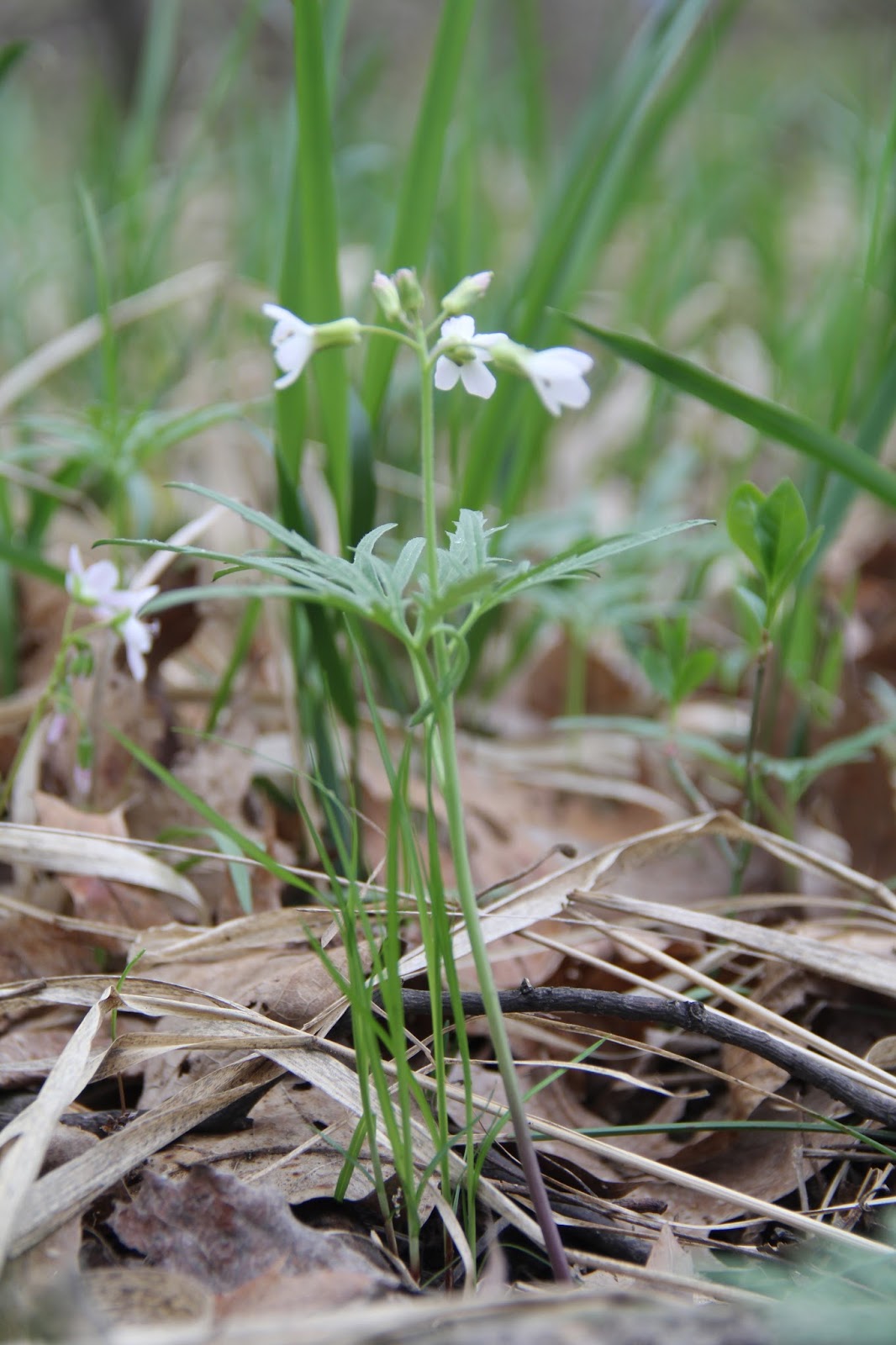
| Cut-leaved Toothwort |
On a completely unrelated note: Baltimore Orioles (Icterus galbula) have returned to the area. We put up our oriole feeders on Thursday and the birds started to visit within hours. On Saturday I got my first ever photo of an oriole at our feeder.
Monday, April 16, 2018
The weather we want and the weather we get
By the middle of April, we want our flower gardens at home to look like this...
In reality, this year it looks like this...
The top set of photos is from 22 April 2017; the bottom set is from today (16 April 2018).
In reality, this year it looks like this...
The top set of photos is from 22 April 2017; the bottom set is from today (16 April 2018).
Subscribe to:
Posts (Atom)