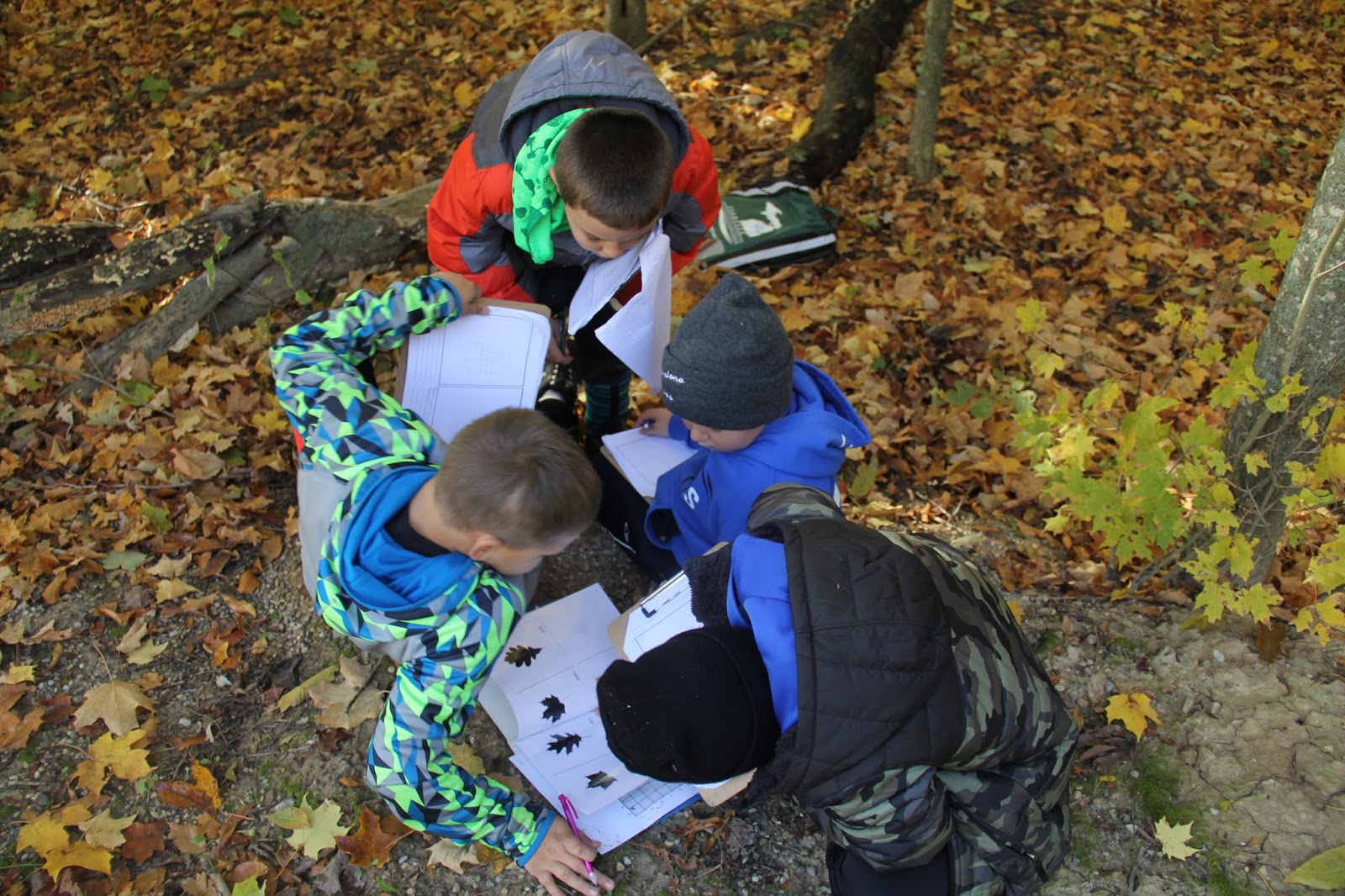
The best part of my job is getting students outdoors. I especially enjoy getting them into the woods to study forestry and forest ecology
Want to make a kid's jaw drop? Tell them that they are going to count how many trees are in a forest. Even better is to tell them that they have to find out how many leaves can be found on the forest floor or that they have to find out how the leaves weigh!
I always manage to get lots of students outdoors in the spring, but this year I made an effort to schedule more field explorations for the fall. Over the past three weeks, I was able to get eleven classrooms from four different schools out into the woods. Two of the classrooms have been out in the woods with me before, but for the other nine classes it was a completely new experience. It's always interesting to see how the students (and their teachers) react to the independence.
Here are a few pictures from three of the schools. (Unfortunately, it looks like I did not take any photos of the two classrooms from the fourth school.) The students in these photos are counting leaves in a square foot plot (or quadrat), collecting leaves to weigh, measuring the forest canopy using a clear grid, and identifying leaves using a guide.
12 October 2018 - Winn Elementary at Audubon Woods
16 October 2018 and 19 October 2018 - Mary McGuire Elementary at Mission Creek Park
25 October 2018 - Beal City Elementary at Beal City School woodlot
Showing posts with label mushrooms. Show all posts
Sunday, October 28, 2018
Tuesday, November 7, 2017
Native Species Profile - Shaggy Mane
Fungus can be very difficult to identify. There are many species; estimates range to more than one million species! Many species can only be differentiated by looking at small obscure features. Identification can be extremely important if you want to forage and eat wild mushrooms. Many edible species have toxic look-alikes. If eating wild mushrooms, a incorrect identification could result in serious illness or even death.
That being said a few species are incredibly easy to identify. One of the fits the category of easy to identify is the Shaggy Mane (Coprinus comatus). This mushroom is one of several species lumped together as "inky caps". These mushrooms have caps that decompose rapidly into an inky black fluid. Also known as the Shaggy Inky Cap is the largest of this group at 3 to 8 inches tall with a cap up to 6 inches across.
Shaggy Mane mushrooms have white caps with shaggy white, brown, or black scales. The edge of the cap is initially attached to the mushroom's stalk. As the the mushroom grows, the edge of the mushroom detaches leaving a white ring around the stalk. Up to this point, the cap is roughly cylindrical, but as it ages it takes on more of a bell shape. When the mushroom reaches full maturity, the edges begin to decay.
Shaggy Manes are saprophytic - meaning that they decompose dead organic matter. This species is commonly found in lawns, along roadsides and other disturbed areas; it often grows on leaf litter, fine woody debris (such as wood chips), and occasionally on animal dung. The species if found across North America and Europe and has been introduced in other locations around the world.
The Shaggy Mane is considered a "choice edible". However, it is best collected and consumed before the cap turns inky. In Mid-Michigan the Shaggy Mane has not toxic look-alikes so identification is relatively easy. However, when consuming any foraged food (especially mushrooms), I recommend confirming identification with multiple sources before consuming. Mistakes are simply not worth the risk.
Basic Information
Shaggy Mane
Coprinus comatus
Size: 3 - 8" tall; 2 - 6" across
Habitat: lawns, roadsides, disturbed areas, compacted ground; decomposes organic matter including woody debris, leaf litter, and animal dung
Color: white with white to brownish (or blackish) scales; decomposes to form an inky black liquid
Bloom
Time: late summer to fall
That being said a few species are incredibly easy to identify. One of the fits the category of easy to identify is the Shaggy Mane (Coprinus comatus). This mushroom is one of several species lumped together as "inky caps". These mushrooms have caps that decompose rapidly into an inky black fluid. Also known as the Shaggy Inky Cap is the largest of this group at 3 to 8 inches tall with a cap up to 6 inches across.
| Shaggy Mane - note how edge of cap has yet to separate from the stalk |
Shaggy Mane mushrooms have white caps with shaggy white, brown, or black scales. The edge of the cap is initially attached to the mushroom's stalk. As the the mushroom grows, the edge of the mushroom detaches leaving a white ring around the stalk. Up to this point, the cap is roughly cylindrical, but as it ages it takes on more of a bell shape. When the mushroom reaches full maturity, the edges begin to decay.
| Shaggy Mane - note bell-shaped cap with inky black edge |
| Shaggy Mane - note "inky" decayed cap |
Shaggy Manes are saprophytic - meaning that they decompose dead organic matter. This species is commonly found in lawns, along roadsides and other disturbed areas; it often grows on leaf litter, fine woody debris (such as wood chips), and occasionally on animal dung. The species if found across North America and Europe and has been introduced in other locations around the world.
| A Shaggy Mane mushroom emerges from leaf litter at the edge of a woods. |
The Shaggy Mane is considered a "choice edible". However, it is best collected and consumed before the cap turns inky. In Mid-Michigan the Shaggy Mane has not toxic look-alikes so identification is relatively easy. However, when consuming any foraged food (especially mushrooms), I recommend confirming identification with multiple sources before consuming. Mistakes are simply not worth the risk.
Basic Information
Shaggy Mane
Coprinus comatus
Monday, October 30, 2017
Visiting four CWC preserves in one day (Part One)
The Chippewa Watershed Conservancy currently own twenty-two preserves scattered across four counties. Yesterday (29 October 2017) I visited the four "flagships" of the CWC's preserve system - Sylvan Solace Preserve, Bundy Hill Preserve, Hall's Lake Natural Area, and Audubon Woods Preserve. The close nature of three out of these four preserves made it easy to link my visits together. My goal was simply to visit each of the four preserves, walk on and off trail, and photograph whatever grabbed my attention. Because I took so many photos I am going to split this into two posts. This post will deal with my visits to Sylvan Solace Preserve and Bundy Hill Preserve.
Sylvan Solace Preserve
Sylvan Solace Preserve was my first stop. This preserve is located on Pickard Road, between Gilmore and Littlefield Roads, approximately 7 1/2 miles west of Mt. Pleasant. I arrived at Sylvan Solace just a few minutes after 9:00AM and spent about approximately 1.5 hours on site.
Here are a few of the many photos that I took during that time.
Along the east trail at Sylvan Solace, I noticed several scrapes made by White-tailed Deer. Scrapes are one of the ways White-tailed bucks leave scent to mark their territory. Located above the scrape is typically a low-hanging branch that the buck will lick and rub with the scent glands located on his head. The buck scrapes the ground with its hooves to draw attention to the scent marker and typically urinates on the scrape to add even more scent. Both bucks and does will check out scrapes. Although bucks create scrapes year-round, this behavior intensifies in the weeks before mating season. I found several fresh scrapes at Sylvan Solace and would go on to find scrapes at each of the other three preserves I visited.
The pictures of my second preserve visit can be seen below.
Sylvan Solace Preserve
Sylvan Solace Preserve was my first stop. This preserve is located on Pickard Road, between Gilmore and Littlefield Roads, approximately 7 1/2 miles west of Mt. Pleasant. I arrived at Sylvan Solace just a few minutes after 9:00AM and spent about approximately 1.5 hours on site.
Here are a few of the many photos that I took during that time.
| A deer trail through a grove of Black Locust trees. |
| A dead pine slowly succumbs to rot, insects, and woodpeckers. |
| Ferns change into their subtle shades of red, orange, and brown. |
| Small metal arrows mark the location and direction of trails throughout the preserve |
| Looking up at the overcast sky through Bigtooth Aspen trees. |
| Bigtooth Aspen leaves turn yellow then brown as they dry out. |
Along the east trail at Sylvan Solace, I noticed several scrapes made by White-tailed Deer. Scrapes are one of the ways White-tailed bucks leave scent to mark their territory. Located above the scrape is typically a low-hanging branch that the buck will lick and rub with the scent glands located on his head. The buck scrapes the ground with its hooves to draw attention to the scent marker and typically urinates on the scrape to add even more scent. Both bucks and does will check out scrapes. Although bucks create scrapes year-round, this behavior intensifies in the weeks before mating season. I found several fresh scrapes at Sylvan Solace and would go on to find scrapes at each of the other three preserves I visited.
| A fresh deer scrape is used to leave a scent "calling card" to announce a buck's presence in the area. |
| A mushroom pokes up from the leaf litter. |
| Looking upstream at Sylvan Solace Preserve. |
| Spreading oak trees grew up in the open before being surrounded by forest. |
| American Beech trees will be among the last to lose their leaves - often holding them through mid-winter. |
| Nest boxes provide artificial cavities used by many bird species. |
| A fern, grasses, and Bigtooth Aspen leaves create a colorful mosaic. |
| Rain and dewdrops bead up on the waxy coating of freshly-fallen Aspen leaves. |
The pictures of my second preserve visit can be seen below.
Monday, January 23, 2017
Searching for color in the winter woods
Yesterday morning I drove into Mt. Pleasant to spend a little bit of time wandering through the swamps at Mission Creek Woodland Park. While I enjoy swamps any time of year, winter is the easiest time to travel through them in mid-Michigan. Much of the surface water in the swamp is frozen this time of year and if you tread carefully you can walk across places where you would normally be in mud up to your knees. I will admit to a few ill-advised steps that broke through thin ice and a few more that were made in areas with no ice present. Mud... it happens.
Any time spent outdoors is good time.
Most of the time a walk through the woods in winter is about seeing the small details.
Color can be hard to find. Sometimes it is subtle...
Sometimes it is jarring when seen against all the drabs colors of the snow and sky.
Did you notice spider webs on the moss in the picture above? There were hundred of webs strewn everywhere throughout the swamp. A closer look revealed the architects...
The brightest color to be found throughout the swamp was the green of sedge tussocks. Some of the tussocks were surrounded by open water (and last year's leaves); other tussocks were surrounded by ice and snow.
The recent spate of warm weather has caused much of the snow and ice to melt away. The trees both slow it down by blocking some of the rays of the sun, and speed it up by warming at the base because of the sun.
Some meltwater is pooling in low areas, filling what will become seasonal ponds later in the year. Other water is flowing away to lower areas. As the water flows it cuts down through the ice.
Eventually, much of the water will flow either over the ground or through the soil to Mission Creek and from there to the Chippewa River.
Some of the my favorite finds of the day were the smallest. Many of the trees in the swamp are covered with various types of lichens. Some are easy to see from the ground. Others are found higher in the trees. When a tree falls, it brings those lichens down to a level where they are easy to see.
My favorite image of the day though was taken as I left the park. Both sides of Crawford Road (also known as Harris St.) are lined with woods that arch over the roadway. Even on sunny days this section of road is dark. Yesterday, the warm temperatures and melting snows caused dense fog throughout the area. It creates a really cool moody feeling to any woodland scene.
Any time spent outdoors is good time.
Most of the time a walk through the woods in winter is about seeing the small details.
| Leaves and stems melting through ice left by a recent storm |
| Fog droplets on a young American Beech tree |
Color can be hard to find. Sometimes it is subtle...
| Turkey Tail fungus on a stump |
Sometimes it is jarring when seen against all the drabs colors of the snow and sky.
| Moss on a fallen log |
Did you notice spider webs on the moss in the picture above? There were hundred of webs strewn everywhere throughout the swamp. A closer look revealed the architects...
The brightest color to be found throughout the swamp was the green of sedge tussocks. Some of the tussocks were surrounded by open water (and last year's leaves); other tussocks were surrounded by ice and snow.
| Sedge tussock and Red Oak leaves |
| Sedge tussocks surrounded by ice |
The recent spate of warm weather has caused much of the snow and ice to melt away. The trees both slow it down by blocking some of the rays of the sun, and speed it up by warming at the base because of the sun.
| Snow melts quickly at the base of trees |
Some meltwater is pooling in low areas, filling what will become seasonal ponds later in the year. Other water is flowing away to lower areas. As the water flows it cuts down through the ice.
| Water flowing over the ice |
| A channel curves around tussocks and through the ice |
Eventually, much of the water will flow either over the ground or through the soil to Mission Creek and from there to the Chippewa River.
| Mission Creek |
| Someday this curve of the creek will cut completely through that bank and create an oxbow |
Some of the my favorite finds of the day were the smallest. Many of the trees in the swamp are covered with various types of lichens. Some are easy to see from the ground. Others are found higher in the trees. When a tree falls, it brings those lichens down to a level where they are easy to see.
My favorite image of the day though was taken as I left the park. Both sides of Crawford Road (also known as Harris St.) are lined with woods that arch over the roadway. Even on sunny days this section of road is dark. Yesterday, the warm temperatures and melting snows caused dense fog throughout the area. It creates a really cool moody feeling to any woodland scene.
| Crawford Road (Harris Street) near Mission Creek Park |
Subscribe to:
Posts (Atom)