Wednesday, October 2, 2013

Native Species Profile - Pitcher's Thistle

Coastal Dune - Lake Huron


Coastal dunes are among the most threatened habitats in the Great Lakes. They can exist only in certain places along the shorelines of the lakes and many are under constant threat of development. Despite their close proximity to water, the dunes themselves are arid habitats.  For plants to survive in this habitat they have to be tough.  Some of the plants found here are endemic to this habitat - this mean they are found nowhere else on earth.  One of the endemic plants of the western Great Lakes is the Pitcher's Thistle (Cirsium pitcheri).

Coastal Dune community with Pitcher's Thistle front and center

Pitcher's Thistle, also known as Sand Dune Thistle, can only be found on the shorelines of Lakes Huron, Michigan, and Superior.  The species is listed as Threatened by the US government and Endangered by the government of Canada.  While Pitcher's Thistle can be found in Wisconsin, Indiana, and Ontario (The species is extinct in Illinois), the bulk of Pitcher's Thistle populations can be found in Michigan.  Populations exist all along Michigan's Lake Michigan shoreline north to the Straits of Mackinaw, south along the Lake Huron shoreline to Saginaw Bay, and in the Upper Peninsula along the north shore of Lake Michigan.  A small population is also found in the Grand Sable Dunes along Lake Superior.

Pitcher's Thistle growing on the Lake Huron Shoreline at P. H. Hoeft State Park near Rogers City, MI

Pitcher's Thistle is a has silver-gray foliage and may grow to reach heights of over 3 feet, but is often much shorter.  The leaves are deeply lobed and almost skeletal in appearance.  For a thistle, the plant has very few spines. 

Pitcher's Thistle - note the white flowers and silver-grey foliage

Pitcher's Thistle is a short-lived perennial,  growing steadily for two to eight years until it stores enough energy in its deep taproot to flower.  After producing one or more white blooms the plant dies.  The plant flowers between May and September.  Like other thistle species, the seeds of Pitcher's Thistle are distributed by the wind. 

Pitcher's Thistle is an early successional species.  It is able to become established on bare sand, but is crowded out by other plants.   It does best on shorelines and dunes that are frequently disturbed by natural processes of wind and water erosion.

Pitcher's Thistle blooms


Basic Information


Pitcher’s Thistle 
Cirsium pitcheri

Height:  up to 3’ tall

Habitat:  dunes, shorelines of Lakes Michigan, Superior, and Huron

Flower Color:  white

Bloom Time:  May – September

Monday, September 30, 2013

Field Trip - Mission Point lighthouse


Located at the end of M-37 on the Old Mission Peninsula north of Traverse City, Mission Point Lighthouse is approximately 2 1/2 hours from Mid-Michigan.  Mission Point Lighthouse was commissioned in 1870 and remained active until 1933.  The lighthouse is a one and a half story wood frame structure with a 35 foot light tower.  The light tower rises approximately 48 feet above lake level. 


The lighthouse is sited on a 5 acre township park and is surrounded by over 130 acres of state land land.  The park is open daily until 11:00PM.  The lighthouse is open to the public between April and December. 


Sunday, September 29, 2013

Early Fall at Mission Creek Woodland Park

I try not to talk about anything but nature or science on this blog, but sometimes politics intrudes.

If you have spent any time looking at this blog, you have probably noticed that I posted a number of times about things that I have found at Mission Creek Woodland Park.  (Type "Mission Creek" in the search box to the right to find the other posts.)  Mission Creek Park is a 60 acre park locates at 1458 N. Harris Street on the northwest side of Mount Pleasant.  Mission Creek is my favorite local park and is the least used of Mt. Pleasant's larger parks -except in winter when the sledding hill sees a excessive amount of use.

For  better or worse this might soon change.  The Mt. Pleasant City Commission will be meeting tonight -  on their agenda is a proposal to add a fenced in dog park at Mission Creek Park.  There is a small vocal minority demanding a dog park be established in Mt Pleasant and they are quite adamant that it be established at Mission Creek Park.

The reason why Mission Creek Woodland Park is special is that it is rather secluded and unused compared to the other parks in town.  It has the feel of a rural park instead of the suburban park that it is.  It is a quiet natural area that is removed from the bustle of the city.  The addition of a dog park (and all that comes with it) will change the nature of Mission Creek Woodland Park.

But, enough ranting.

I took a trip out to Mission Creek last week to see what could be found on an early Fall Day.

Wednesday, September 25, 2013

Eat Seasonal. Eat Local.

Certain foods are best eaten fresh.  The best way to eat food that tastes the best (and is most nutritious) is to eat foods that are local and in season.  In Mid-Michigan, this means that tomatoes are best in late summer and early fall when they are ripe locally.  Strawberries are best when they are fresh picked in June.

Right now is apple season.  An apple can be stored for 16 months (but that doesn't mean they should be).  A stored apple loses its flavor, dries out, and becomes "mealy".  Fresh, local apples can be found in Mid-Michigan from late-July through late-October.  They are fresh, juicy, crisp, and perfect.

Go to the store and get some apples.

Better yet.  Go to the farmers market.

Even better, visit the orchard and pick some up.

Best of all, pick your own.  It's too late to plant apple trees now, but if you plant them in the Spring you can be enjoying your own apples within two year.

Try a variety that you are not familiar with.  There are so many apple varieties beyond Red Delicious, Macintosh, and Honey Crisp.  I like Braeburn, Matsu, Pink Lady, and Ginger Gold.

My favorite apples are from trees that I find growing along roadsides or in the woods.  Trees that were self-seeded or planted in orchards long ago and then abandoned.  The best apples that I have ever eaten were from an abandoned farm near Sleeping Bear Dunes.  My second favorite apples grow on a tree in a local park.  I don't have any idea what kind they are, but they are crisp, sweet and tart, and juicy.

Apples on a tree in an abandoned orchard in Sleeping Bear Dunes - my favorite apples of all time

Sunrise Photos - 25 September 2013

Just some pictures from this morning's sunrise.  We stopped twice on our way in to work to take them. 

Sunrise - Isabella County, MI (25 SEP 2013)

Sunrise - Isabella County, MI (25 SEP 2013)

Sunrise - Isabella County, MI (25 SEP 2013).  Photo by Shara LeValley.

Sunrise - Isabella County, MI (25 SEP 2013).  Photo by Shara LeValley.

Tuesday, September 24, 2013

What Do I Eat? - Herbivores

The word "herbivore" means plant-eater.  It derives from the Latin words herba (plant or grass) and vorarae (devour).

The teeth of herbivorous mammals have evolved to eat a diet that is mainly composed of plants.  Often herbivores have upper and lower incisors are quite sharp and shaped like chisels.  In some mammals like rodents and rabbits these incisors meet or nearly meet and allow them to bite cleanly through plant stems. 

Muskrat (Ondotra zibethicus) skull showing the large incisors

The incisors of these animals grow throughout their lives and are worn down through constant chewing.  Only the front surface of their incisors is covered with hard enamel - causing the back of their teeth to wear faster and giving their incisors that chisel-shaped profile.

North American Beaver (Castor canadensis) skull showing chisel-shaped profile of incisors

This sharp tooth profile allows them to cut easily through non-woody plants and even woody stems.

Branch showing marks from beaver teeth

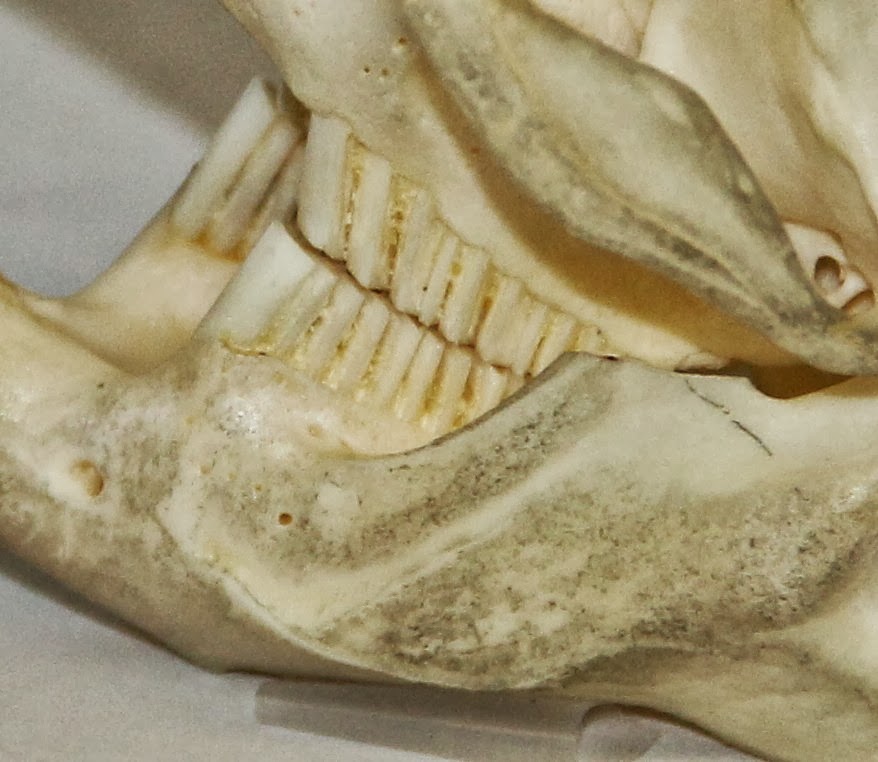
The molars of herbivorous mammals are generally flat with a chewing surface that is covered with several ridges.  These ridges allow the teeth to be used to grind leaves, stems, bark, etc. so that they may be more easily digested.  In some animals (such as rodents) the surface of the molars is quite flat and the ridges are small.

Beaver molars
 
Muskrat molars

Other herbivores such as White-tailed Deer (Odocoileus virginianus) have molars that while generally flat have much larger ridges.


White-tailed Deer (Odocoileus virginianus) molars

There is something interesting about the teeth of White-tailed Deer.  White-tailed Deer (and all other deer) do not have top incisors.  This means that they are unable to bite directly through plants like those species that have opposing incisors.


White-tailed Deer (Odocoileus virginianus) skull - note the lack of upper incisors

Instead their bottom incisors come in contact with a rough pad on their upper jaw, enabling them to tightly grab onto plants which they then tear or twist off.  Branches that are browsed by White-tailed Deer are often cut on one side (by the lower incisors) and roughly torn on the other rather than being neatly cut like plants chewed by rodents.

White-tailed Deer (Odocoileus virginianus) skull - Lower incisors meet up with a rough pad on the upper jaw.

Monday, September 23, 2013

Fall

Happy Fall!


Yesterday at 4:44 PM EST, Summer ended and Fall officially began.  The first day of Fall is also known as the Autumnal (Fall) Equinox.  The word Equinox means "equal night" and comes from the Latin words aequus (equal) and nox (night).  On this date the sun is striking directly on the equator, resulting in approximately equal amounts of daylight and darkness around the globe.