Showing posts with label shorelines. Show all posts

Monday, August 13, 2018

The Days of Summer - Day Forty-five through Day Fifty-one

This is part seven of my Days of Summer photography project.   Beginning with the Summer Solstice (21 June 2018) and ending with the Fall Equinox (22 September 2018), I am making it a point to get outdoors and photograph something every single day.  One photograph from each day is being selected for this project and shared here.

The previous installments of this project can be found at the links below:

Part Six
Part Five
Part Four
Part Three
Part Two
Part One

I hope you enjoy the photos from this past week - one of them might be quite a surprise.

Day 45 (04 August 2018) - A Banded Bird


The first image of the week was taken at Forest Hill Nature Area.  If you look closely at This female Common Yellowthroat (Geothlypis trichas) you might notice that her left leg sports a band.  Between this picture and several others of this bird I was able to make out a couple numbers on the band.  With that information, I contacted Mike Bishop at Alma College - he is running a banding project at Forest Hill.  With the numbers I gave him, Mike was able to narrow it down to one of two birds that he banded on June 28th of this year.  We both thought this was pretty cool.

This photograph has been cropped into a landscape format - taking some off the top and bottom of the image.  I just thought it was the most appealing of all the different crops that I tried.  I like how the bird looks like she is about the launch herself at the goldenrod to the left of the image.

Monday, November 28, 2016

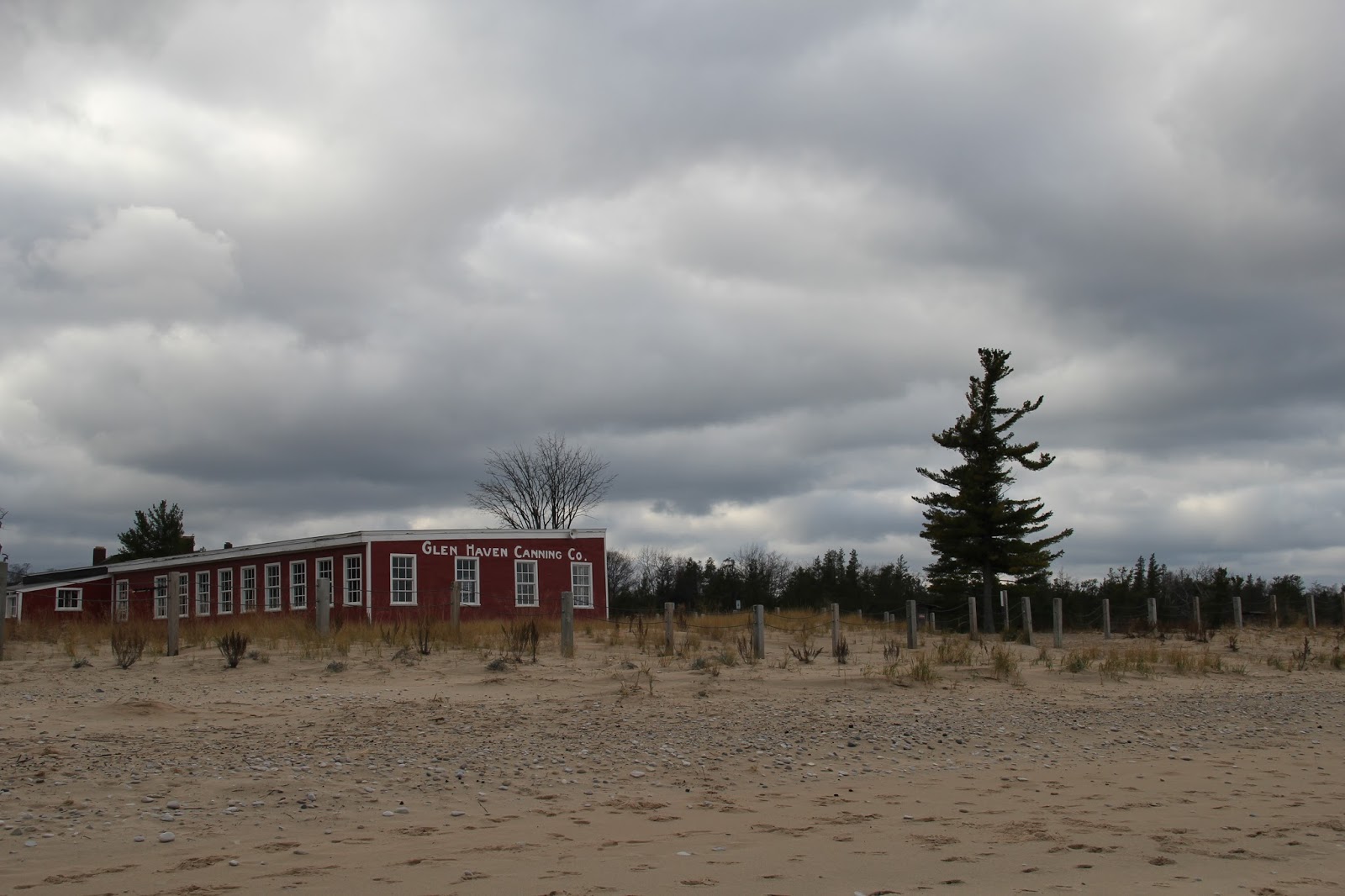
Clouds over Lake Michigan (26 November 2016)

Stormy skies and waves are among my favorite subjects to photograph - It's almost impossible to take a bad picture.  We spent this past weekend visiting northwest Michigan and I got plenty of photographic opportunities on Saturday (26 November).

The first set of photos was taken at the Empire municipal beach.  Despite years of visiting this part of the state.  This was the first time that we have ever stopped at this beach.


After leaving Empire, we next made a stop at Glen Haven.  Glen Haven is a restored fishing village located within Sleeping Bear Dunes National Lakeshore.


Our final shoreline stop of the day was the Mission Point Lighthouse located at the tip of the Old Mission Peninsula that divides the East Arm and West Arm of Grand Traverse Bay.  This is one of my favorite places to photograph.


Monday, September 26, 2016

Field Trip - Pyramid Point Hiking Trail

Shara and I spent the weekend camping near Traverse City.  On Saturday (24 SEP), we went to Sleeping Bear Dunes National Lakeshore and hiked a section of the Pyramid Point Trail.  This popular trail segment leads to a bluff that rises 300 feet above Lake Michigan.  The trail to this overlook measures about 0.6 miles one way (for a 1.2 mile round trip).  The total elevation change of this trail is more than 200 feet, with about 140 feet of that coming in the final 0.2 miles of the climb.  If you are not used to climbing hills it can be a challenge, but the view is entirely worth the effort.

The trail leads upward

The trail passes though a mixed hardwood forest - including stands of birch

Shara stops to photograph something along the trail

Pay attention to the sign!

Tired, but proud, the view is totally worth it

Me with North Manitou Island in the background

The South Manitou Island lighthouse can be seen on the horizon at the left

The lake is 300 feet down from the top of the bluff!

Looking east along the bluff

A wider angle view of the horizon to the northwest

North Manitou Island - you see the dunes on the island's southwest side


Another view of the eastern horizon

Heading back down the trail

The Pyramid Point Trail is just one of thirteen named trails within Sleeping Bear Dunes National Lakeshore - not counting the trails on the Manitou Islands.  Sleeping Bear Dunes is located about 2 hours 15 minutes from Mid-Michigan.  There is a fee for using the park. Currently, a 7-day vehicle pass costs $15 or an annual pass can be purchased for $30.  There is also a pass for people entering the park on foot or by bicycle ($7 for 7 days).  Check the calendar, there are several fee-free days throughout the year - the next one is scheduled for Veterans Day (November 11th).

Wednesday, October 2, 2013

Native Species Profile - Pitcher's Thistle

Coastal Dune - Lake Huron


Coastal dunes are among the most threatened habitats in the Great Lakes. They can exist only in certain places along the shorelines of the lakes and many are under constant threat of development. Despite their close proximity to water, the dunes themselves are arid habitats.  For plants to survive in this habitat they have to be tough.  Some of the plants found here are endemic to this habitat - this mean they are found nowhere else on earth.  One of the endemic plants of the western Great Lakes is the Pitcher's Thistle (Cirsium pitcheri).

Coastal Dune community with Pitcher's Thistle front and center

Pitcher's Thistle, also known as Sand Dune Thistle, can only be found on the shorelines of Lakes Huron, Michigan, and Superior.  The species is listed as Threatened by the US government and Endangered by the government of Canada.  While Pitcher's Thistle can be found in Wisconsin, Indiana, and Ontario (The species is extinct in Illinois), the bulk of Pitcher's Thistle populations can be found in Michigan.  Populations exist all along Michigan's Lake Michigan shoreline north to the Straits of Mackinaw, south along the Lake Huron shoreline to Saginaw Bay, and in the Upper Peninsula along the north shore of Lake Michigan.  A small population is also found in the Grand Sable Dunes along Lake Superior.

Pitcher's Thistle growing on the Lake Huron Shoreline at P. H. Hoeft State Park near Rogers City, MI

Pitcher's Thistle is a has silver-gray foliage and may grow to reach heights of over 3 feet, but is often much shorter.  The leaves are deeply lobed and almost skeletal in appearance.  For a thistle, the plant has very few spines. 

Pitcher's Thistle - note the white flowers and silver-grey foliage

Pitcher's Thistle is a short-lived perennial,  growing steadily for two to eight years until it stores enough energy in its deep taproot to flower.  After producing one or more white blooms the plant dies.  The plant flowers between May and September.  Like other thistle species, the seeds of Pitcher's Thistle are distributed by the wind. 

Pitcher's Thistle is an early successional species.  It is able to become established on bare sand, but is crowded out by other plants.   It does best on shorelines and dunes that are frequently disturbed by natural processes of wind and water erosion.

Pitcher's Thistle blooms


Basic Information


Pitcher’s Thistle 
Cirsium pitcheri

Height:  up to 3’ tall

Habitat:  dunes, shorelines of Lakes Michigan, Superior, and Huron

Flower Color:  white

Bloom Time:  May – September