Showing posts with label Michigan. Show all posts

Wednesday, October 17, 2018

Get your Earth Science Week Geek On!

Happy Earth Science Week 2018!

Earth Science Week is an annual week-long celebration of everything earth science.  This celebration is sponsored the American Geosciences Institute.

When you think of exciting earth science locations, Michigan doesn't immediately spring to mind.  That doesn't mean that there isn't a lot to see.

Here are five of my favorite locations in Michigan.

Sleeping Bear Dunes National Lakeshore


Located in the northwest part of the Lower Peninsula, Sleeping Bear Dunes National Lakeshore is probably the best place to see sand dunes anywhere along the Great Lakes shorelines.  These dunes have built up since the end of the last glacial maximum (ice age) and now soar hundreds of feet above the surface of Lake Michigan.  The dunes are not the only attraction - Sleeping Bear dunes also has dozens of miles of hiking trails, some of the best spring wildflowers in the state, and two islands to explore (North and South Manitou).

Pictured Rocks National Lakeshore


If Sleeping Bear Dunes is all about sand, Pictured Rocks National Lakeshore is all about sandstone.  The geologic formation of Pictured Rocks dates back more than 500 million years.  While you can enjoy the Pictured Rocks from land, they are best seen from the water.  Located along the shoreline of Lake Superior near Munising, MI Pictured Rocks National Lakeshore is too far away from Mid-Michigan for a day trip, but can easily be visited during a long weekend.  Not only are there giant sandstone cliffs, but the Lakeshore is home to several spectacular waterfalls and the largest dunes on Lake Superior (Grand Sable Dunes).

Lake of the Clouds, Porcupine Mountains Wilderness State Park


Porcupine Mountains State Park is located near the west end of the Upper Peninsula along the shore of Lake Superior.  The valley that holds Lake of the Clouds was carved out by glaciers from rock dating as much as 1.1 billion years old.  This rock can best be seen from the Lake of the Clouds overlook on the Carp River Escarpment.


As a bonus, this area is home to several fault lines - places where plates of the earth's crust contact each other.  One of these faults can be seen at nearby Bonanza Falls, where the Big Iron river crosses over a tilted layer of Nonesuch Shale.  Bonanza falls is located just east of the park boundary near Silver City, MI.

If you visit the Porcupine Mountains take the time to drive up the nearby Keweenaw Peninsula to visit the A.E. Seaman Mineral Museum at Michigan Technological University.  It's a geology nerd destination in its own right.

Muskallonge Lake State Park


To me Muskallonge Lake State Park is the best place in Michigan to pick up rocks.  The park is located in the eastern Upper Peninsula, tucked between the shore or Lake Superior and inland Muskallonge Lake.  The shoreline of Lake Superior is a rock beach - with new rocks being constantly driven up by waves from the lake this is a rockhunters dream.  I find it impossible to leave with out pockets full of rocks.  Everyone is looking for agates, but some of the igneous rocks are just as beautiful!

As a bonus, Muskallonge Lake has some of the best stargazing I have ever experienced.  We lay on a picnic table watching the stars at 2:00AM for nearly an hour during our last visit to the park.

Bundy Hill Preserve


I hate to say it, but Mid-Michigan is not the best location for geology nerds.  Our rock formations are buried under hundreds of feet of glacial till.  If you can't beat the glacial deposits, you might as well enjoy them!  Bundy Hill is the highest point in Isabella County.  At 500 feet higher than the nearby town of Mt. Pleasant, Bundy Hill is a moraine, formed where two glacial lobes came together, piling sand and rock between them.  Owned by the Chippewa Watershed Conservancy, Bundy Hill is accessible to the public and has two miles of brand new hiking trails.  If you go, make sure to take a picture of the summit marker and search for the large boulders (glacial erratics) that dot the site.  One of these boulders, located near the summit is nearly 40 feet around!

Monday, October 8, 2018

Michigan Species to Know - Tree Swallow (Tachycineta bicolor)

Here's the next Michigan species card - the Tree Swallow (Tachycineta bicolor).  I've written extensively about this species in the past, including this species profile from 2013.  Tomorrow I will post a card for the Downy Woodpecker and then I'll share a way that i use these in the classroom.


Tuesday, October 2, 2018

Michigan Species to Know - Silky Dogwood (Cornus amomum)


The next Michigan species card is here.  This time it's for the Silky Dogwood (Cornus amomum).  This species is pretty easy to identify when fruit is present, but it can be a challenge early in the year before flowers and fruit are present.  In May 2013 I wrote a post about how to tell the difference between Silky Dogwood and the similar Red-Osier Dogwood (Cornus sericea).

Monday, October 1, 2018

Michigan Species to Know - Black-capped Chickadee (Poecile atricapillus)


Here is another Michigan species card - the Black-capped Chickadee (Poecile atricapillus).  

One of the first posts that I ever wrote for this blog was about the winter survival strategies of Black-capped Chickadees. You can read it here.

Over the next few days I plan to share cards for the Downy Woodpecker, Tree Swallow, and Silky Dogwood.  Then I'll give an example of how I use these cards in the classroom.

Monday, August 13, 2018

The Days of Summer - Day Forty-five through Day Fifty-one

This is part seven of my Days of Summer photography project.   Beginning with the Summer Solstice (21 June 2018) and ending with the Fall Equinox (22 September 2018), I am making it a point to get outdoors and photograph something every single day.  One photograph from each day is being selected for this project and shared here.

The previous installments of this project can be found at the links below:

Part Six
Part Five
Part Four
Part Three
Part Two
Part One

I hope you enjoy the photos from this past week - one of them might be quite a surprise.

Day 45 (04 August 2018) - A Banded Bird


The first image of the week was taken at Forest Hill Nature Area.  If you look closely at This female Common Yellowthroat (Geothlypis trichas) you might notice that her left leg sports a band.  Between this picture and several others of this bird I was able to make out a couple numbers on the band.  With that information, I contacted Mike Bishop at Alma College - he is running a banding project at Forest Hill.  With the numbers I gave him, Mike was able to narrow it down to one of two birds that he banded on June 28th of this year.  We both thought this was pretty cool.

This photograph has been cropped into a landscape format - taking some off the top and bottom of the image.  I just thought it was the most appealing of all the different crops that I tried.  I like how the bird looks like she is about the launch herself at the goldenrod to the left of the image.

Thursday, February 23, 2017

Logging Images

During the winter, in addition to the science programs that I present at schools, I also spend a couple of months presenting two different programs on Michigan history.  One of these programs focuses on Michigan's logging history.

Logging was one of the first major industries in Michigan and products from Michigan's forests were used to build much of the nation's cities during the period after the American Civil War. For nearly half a century Michigan could lay claim to the title of the logging capital of the world.  While other a few other states may dispute this claim, it is hard to argue with a place where one river system alone produced over 22 Billion board feet of lumber during its run!
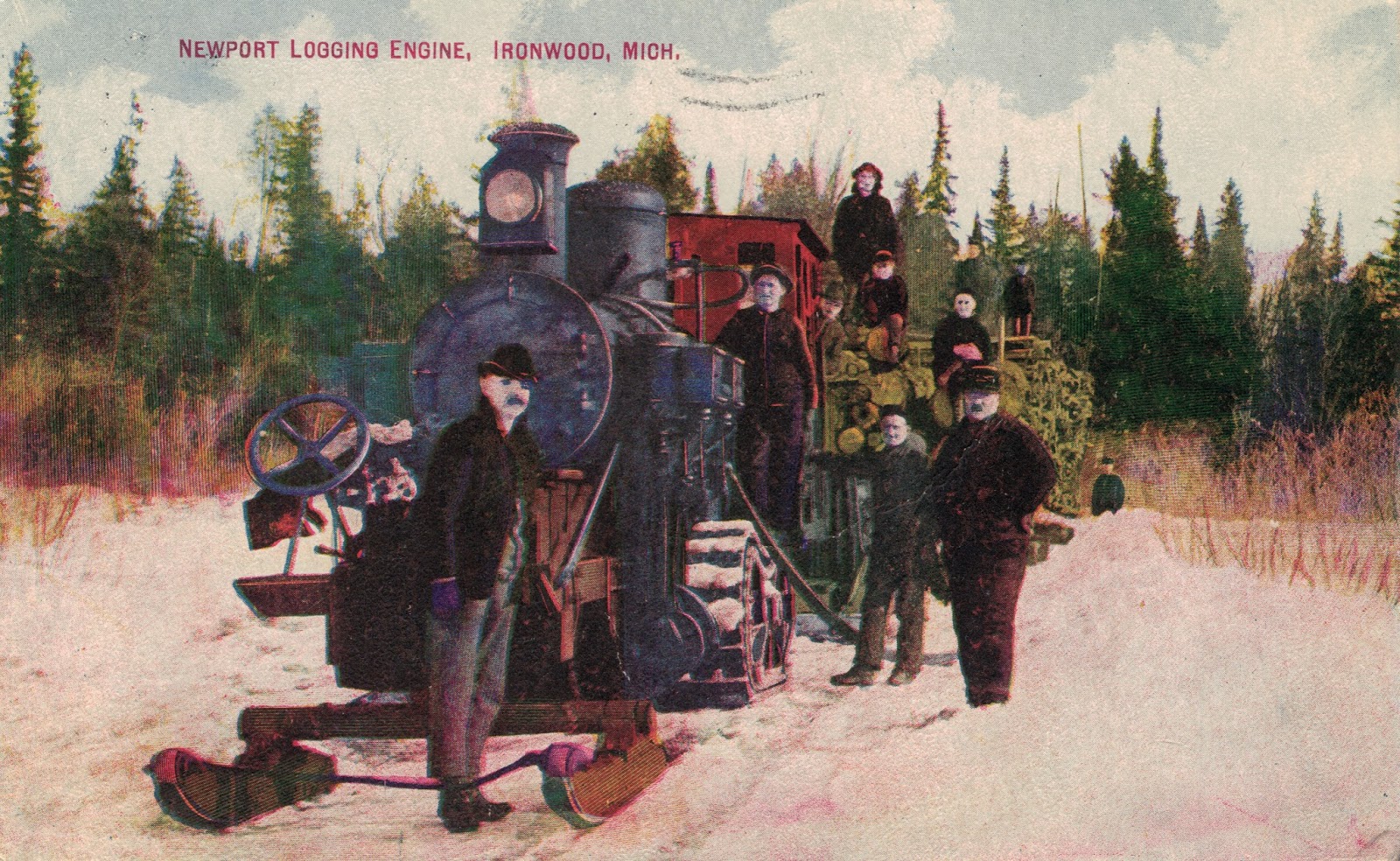
Recently I purchased a new lot of logging postcards.  Most of these are from Michigan, but unfortunately some of the photo locations are not documented on the images.


These postcards show vignettes of logging life. Most images are posed, with little action portrayed in the photograph.  One of my favorite images shows a crew of four with a team of horses (used to skid or drag the logs through the woods).  Two of the men lean on cant hooks used for rolling logs.  A third man leans on a double-bit axe.  I especially like the fact that two of the men in the picture have cut off the bottom of their overalls so they don't get soaked with snow.

A crew of men ready and equipped to move logs through the snowy woods. (Unknown location)
This next picture is a later image - it dates to probably the 1950s.  What I like about this picture is that it shows how teams of oxen (or horses) would be used to skid the logs.  A close look at the picture reveals the skidding tongs clamped onto each log.  The two sharp points of the tongs would bite into the log so it could be pulled through the snow.  Oxen were sometimes used in the camps because of their brute strength, but horse were both faster and required less feed so most camps preferred to use horses.

Oxen skidding logs (Newaygo County, MI)

I think this next picture is another later image.  The cleared land and fences give the impression that this photo was not taken during the early days of logging in Michigan.  I like that this image shows how multiple teams of horses would be connected in tandem to pull a load uphill.  When going downhill, a chain was often connected to the back of the sleigh and wrapped around a tree at the top of the hill where a team of horses would be used to help slow the sleigh down.

Three teams pulling a sleigh uphill (Oceana County, MI)

I have several pictures in my collection showing crews loading logging sleighs.  The men who stacked the logs on the sleighs were known as top loaders.  This was one of the most difficult and dangerous jobs in a lumber camp.  A good top loader would receive higher pay than many other members of a crew.


One common feature of many logging postcards is lumber camps showing off by loading the biggest sleigh-load of logs imaginable.  Sleighs loaded were not loaded like this on a daily basis.  Loads of this size are highly impractical.  They take too long to load and are really too large of a burden for the horses.
Loads like this were used to show off - they were not practical. (Wexford County, MI)

Despite the label on the postcard, this is not a "typical lumber scene".  While many lumbering images show full logs that would eventually be cut into boards, another side of logging was the cutting of railroad ties and fence posts.  Men who cut posts and ties were often paid by the piece rather than being paid by the day as they were in camps that cut large logs.

A forgotten part of logging was the cutting of ties and posts (Alpena County, MI)

I think this is another later image (sometime in the 20th Century).  It would have been highly unusual to use a sleigh to haul a single log.

Hauling a single log on a sleigh (Location unknown)

The next photograph shows a crew of "river hogs".  Also known as "river pigs", these men would float down the river during the spring log drives.  Corked boots (boots with spikes on the soles) allowed the to keep their footing as they walked on the floating logs.  They used pike poles (the long-handled tools) and peaveys (the short-handled tools) to keep the logs moving downstream.

River hogs use pike poles and peaveys to control the movement of logs on a river drive (Antrim County, MI)

By the 1880s, railroads became an important part of logging operations.  Trains allowed lumber crews to work far away from rivers.  The first image shows a train loaded with logs.  At the back of the train is a steam jammer.  This steam-powered winch and boom, pivoted on a central axis and allowed crews to lift logs to load them on the train cars.

Logging trains allowed companies to efficiently log far from rivers (Location unknown)

In this image, train cars are being loaded by the simpler method of cross-hauling.  In this process chain attached to a team of horses (or a powered winch) is used to drag logs up a ramp onto the train where they would be chained in place.  If you click on the image, both the chain and team of horses can be seen in the photo.

Crosshauling logs onto a Grand Trunk rail car at the Coopersville Depot (Ottawa County, MI)

After World War One, gasoline powered equipment such as this Holt tractor became available for logging.  These strong engines could pull long trains consisting of ten or more loaded sleighs across the snow.  In this picture, a second tractor with an additional train of sleighs can be seen at the left rear.

Gasoline tractors greatly reduced the need for horses in logging (Location unknown)

The piles of logs waiting for sawing at mills are a common feature of many logging photographs.  Logs would be stockpiled at the mills after the spring river drives and remain there until thy could be cut up into boards and other products such as shingles, barrel staves, etc..

Logs at a mill in Alpena. The ship in the middle ground is probably a lumber schooner. (Alpena County, MI)


The amount of logs could be truly staggering (Charlevoix County, MI)

The development of small steam-powered circular saws allowed portable mills to be set up almost anywhere.  Boards sawn at these mills would often used locally instead of being shipped for use out of state.

Portable mills often sawed lumber for local use (Location unknown)

Information on the back of the next image identifies it as Phipps Mill.  It was sent from Henderson, MI and I assume the image was taken near there.  I like that you can see the steam engine to the left of the photo and the belt drives that would power the mill.  I love seeing how the men are dressed in those old photos - I only wish they were in color.

Portable mill - note the steam engine and belt drives (Shiawassee County, MI)

The next picture shows a group of men outside a mill - a circular saw can be seen in the building at the rear.  I am going to presume that they are sawing wood  to lengths that would later be split into shingles.  The wood could also be used to feed the boiler that would provide steam power to the mill.  I like this image because it shows a clear picture of a two-man bucking saw.  Bucking saws are used to cut logs into lengths.  A man to the left rear holds a single-bit axe over his shoulder, and the man to the far right holds the handle of a cant hook (or peavey) for rolling logs.

A crew processing logs into short lengths probably for shingles (Location unknown)

The final picture shows an area of land after logging.  The stumps, snags, and slash on the ground would do little to hold the sandy soil in place.  Later, during the Great Depression, much of this area would be replanted by members of the Civilian Conservation Corps.

Large areas of the Great Lakes State were completely deforested during the latter half of the 19th Century          (Roscommon County, MI)

For more logging images check out these four posts.

Logging Photos - Getting Logs out of the Woods

More Logging Photographs

Michigan Logging Photos

Days Gone By - Logging Photos


Monday, February 1, 2016

What should be Michigan's Official State Insect?

If you know me personally or if you have read this blog for any amount of time you probably realize that I am a big fan of the Monarch Butterfly (Danaus plexippus).

My wife and I collect caterpillars to raise to adulthood and then tag them as part of the Monarch Watch tagging program.

Monarch caterpillars and chrysalises

A tagged Monarch at the Saginaw Chippewa Academy (photo by Shara LeValley)

We participate in an annual Monarch Butterfly Celebration at the Ziibiwing Center in Mt. Pleasant.

At the 2011 Monarch Butterfly Celebration (photo by Shara LeValley)

I have even helped create five gardens that are certified as Monarch Waystations:  our home garden, Saginaw Chippewa Academy, Winn Elementary, Morey Public School Academy, and the Mt. Pleasant Discovery Museum.

Native Pollinator Garden at the Saginaw Chippewa Academy

Recently I learned of a movement to make the Monarch Butterfly the official insect of the State of Michigan.  Michigan is one of only three states without an official insect.

It may be a surprise, but I am opposed to this proposition.

Why?

There are seven other states that have the Monarch as their official insect or butterfly.  Although I love the Monarch and look forward to them every year, I would rather Michigan pick something unique.

I also think that if Michigan is to have an official insect that it should be something that resides in the state year round and not just for 4-5 months of the year.

What do I think should be the Official Insect of Michigan?

I would suggest the Common Eastern Bumblebee (Bombus impatiens).  No state has the Common Eastern Bumblebee as its official insects - seventeen states have the European Honeybee (a non-native species) as their state insect.

Why would the Common Eastern Bumblebee make a suitable state insect?  For starters it is a year-round resident of the state.  Right now young bumblebee queens are hibernating, just waiting for spring to emerge and begin new colonies.  Second, the bumblebee is an incredible pollinator.  It is probably the number one pollinator of many of our native wildflower species.  It is also an important pollinator for many fruit and vegetable species that are grown in Michigan.  Finally, like the monarch butterfly, the bumblebee is suffering from a population decline, caused mainly by habitat loss.  Unfortunately the decline in many native bee species is not getting the same press coverage as the monarch.  If the monarch disappeared from the state it would be a horrible sad loss of a charismatic species, but if the bumblebee disappeared it would be catastrophic.


Common Eastern Bumblebee worker on an aster flower

What do you think?  I want to know.

Wednesday, September 16, 2015

Logging Photographs - Getting Logs out of the Woods

A month from now I will be presenting at the Michigan Alliance for Environmental and Outdoor Education annual conference in Sault Sainte Marie, MI.  This will be the second time that I have presented at the MAEOE conference.  In 2014, I gave a presentation titled "Teaching With and About Michigan's Wildflowers".  This year my program is on Michigan's Logging History from the 1850s to the 1920s.  Teaching about history may seem out of place at an environmental and outdoor education conference, but Michigan's history and environment are inseparably intertwined.  The Michigan that we see today is completely different than it was when the first Europeans explored the state.  The vast forests that once covered the state were almost entirely logged off during the latter half of the nineteenth century.  I have written several previous posts about the logging industry.

Days Gone By - Logging Photos

Michigan Logging Photos

More Logging Photos

Logging Tools Part 1 - Axe and Saw

Anatomy of an Axe 

One thing that always amazes me about the early logging industry is the way that they not only embraced technological change but also were innovators in their own right.  Logging was hard physical labor and the men in the lumber camps constantly sought ways to make their work both easier and more efficient.

During the earliest years of Michigan's lumber industry, the majority of logging was done during the winter.  Winter was the easiest time of year to move logs in the woods.  Sleighs pulled by draft horses could move heavy loads containing many board-feet over iced roads through the woods.  The logs were then deposited in banking grounds along the state's many rivers where they would be floated to the sawmills during the spring floods.

Part of a logging crew standing around a small load of logs in northern Michigan


River hogs prying logs loose from the shore during a river drive

Logging in this manner had some advantages.  It was relatively inexpensive and did not require much infrastructure.  However, logging in hilly terrain was difficult and many areas were too far from rivers to log efficiently.

Towing a load uphill often required the additional pulling power of a second team of horses

Even with these disadvantages, the use of horse-drawn sleighs and river drives remained popular throughout Michigan's logging era.  Even though the use of sleighs continues, the methods evolved over time.  For much of the period, logs were loaded onto sleighs by a method called cross-hauling.  Cross-hauling involved propping a pair of hardwood logs against the side of the sleigh and using a chain pulled by a team of horses to slide the log up this improvised ramp and onto the sleigh.  A pair of loaders equipped with cant hooks helped guide the log into place.

Cross-hauling was a long-used method of loading logging sleighs

Over time, many lumber camps introduced the use of jammers.  A jammer is a tripod or derrick used for lifting rather than dragging the log onto the sleigh.  Hooks were driven into both ends of a log and attached to a wire cable running through a system of pulleys.  Horses pulling on the end of the cable lifted the log atop the sleigh.  A pair of hardwood logs would still be propped against the sleigh creating a ramp to guide the logs, but the majority of the effort was directed upward rather than across the sleigh.  Although this method required more equipment, it was much more efficient than cross-hauling and could be used to stack loads higher than the old method.

A jammer loading logs near Mackinaw City, MI

Efforts were made to log during the summer, but the use of horse-drawn wagons was considered very inefficient.  Only a few logs (sometimes only one large log) could be loaded on a wagon at a time.  The rough conditions of logging roads also damaged the wagons on a regular basis.

Summer logging with wagons was not very efficient as only a few logs could be hauled at a time.

The invention of "high wheels" near Manistee, MI allowed summertime logging to become more efficient.  These pairs of large (up to 11 ft diameter) spoked wheels could be used to suspend logs off the ground and roll them across the rough terrain more easily.

High wheel, also known as big wheels or katydids in use near Stanton, MI

Michigan lumbermen were the earliest in the country to adopt the use of railroads for logging.  Although there is some debate as to which purpose-built logging railroad was constructed first, one of several in mid-Michigan can probably lay claim to the title.

The Lake County Railroad operated between the Pere Marquette and Manistee Rivers in northwest Michigan

The adoption of railroads allowed the lumber companies to log areas that had previously been too far from rivers to be economically viable.  Over time, logging railroads allowed removals of most of the previously inaccessible timber across the state.  These railroads often operated for only a few years before being abandoned when timber resources were used up.

A narrow logging railroad cut through the woods near Cadillac, MI

Sawmills in some communities were supplied by both river and railroad
Methods used to load trains were the same as those used to load sleighs, cross-hauling and jamming.  The photo below shows a swing jammer with a pivoting arm that lift logs off to the side of the train and then swing around to lower them straight down atop the train cars.

A swing jammer in use in Michigan's Upper Peninsula


In addition to the railroads, lumbermen were quick to adopt steam power in many forms.  Steam engines powered sawmills throughout the Great Lakes.  Stationary "donkey" engines were used to drag and lift logs on logging sites.  Around 1900 the steam crawler was developed.  Running on a continuous steel track, the stem crawler could take the place of many teams of horses pulling sleighs through the woods.  The first crawlers were steered by a team of horses that when before the steam engine.  Later models were directed by a driver who steered a pair of track placed in front of the treads.


A steam crawler used to haul lumber in the western Upper Peninsula

Steam was also eventually used as a replacement for horsepower for loading logs onto the railroads.  Some steam jammers were built stationary next to the railroad sidings.  Other jammers were placed on railcars and could load trains anywhere along the track.

A steam jammer grasps a load of logs in this photo from northeast Wisconsin

Eventually, toward the end of Michigan's logging era, steam powered equipment was replaced by gasoline engines. 

A gasoline powered Holt Tractor hauling logs in northern Michigan

Even with the introduction of new technologies, the use of water to float logs remained a popular option throughout the Lake States (Michigan, Wisconsin, and Minnesota).  Floating logs was a cheap option and the logs were often stored behind booms in the rivers until the sawmills cut them up


Logs in the Thunder Bay River at Alpena, MI

Some locations were too far removed from sawmills for transport by rail.  In locations along the shores of the Great Lakes these logs were often dumped into the lakes, connected into large rafts and floated to the closest sawmills.

Logging waiting to be rafted near Grand Marais in Michigan's Upper Peninsula

Rafting logs from distant locations allowed some sawmills to remain in operation even when nearby forests were cut down.  Mills in Saginaw and Bay City, MI received logs from as far away as the Canadian shore of Lake Huron and remained in operation for nearly twenty years after local supplies of logs dwindled.

Log rafts in the Saginaw River