Showing posts with label nesting. Show all posts

Monday, July 9, 2018

Our home is a giant nest box...

We have a Mourning Dove (Zenaida macroura) nesting on roof bracket at the corner of our front porch.  Its nest is on top of an old American Robin nest on top of another American Robin nest.  Mourning Doves are not the best nest builders.  Building on top of an older nest is a common strategy.  In fact a Mourning Dove nested in the same location last summer.


Some of their nest material choices are questionable.  Like using a Honey Locust branch with 2 - 3 inch thorns as part of the nest lining...


So far this year we have had two nests of American Robin chicks (on another roof bracket) and one nest of House Finches (in a hanging fern) fledge from our house.  Right now, in addition to the Mourning Dove, the House Finch pair is building another nest in the other hanging fern!

Friday, June 29, 2018

The Days of Summer - Day One through Day Nine

I've given myself a photo project.  I love nature photography, but sometimes everything else in life gets in the way and I don't take time to get outdoors and take pictures.  So this summer I decided to do something about it.  Starting with the first day of Summer (21 June) I am going to take at least one photo every day of the season and share it here.  I wish this was an original idea, but it's not.  One of my favorite nature photographers is Jim Brandenburg.  For one season (in this case Autumn), Brandenburg took only one photo per day.  A personal project to reignite his love of photography and to connect with his home ground, these photos were not originally meant to be published but they resulted in the book called Chased By The Light: A 90-Day Journey (1998).  Five years later he published a companion book titled Looking for Summer (2003).  For Looking Brandenburg did not take one photo per day as he did for Chased, but the goal was the same to connect with a place and a time. Both Chased and Looking are sitting in our living room right now - they are among the books I turn to for photographic inspiration. 

So I'm inspired... I sit typing these words on June 29th, the ninth day of summer and I have nine photographs to share.  I am not taking a single photo a day as per Chased By The Light, but I am picking a single image to represent each day.  Collectively, I hope these photos represent the season as I experience it.  Expect updates on a weekly basis from here out.

Day One (21 June 2018) - Summer Solstice


I started summer with a sunrise hike at the Chippewa Watershed Conservancy's Bundy Hill Preserve.  While I took over 200 photos that morning, this image of a pair of brightly lit broadleaf trees in a dark pine forest is my favorite.

Day Two (22 June 2018) - Mare's Tails


I am drawn to clouds - I photograph them over and over again.  A good cloud always merits a photograph.  This image of cirrus clouds was taken on the Saginaw Chippewa Reservation just east of Mt. Pleasant on my way home from work.  I noticed the clouds and pulled into a parking lot to get this image. Cirrus clouds are often referred to as Mare's Tails because of their resemblance to the curling hairs of a horse's tail.  The word cirrus actually means "a curl of hair" in Latin.

Day Three (23 June 2018) - Baby Birds


A Boston Fern on our front porch is currently home to a nest full of baby House Finches (Haemorhous mexicanus).  When I took this picture, the nestlings were several days old but had yet to open their eyes.

Day Four (24 June 2018) - Raindrops on Butterflyweed


Sunday June 24th found us leaving for a trip to Chicago for a graduation party, and then on to Wisconsin and Iowa for a mini-vacation. I photographed this Butterflyweed (Asclepias tuberosa) in our home pollinator garden while I was packing for the truck for our trip.  It had just started to rain and the flowers were covered with hundreds of tiny water droplets. 

Day Five (25 June 2018) - Wading Whooper


One of my favorite places is the International Crane Foundation in Baraboo, Wisconsin.  We originally visited there in July 2015.  When we decided to head back to Wisconsin this summer, ICF was at the top of our list of places to visit.  During our first trip the pair of Whooping Cranes (Grus americana) stayed toward the back of their exhibit space and we barely saw them.  That almost happened again this time, but we hung around the exhibit and the birds decided it was time to feed in the pond near the viewing area.  This is not the closest image that I took, but it is my favorite of the bird in action stalking something in the pond.

Day Six (26 June 2018) -  A Row of Mounds


Our next day found us in eastern Iowa at Effigy Mounds National Monument.  I am fascinated by Native American earthworks, especially mounds.  In 2016 we visited Great Serpent Mound in Ohio and Cahokia Mounds in Illinois.  Effigy Mounds was next on my list.  These mounds are attributed to the Hopewell Culture that existed in the area approximately 1500-2000 years ago.  Although the site is best know for its effigy mounds (earthen mounds in the shapes of animals or humans) I was equally impressed by the rows of conical mounds such as this group leading up the the area known as Fire Point.


Day Seven (27 June 2018) -  Bufflehead Drake


Shara firmly believes that if a city you are visiting has an aquarium it must be visited; I tend to agree.  That's how we ended up at the National Mississippi River Museum and Aquarium in Dubuque, Iowa. My favorite thing was the American Paddlefish feeding (daily at 10:30AM), but my favorite photo was this one of a Bufflehead (Bucephala albeola) drake at the Backwater Marsh exhibit. 


Day Eight (28 June 2018) - Moonrise


The photo for June 28th was taken back home in Michigan at the Forest Hill Nature Area.  After driving home from Iowa earlier in the day, I decided to go out to Forest Hill to watch the sun set and the full moon rise.  There were not enough clouds for a spectacular sunset, but just enough to prevent really clear photos of the moon.  Even so I really like this yellow moon in the inigo sky as barely rises above the black treeline.

Day Nine (29 June 2018) - Hope is a tree with seeds


Emily Dickinson famously wrote that '"Hope" is the thing with feathers-', but to me this tree represents hope.  It's a Green Ash (Fraxinus pennsylvanica).  Why does this tree give me hope?  Do you see all the dead trees in the background?  Those are also Green Ash trees.  They were killed by the Emerald Ash Borer, an invasive species that has obliterated ash populations in Michigan and across the Midwest.  Entire forests were wiped out in a few short years.

But...

The Emerald Ash Borer didn't get every tree.  Trees that were small when the Ash Borer arrived in an area were sometimes passed over as Ash Borer populations moved on to more promising feeding grounds.  These small trees are now reaching a size where they are capable of reproducing.  In a short walk at Mill Pond Park I discovered several 15 - 25 foot Green Ash trees.  The best part of the discovery; they all had seeds (hundreds of them)!  These seeds represent hope for the survival of the species as a viable component of our forests.

Wednesday, April 25, 2018

Nature Happens - On A Cell Tower

I have stated repeatedly on this site that I am not a birder, but sometimes birds seem to come to me in bunches.  Whether it's Snowy Owls along the road or Peregrine Falcons on a water tower, I seem to spend a lot of time devoted to looking at, photographing, or writing about birds.  This week it's a pair of Osprey (Pandion haliaetus) nesting on a cellular communications tower at the City of Mt. Pleasant Waste Water Treatment Plant.  I was tipped off to this nest by an email from Tammy Bow at the City's Department of Public Works - Tammy and I have corresponded in the past about recycling and she casually mentioned that she liked one of my photos of a Red-tailed Hawk.  (It pays to be nice to people, they will tell you about cool things.)  Her email didn't state that the nest belonged to an Osprey, but I had my suspicions - Osprey are well known for nesting on man-made structures including cell towers.

So with a little time to kill I set out to see an Osprey yesterday morning (24 April 2018).  The Wastewater Treatment plant is located on N. Washington north of Pickard Rd.  As I approached the plant from the east I could easily see one Osprey atop the tower from several hundred yards away.  I did stop on one side street to look at the bird through binoculars.

Eventually I made my way to Washington St. and parked a short distance away from the tower - far enough away to be able to get photographs from a good angle.  It is illegal to disturb nesting birds (as per the Migratory Bird Treaty Act of 1918);  I doubt my presence had any impact on this pair.  The nest is located right next to the Waste Water Treatment plant, with people going in and out, and right next to a road with lots of traffic from the City's Street Department.  When I got out of my truck and looked up this is what I saw...


We claim this tower under the Migratory Bird Treaty Act!

Not just one Osprey, but both birds of the pair were perched atop the tower preening their feathers.  Their nest is clearly visible beneath them, supported by the system of braces that hold up the various cellular communications antennas.

And we're preening...

I hung around for a few minutes taking photos, but the drab sky and flat light discouraged me from hanging around too long.  I planned to go back when the sky was blue and the sun was shining.

So back I went this morning (25 April 2018).  Unlike yesterday, only one adult Osprey was visible.  The other bird may have been sitting on the nest or it may have been off hunting.  Like yesterday, this bird preened much of the time I was watching.  It also kept scanning the sky - this made me think that its mate was indeed off hunting.  I stuck around for about 15 minutes, waiting for the second Osprey to appear


Scanning the sky


As so often the case, the Osprey was facing away from me most of the time I was trying to photograph it.

Shaking vigorously is part of preening

The nest can be seen on the upper platform with many sticks fallen to the platform below


A cropped image - note the brown stripe through the eye.  This is one of the keys to identification.

If the nest is successful, I expect the pair to be around for several more months a the young mature.  Also if the nest is successful, it is likely that the pair will be back again next year to nest in the same location.  I look forward to the opportunity to observe this pair more as the year progresses.

Wednesday, April 18, 2018

Nest Boxes - It's not too late!

On Sunday we noticed  a pair of Black-capped Chickadees (Poecile atricapillus) intently checking out the nesting box located in a tree outside our kitchen window.  One bird would enter the box, stay for a minute or so, and then exit the box.  At this point the other bird of the pair would enter the box and repeat the process.  They went t this for quite some time.  We think they must have found the accommodations to their liking; Shara and I both saw Chickadees entering and exiting the box again on Monday.  

It's not to late to put out a nesting box.  The cold, wet weather seems to have delayed nesting for many species.  I use the plan below for all of my small nesting boxes - I am not sure of the original source of the plan as it is found all over the internet.  They are very easy to construct and can be built in less than an hour even by someone with no woodworking experience. 

One note on construction:  The box outside our window was built specifically for Chickadees so the entrance hole is only 1 1/8 inch diameter.  We live in town and there are lots of House Sparrows - they would quickly take over the box if it had a 1 1/2 hole as shown in the plan below.


https://blogger.googleusercontent.com/img/b/R29vZ2xl/AVvXsEi5vhHwr4weZ8vno_c-9nJYIMoBlI8hCj_788qmTShb1Q5hcgsF2b1hHZPOisjLh_n92sx33-vF4QIG8W7ag0_8KdUdyTtqB0xyPRAdm8p8S93zdjbiadzvMD5x6N783kWhG4Zukh5eiEPk/s1600/eastern+bluebird+box.jpg 


Friday, June 2, 2017

Another baby picture

Just one more picture of baby birds...

Yesterday afternoon, Shara and I checked all of the bluebird nesting boxes at the Saginaw Chippewa Academy.  To our surprise, there was very little nesting activity.  We only found two boxes (out of ten) with active nests.  Both were occupied by Tree Swallows. 

Tree Swallow nestlings (photo by Shara LeValley)

If you look closely, there are six nestlings in this picture.  Five of them are obvious while the sixth on is partially obscured by the feather on the bottom right of the image.  At this stage, the nestlings basically do nothing but eat and sleep.  Both parents were fully occupied with catching enough flying insects to feed their growing brood.

We did see an adult male Eastern Bluebird in the field where the nest boxes are located, but did not find a bluebird nest.  He kept flying toward a nearby woodland so it seems likely that this year the bluebirds found a natural cavity to nest in.

Thursday, June 1, 2017

Tree Swallow nestling

Continuing with the theme of baby animals...

Yesterday after work, we stopped to check on the nesting boxes at the Ziibiwing Center.  We only looked into three of the seven boxes.  In two cases the female bird was sitting on the nest when we opened the box - we quickly closed those boxes back up to avoid disturbing them further.

In the third box, this is what we found...


This Tree Swallow nestling was no more than a few hours old.  The rest of the eggs should be hatching within a day or two.

Thursday, May 25, 2017

Bluebird and Swallow eggs

Yesterday (24 May), we stopped after work to check on the nesting boxes at the Ziibiwing Center.  Out of seven boxes, we found five active nests - one Eastern Bluebird (Sialis sialis) nest and four Tree Swallow (Tachycineta bicolor) nests.  The remaining two boxes showed evidence of House Sparrows and were cleaned out.

Here are photos of four of the active nests; the fifth nest had a swallow in the box and we didn't open it.

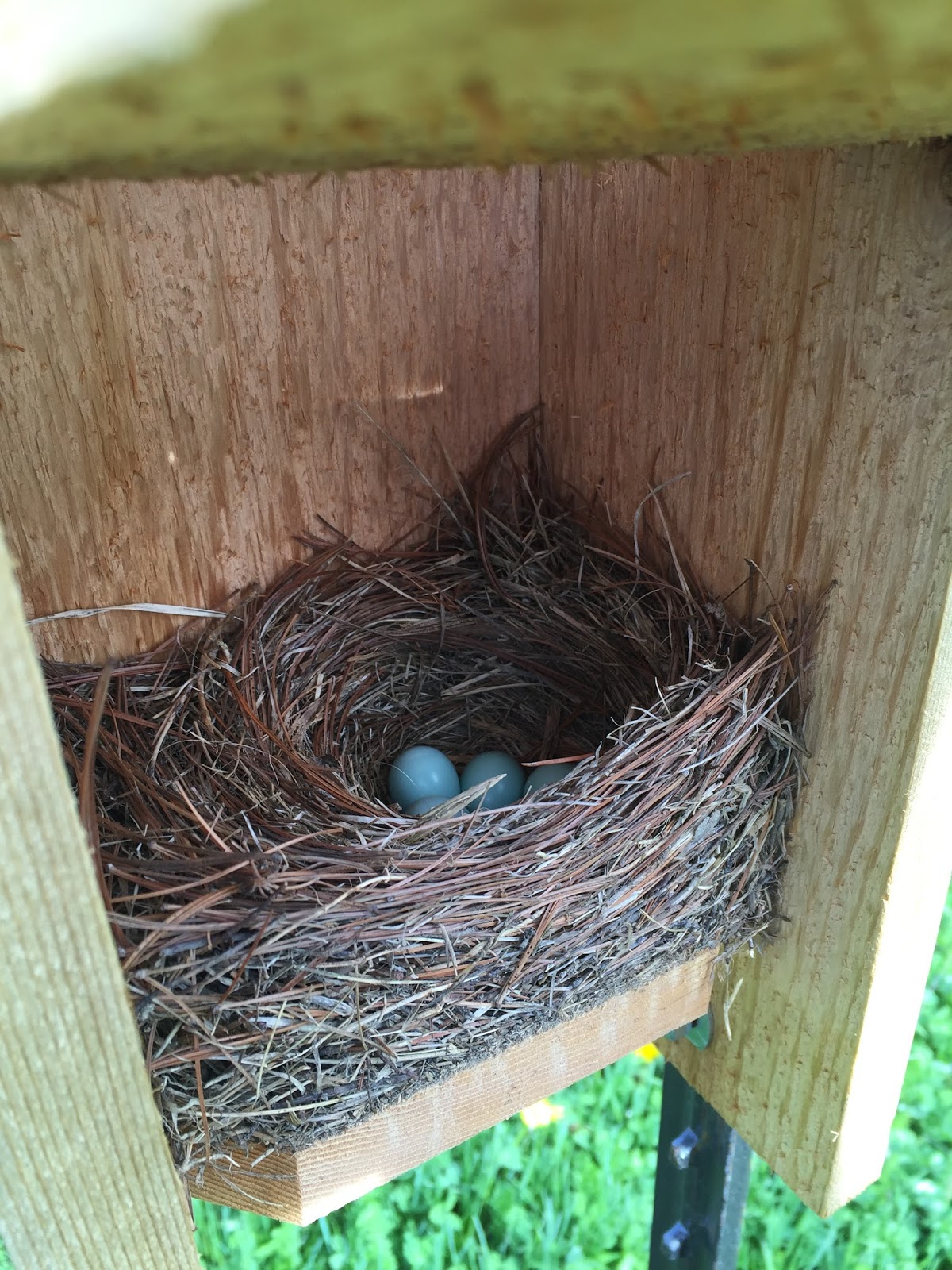
First up is the Bluebird nest.  This box was also used by a pair of Bluebirds in 2016 - last year they successfully raised five young.  The colder weather this spring has delayed nesting for many birds.  At this point last year, the Bluebird chicks were a week old.  As of yesterday they were still eggs.


Eastern Bluebird eggs (photo by Shara LeValley)

Next is a picture of a Tree Swallow nest.  You'll notice the difference in nests right away.  Bluebirds construct their nests of fine grasses.  So do Tree Swallows, but then they line their nests with feathers.
This nest got a late start - the bird have only laid one egg so far.

Tree Swallow nest and egg (photo by Shara LeValley)

The final two active nest both contained six Tree Swallow eggs.

Tree Swallow eggs (photo by Shara LeValley)

Another Tree Swallow nest (photo by Shara LeValley)

We'll check on the boxes again next week - hopefully there will be baby birds to show.

Sunday, June 26, 2016

Nesting Bees

Yesterday afternoon (26 June 2016), I noticed a lot of activity around our native bee nesting box.  Several dozen bees recently emerged as adults.  The male bees were buzzing around the nesting box trying to attract females.  Females were busy clearing nesting sites of last year's nesting materials, collecting pollen, and laying preparing to lay eggs.  Here is a short video showing some of the activity.


Thursday, June 2, 2016

Baby Bluebird Update (31 May 2016)

The baby Eastern Bluebirds at the Ziibiwing Center continue to grow quickly.  They have begun to spill out of the nest cup.  At a minimum these nestlings are 15 days old.  They could fledge (leave the nest) any day.

It's getting crowded in here... (Photo by Shara LeValley)


Baby Eastern Bluebirds (Photo by Shara LeValley)

One of the other nest boxes has a Tree Swallow nest.  When we opened the box, Mama Tree Swallow was sitting inside.

A female Tree Swallow sitting on her nest (Photo by Shara LeValley)

Meanwhile, in one of the nest boxes at the Saginaw Chippewa Academy a clutch of Tree Swallow eggs has hatched.

Tree Swallow nestlings (Photo by Shara LeValley)

Tuesday, May 31, 2016

Baby Bluebird Update (26 May 2016)

Last Thursday (the 26th), we stopped at the Ziibiwing Center to check on the progress of the Eastern Bluebird nestlings.  They look more and more like adult birds every time we check on them.


I've got my eye on you! (Photo by Shara LeValley)

Eastern Bluebird nestlings - that nest is getting pretty full (Photo by Shara LeValley)

Not the greatest photo, but you can see all five nestlings (Photo by Shara LeValley)

Eastern Bluebird nestlings - check out the blue wing feathers (Photo by Shara LeValley)

Monday, May 23, 2016

Baby Bluebird Update (23 May 2016)

The Eastern Bluebird nestlings at the Ziibiwing Center are coming along nicely in their development.  They have their eyes open now and are covered with feathers.  They are beginning to look like birds.


Thursday, May 19, 2016

Baby Bluebird Update

We stopped at the Ziibiwing Center yesterday (18 May) on our way home to check on the nesting boxes.  The baby bluebirds are growing and changing quickly - their feathers are starting to develop.  I expect their eyes to open in the next day or so.

Baby Eastern Bluebirds - there is a fifth one on the bottom of the pile (photo by Shara LeValley)

Tuesday, May 17, 2016

Baby Birds

We stopped yesterday afternoon (16 May) to check on the bluebird nest at the Ziibiwing Center.  Opening it up, here is what we discovered.

Five adorably ugly baby Eastern Bluebirds - photo by Shara LeValley

Look here to see the eggs before they hatched.

Wednesday, May 11, 2016

Continuing a recent theme... more eggs

Over the weekend, I went out to search for more wildflowers.  Along the way I found something even more interesting.

Blue Jay sitting on its nest

I knew this nest was there.  About two weeks ago I saw a pair of Blue Jays (Cyanocitta cristata) working diligently on its construction.  This nest is located probably only a dozen feet from a busy trail.

Inside the nest, were five perfect light brown eggs with dark brown spots.  I snapped a quick picture and then backed away from the nest to allow Mama Blue Jay to come back.

Blue Jay eggs are light brown or pale blue, with dark brown spotting

Tuesday, May 10, 2016

On the Bluebird Trail

Yesterday afternoon, Shara and I stopped at the Ziibiwing Center to check on the nest boxes along their new Bluebird Trail.  Most of the boxes are unoccupied - it is not unusual for birds to take a while to discover and use new nesting boxes.

However, one of the boxes contained a full clutch of five Eastern Bluebird eggs.

Eastern Bluebird nests are made entirely of grasses - photo by Shara LeValley

Eastern Bluebird eggs - photo by Shara LeValley

There were several pairs of Tree Swallows flying around the nest boxes.  Now that the weather has finally begun to warm up, I expect that they will also begin too nest soon.

Don't forget to come by the Ziibiwing Center this Saturday (May 14th) for the annual Bird Day Celebration.

Wednesday, May 4, 2016

A Frog and a Blackbird Egg

Yesterday I spent the morning at Mill Pond Park with 4th grade students from Ganiard Elementary.  Recently, I had visited their classrooms to give a presentation on wetland habitats - the field trip was an extension of that presentation.  During their field trip, the students spent most of their time searching for and identifying aquatic macroinvertebrates

Macroinvertebrates were not the only animals that were observed.  Students also noted muskrat lodges, sunning turtles, Canada Geese, and Red-winged Blackbirds.  Several very observant students discovered a few surprises like this well-camouflaged Green Frog.

Green Frog at Mill Pond Park.

Staring contest

Even more well-hidden was a Red-Winged Blackbird nest, nestled in among the cattails.


Red-winged Blackbird nest among cattails

Tucked down in the bottom of the nest was a single pale blue egg, mottled with dark spots.

Red-winged Blackbird egg


Wednesday, March 30, 2016

A new bluebird trail in Mt. Pleasant

A bluebird nest box with the Ziibiwing Center in the background
 
Yesterday afternoon I stopped at the Ziibiwing Center to install a new bluebird trail.  A bluebird trail is simply a series of nesting boxes arranged in some sort of pattern.  This will be the fourth bluebird trail that I have installed.  The others are at the Saginaw Chippewa Academy, Winn Elementary, and the Morey Public School Academy.  I maintain the boxes at SCA, the other boxes are maintained by teachers at the schools.

Why install bluebird trail at the Ziibiwing Center?  First, the Ziibiwing Center is the host site for our annual International Migratory Bird Day Celebration and I thought this would be a great addition to this year's celebration.  (This year's Bird Day is scheduled for Saturday May 14th - more information will come soon.)  Second, the Ziibiwing Center is surrounded by open grassy fields - good habitat for bluebirds.  Finally,  I have worked with the Ziibiwing staff on a number of projects over the years and though this was a great way to say thank you for their assistance. 

I also want to say thanks to Heather Shaw (wildlife biologist for the Saginaw Chippewa Indian Tribe) for helping me install the boxes.  If you want to learn a little more about Heather and the work she does, check out this post from August 2015.

In total, we placed seven boxes around the perimeter of the Ziibiwing Center.  I plan on going back and adding at least one more box.  There is also the potential to add some boxes at the nearby Andahwod senior center.  While putting up the boxes, we were able to watch hawks hunting in the surrounding fields and I think I saw an Eastern Meadowlark at one point.  I expect both Eastern Bluebirds and Tree Swallows will find these nesting boxes and make use of them in the upcoming years.

For plans to build a bluebird nesting box of your own, look here.

Monday, November 9, 2015

Native Species Profile - Great Blue Heron

When I teach students about birds, we talk about how birds are the only living creatures with feathers.  Then I ask if there was ever any other animal that was covered with feathers.  There is usually at least one student that knows the answer - dinosaurs!  Dinosaurs are birds!  Not every dinosaur was a bird, but every bird is a dinosaur.  That robin hopping around your yard - it's a dinosaur.  Your Thanksgiving turkey - also a dinosaur.  It's difficult to see the connection between birds and dinosaurs when you see a chicken or a chickadee, but sometimes the relationship stares you in the face.

Herons' eyes are located on the sides of their heads - they don't see things directly in front of them all that well.

This is the Great Blue Heron (Ardea herodias).  It is Michigan's second largest bird after the Sandhill Crane.  Mature Great Blue Herons can be between 38 and 54 inches tall and have a wingspan of 65 to 79 inches!  Having one take flight at close range is always a thrill.

Herons are an ancient group of birds.  Although fossils are rare, they have been found dating back as far as 60 million years ago.  With their large size and ancient heritage, it is no stretch to see these birds as living dinosaurs.

A Great Blue Heron wades among water lilies.


It's even easier to see the connection when you watch them hunting.  Great Blue Herons are pure predators.  Their long legs allow them to stalk silently through shallow waters and along shorelines.  The largest percentage of their diet is composed of fish, but they also eat amphibians, reptiles, small birds, and large invertebrates.  Sometimes they can be seen stalking through field in search of mice, voles, and other small mammals.  When prey is sited, the heron will curl its long neck and then rapidly extend it to stab with the long spear-like beak.  They then swallow their prey whole - often tilting their head skyward to have gravity help the process.

A Great Blue Heron tilts its head for a better view of its prey.

The Great Blue Heron is often a year-round resident of Mid-Michigan.  Many will remain in the region throughout the winter, unless all surface water is frozen over.  Other herons will join in a migration that may take them as far south as Central America or the Caribbean.

Heron tracks on the Chippewa River ( January 2014)

During the majority of the year Great Blue Herons are solitary birds.  However, in springtime, Great Blue Herons (and related species) will nest in communal nesting colonies called heronries (or heron rookeries).  Each heron pair will build a  platform of sticks lined with softer materials such as grasses and moss.  In an established heronry, the birds will often build upon the work of previous years.  Large nests can be 4 feet across and nearly as tall.

A small heronry in Gratiot County
It is easy to find herons.  In Mid-Michigan any body of water (including backyard fish ponds) is likely to attract the attention of a heron.  The Chippewa River in Mt. Pleasant always has a resident population of herons.  To see large numbers, visit the heronry along US-127 near Houghton Lake or the Maple River State Game Area between Ithaca and St. Johns.

Great Blue Heron in the shallows at Mill Pond Park - scan of a photo from 2005


Basic Information


Great Blue Heron 
Ardea herodias

Size: 38-54” long, 65-79” wingspan

Habitat:  wetlands, riverbanks, streams, lakes, ponds, ditches

Eats:  fish, invertebrates, amphibians, reptiles, birds, small mammals

Nest:  in trees, large platform of sticks, nest in colonies

Year-round resident