Showing posts with label owls. Show all posts

Sunday, February 17, 2019

A backyard visitor

We live in town in a residential area.  So imagine my surprise when I opened our back door one night last week to see this...


That's an Eastern Screech Owl (Megascops asio) sitting in a large Honey Locust tree less than 25 feet from the house.  This species is common across the eastern United States and can be found anywhere mature trees exist including urban or suburban areas.


This owl was probably hanging out in our yard waiting for a mouse to show up under our bird feeders - it was facing directly toward the feeders. This is actually the first screech owl that I have ever seen in the wild.  It was pretty amazing to see (and photograph) one in my backyard.


To learn more about the Eastern Screech Owl check out this entry from the Cornell Lab of Ornithology.

Monday, August 13, 2018

The Days of Summer - Day Forty-five through Day Fifty-one

This is part seven of my Days of Summer photography project.   Beginning with the Summer Solstice (21 June 2018) and ending with the Fall Equinox (22 September 2018), I am making it a point to get outdoors and photograph something every single day.  One photograph from each day is being selected for this project and shared here.

The previous installments of this project can be found at the links below:

Part Six
Part Five
Part Four
Part Three
Part Two
Part One

I hope you enjoy the photos from this past week - one of them might be quite a surprise.

Day 45 (04 August 2018) - A Banded Bird


The first image of the week was taken at Forest Hill Nature Area.  If you look closely at This female Common Yellowthroat (Geothlypis trichas) you might notice that her left leg sports a band.  Between this picture and several others of this bird I was able to make out a couple numbers on the band.  With that information, I contacted Mike Bishop at Alma College - he is running a banding project at Forest Hill.  With the numbers I gave him, Mike was able to narrow it down to one of two birds that he banded on June 28th of this year.  We both thought this was pretty cool.

This photograph has been cropped into a landscape format - taking some off the top and bottom of the image.  I just thought it was the most appealing of all the different crops that I tried.  I like how the bird looks like she is about the launch herself at the goldenrod to the left of the image.

Friday, January 26, 2018

Another Snowy Owl

Yesterday morning I had two presentations to give at Beal City Elementary.  On my drive to the school I kept a watch out for Snowy Owls - one has been reported hanging out between Rosebush and Beal City near the intersection of Weidman Road and Nottawa Road for several weeks.  Sure enough, as I approached the intersection from the east there was an owl perched on a utility pole.

I didn't have time to stop right then, but hoped the owl would still be there when I drove back through the area.

Two and a half hours later, after completing my classroom programs, I drove back down the same road with hopes that the owl I sighted earlier would still be near the road.

Fortunately for me, the owl was perched on the same roadside pole.  I pulled my truck as far off the road as possible and hopped out.  The owl was definitely aware of my presence and it looked directly at me several times, but it was more interested in the several cars and trucks that passed by in the few minutes that I stayed there.  Whenever a car went by the owl would turn its head to follow it.

Snowy Owl (Bubo scandiacus)

This is the fourth individual Snowy Owl that I have seen this winter and the third that I have had the opportunity to photograph.  This one was by far the most heavily marked owl that I have seen this winter.  Most likely this is an immature female - female birds are more heavily marked than males. Hopefully I will see several more yet this winter before they return to the Arctic. 

Snowy Owl - cropped to a vertical image

Monday, January 22, 2018

Snowy Owls in Mid-Michigan 2018

Do you want to see a resident of the Arctic without leaving Mid-Michigan?

Right now we are undergoing an event called a Snowy Owl irruption.  During an irruption, Snowy Owls (Bubo scandiacus) descend from the Arctic in large numbers.  It is normal for some snowy owls to migrate south to southern Canada and the northern United States every winter, but during an irruption year the migration is much larger than normal. Snowy Owls have been reported this winter as far south as Oklahoma and Virginia.

Many people mistakenly believe that an irruption indicates that the animals are suffering food shortages in their native habitat and arrive weak and starving.  Instead, the opposite is probably true.  Irruption years have been linked with abundant summer food supplies allowing more young owls to successfully fledge (develop wing feathers large enough for flight) and strike out on their own.  These young owls form the majority of owls during an irruption.

Snowy Owl near Rosebush, MI (19 January 2018)

While most owls are secretive and prefer to hide during daylight hours, Snowy Owl are quite comfortable hunting during the day - during the Arctic summer these birds experience nearly 24 hours of sunlight each day.  Also these birds are used to open habitats.  While most owls retreat to the security of wooded areas during the day, Snowy owls are more likely to perch on the ground in an open field, atop a building, or atop a roadside utility pole.  This visibility and their exotic nature makes Snowy Owls one of the few birds that will excite non-birders.

Snowy Owl between Alma and Shepherd, MI (19 January 2018) - photo by Shara LeValley

If you want to see a Snowy Owl, you can always just drive around and look for them, but the best way to see them is to find out where other people have been sighting them.  Ask a birder - they will know where the local Snowy Owls are hanging out.  If you lack access to a birder check out the website eBird.  Here is link for the current year's Snowy Owl sighting.  Once on the page you can zoom in to your location and see if any have been sighted nearby.  If want to see other birds, you can search for them on eBird too - just type in the search box.  Most of the Snowy Owls that I have seen were ones that were previously reported on eBird.  The owl in the second photograph above was one that I found on my own simply by observing the fields as I drove home from work.

If you go out looking for Snowy Owls please remember that these owls are best enjoyed from a distance. If the owl keeps looking at you with fully open eyes, stands erect, or takes flight then you are getting too close.

Monday, December 11, 2017

Native Species Profile - Snowy Owl (Bubo scandiacus)

Most people don't understand birders.  The idea of going birding (looking for and recording bird sightings) is seen as odd a lot of people.  Why would you go looking for birds - birds are just there.  They're around us every day - they are so common that they fade into the background and become part of the scenery.

Despite my other nature obsessions, I will admit that I don't bird (the verb).  It takes a lot of bird (the noun) to get me excited enough to go bird (the verb).  One of he few species that excites the general public (and me) enough to go birding is the Snowy Owl (Bubo scandiacus).  A Snowy Owl is not so much a bird (the noun) as it is an event.

Snowy Owl - Isabella County, MI (December 2014)


The winter of 2017 - 2018 looks to be a big year for fans of the Snowy Owl.  There have already been dozens of sighting of Snowy Owls in Michigan and birds have been reported as far south as Missouri and Virginia.  Some years the population of Snowy Owls moves southward in large numbers during the winter months.  This movement is known as an irruption - the last big irruption was in 2013 and 2017-18 looks like it will be even bigger.

The exact cause of irruptions is not well known.  It may be tied to downswing in the population of Arctic lemmings, the owls major food source.  When lemming populations fall, birds must come south to find enough food.  it may also be related to upswings in lemming population - more lemmings available during the breeding season means more young birds survive to adulthood. When there are more owls in the Arctic some of them must come south to find enough food.  I tend to believe this latter explanation because a large percentage of the irrupting Snowy Owls tend to be immature birds.

One of the reason Snowy Owls are so exciting is that they are large birds.  They measure 20 to 28 inches long and have wingspans of 49 to 57 inches.  As is typical of raptors, females are usually larger than males.  The Snowy Owl is the heaviest owl species in North America weighing 3.5 to 6.5 pounds; the Great Horned Owl, Mid-Michigan's largest resident owl weighs an average of 2.0 to 5.5 pounds.

Snowy Owls are primarily white.  Females and immature birds will have dark brown or black barring on the wings, back, and chest.  Mature males are pure white or nearly so.  Both male and female birds have bright yellow eyes

Another reason that Snowy Owls are so exciting is the fact that they are diurnal.  This means that they are active during the daytime.  Combined with the fact that they prefer open areas such as fields to wooded areas and they become easy to find.  (I say easy to find, but in January of this year it took us three trips to find one of several that had been reported nearby for weeks.)  Snowy Owls often rest on the ground - their native tundra has few trees and the birds are used to perching on the ground.  Birds that are part of the irruption often perch on utility poles so they can better see their surrounding.

Snowy Owl - Gratiot County, MI (January 2017)


Basic Information

Snowy Owl
Bubo scandiacus

Habitat:  Arctic tundra; birds may overwinter in the Continental United States, over-wintering birds usually found in open areas such as fields, prairies, airports, golf courses

Size:  20 - 28 inches long with a 49 - 57 inch wingspan, females are typically larger than males

Diet:  small mammals, birds

Monday, January 16, 2017

Snowy Owls in Mid-Michigan (2017)

For approximately the last month, two (or maybe three) Snowy Owls have been found in the fields a few miles southeast of Alma.  Twice Shara and I drove through the area where people sighted them.

No luck.

Several people that I know, both serious birders and casual birders have had success in seeing at least one of the owls.

Yesterday we decided to give it another try.  We drove right back to the same location that we had visited before and slowly drove down the road.

Success! Finally!  Shara spied the bird out in a field, about 100 yards away, perched atop a small snow bank.  We pulled over and observed the owl for about 15 minutes, with hope that it would fly somewhere we could get a better (closer) view of it.


It was not to be, but we can say that we saw it.  We both snapped several photos.  The pictures are nothing special, but as this is only the third Snowy Owl that either of us has seen they are special to us.

To find recently sightings of Snow Owls (and other birds) visit eBird.  This website allows people to post data and photos of their sightings and is a valuable tool both for birders and scientists.  The report that I filed for this owl can be found here.

Thursday, July 14, 2016

Sad news from Wings of Wonder


Sad news from the Wings of Wonder Facebook page:

"A bit of sad news to share . . . our littlest 'family' member, Ned, has passed away suddenly. Ned, a Northern Saw Whet Owl, showed signs of illness on July 9th and was gone by July 11th. We are currently awaiting the results from an autopsey so I will share that information when I receive it. Ned was one of our most popular raptors, delighting thousands of folks over the many years with his cuteness, small size, beauty and quirky personality. He will be so very, very missed . . . and I wish him well on his next journey. My loving thanks to little Ned for opening our eyes and hearts to the greatness of Northern Saw Whet Owls."

Ned made the trip to Mt. Pleasant a couple of times for the International Migratory Bird Day Celebration at the Ziibiwing Center.

Rebecca Lessard with Ned at the Ziibiwing Center (2016)

Shara and I have also been fortunate enough to visit Wings of Wonder on two occasions and see Ned (and all of the other WOW birds) at "home".

Ned in his flight enclosure at Wings of Wonder (2015)

Ned will be missed by many.   Contributions in Ned's memory can be made to Wings of Wonder.

Tuesday, March 29, 2016

Boxes for owls, in trees

Last month (February 2016), I built several nesting boxes for different sized birds.  These included a box intended for Eastern Screech Owls and another intended for Barred Owls.  I gave the two boxes to my parents to put up on their property near Laingsburg.  On Sunday (27 March), I was finally able to see where they placed the boxes.

My parents own about 15 acres of land.  More than half of this land is located in the floodplain for the Looking Glass River.  The rest of their property is above the flood plain and is composed mostly of clay soils.  This property was formerly owned by my maternal grandparents and was once operated as a small farm.

Since my parents purchased the property they have been slowly planting trees to reforest much of the land.  This task has been complicated by the fact that many of their trees were ash trees and have been killed off by the invasive Emerald Ash Borer beetle.  As a consequence, there has been increased urgency for the past several years.

Many of the first trees planted on the property were a combination of pine and spruce species.  Some of these trees are now more than 30 feet tall and provide a dense overhead cover.

A stand of twenty year old pines

Over the past two years, they have found several dozen owl pellets under these trees.  This seemed like a good location to place one of the two owl nesting boxes.

The screech owl nesting box is located in the pine tree just left of center

A closer view of the nesting box.

This box has already been occupied, but not by owls.  It seems that a Red Squirrel (Tamiasciurus hudsonicus) has taken up residence in this box.

The other nesting box is placed in one of the largest trees on the property.


Placed nearly twenty feet up in a large oak tree, this box overlooks an area of mixed hardwood swamp.  This is exactly the place that I envisioned when I made this nesting box.  It seems like the right place to find a Barred Owl - the only drawback being that there may not be enough mature trees in the area.  I guess only time will tell.


I didn't see any owls, but I did manage to see something just as wild.  While walking along the edge of the flooded marsh, I surprised a large Mink (Neovison vison).  The mink quickly began to swim away and I was able to only get a couple of pictures as it swam away.  Even though it was only a brief sighting, it's always exciting to see a mink.


Friday, May 1, 2015

Daylight Owl

The state schedule for standardized testing has wreaked havoc with my spring calendar.  Instead of teaching students about aquatic invertebrates,  I spent yesterday afternoon wandering around the wetlands at Mission Creek Woodland Park.  I was looking for Spring wildflowers, but I found something even better.


This Barred Owl (Strix varia) flew up from the ground about 20 yards in front of me and landed in a tree further in the wetland.  I took a moment to change lenses on my camera and started walking closer.


After a couple of minutes the owl flew into an Eastern Hemlock (Tsuga canadensis) tree on a nearby slope.  I took a couple more photographs before the owl again flew further away.


At this point I walked up the slope, not expecting to see the owl again.  I took one further look around and the owl was tucked in another nearby hemlock tree.  I was able to take one last picture before it flew back down onto the wetlands and disappeared.


Seeing a Barred Owl in the middle of the day is not that unusual.  They commonly hunt during daylight hours.  This is actually the second time that I have seen a barred owl in this location.

Tuesday, December 9, 2014

Owls, owls, everywhere!

Keeping with the recent theme of owls... I have seen two in the past twenty-four hours.  A Barred Owl crossed the road in front of me at dusk last night and then today I saw this beauty along the road in northwest Isabella County.

Snowy Owl near Weidman, MI (09 DEC 2014)

This Snowy Owl (Bubo scandiacus) has been hanging around the same general location since Thanksgiving Day.  I found it along Weidman Road., between Littlefield Road and Gilmore Road.  At one point a flock of Snow Buntings (Plectrophenax nivalis) swooped around over the owl's head - two arctic tundra species meeting in Mid-Michigan.  It makes you wonder if these individuals migrated from the same location only meet up again here.

Snowy Owl and Snow Buntings near Weidman, MI (09 DEC 2014)

Monday, December 8, 2014

In the Company of Owls

Saturday night was a great night to walk through the woods at the Chippewa Watershed Conservancy's Sylvan Solace Preserve.  CWC Director Stan Lilley and I led this walk for a total of twenty-one interested people.  Most of those attending had never taken a moonlit walk through the woods before and a few people had never visited Sylvan Solace.  We gave everyone a glowstick so people would not get lost.  The weather cooperated with a crisp clear night with a full moon and lots of stars (until the moonlight blotted most of them out).  We took a little over an hour to walk one for the preserve's trails.

The moon through the trees

At several points along the trail we stopped to call for owls - Eastern Screech, Barred, and Great Horned.  We were successful at calling in a pair of Barred Owls along the Chippewa River.  The first owl just swooped around overhead, but the second landed in a tree nearly overhead.  When we shined a light on it there were several cries of amazement.  Unfortunately I was unable to get a good photograph of it while shining a flashlight at the same time.
 
Stan Lilley calls for owls with an app on his phone.

The blurry thing in the very center of this photo is one of the Barred Owls

After the walk, a small group stayed around to drink hot chocolate and talk.  There is already talk of schedule a spring moonlit walk to listen for frogs and we have a moth outing scheduled for July.

Monday, December 1, 2014

Roadside Snowy Owl in Northwest Michigan

Yesterday (Sunday 30 NOV 2014), I saw my first Snowy Owl (Bubo scandiacus).  Not my first of the year, but my first ever.  This owl was found along U.S. Route 31 just south of Traverse City (near Chum's Corner).

Photo by Shara LeValley

A big thank you to the staff at the Traverse City Wild Birds Unlimited for letting us know where this bird had recently been sighted.   We saw this bird as we were traveling home from a long weekend visit to Traverse City - the bird was literally sitting in the ditch along our route home.  We stopped to look at it for couple of minutes.

After several minutes of observing, the owl took off and flew atop a pole across the road.


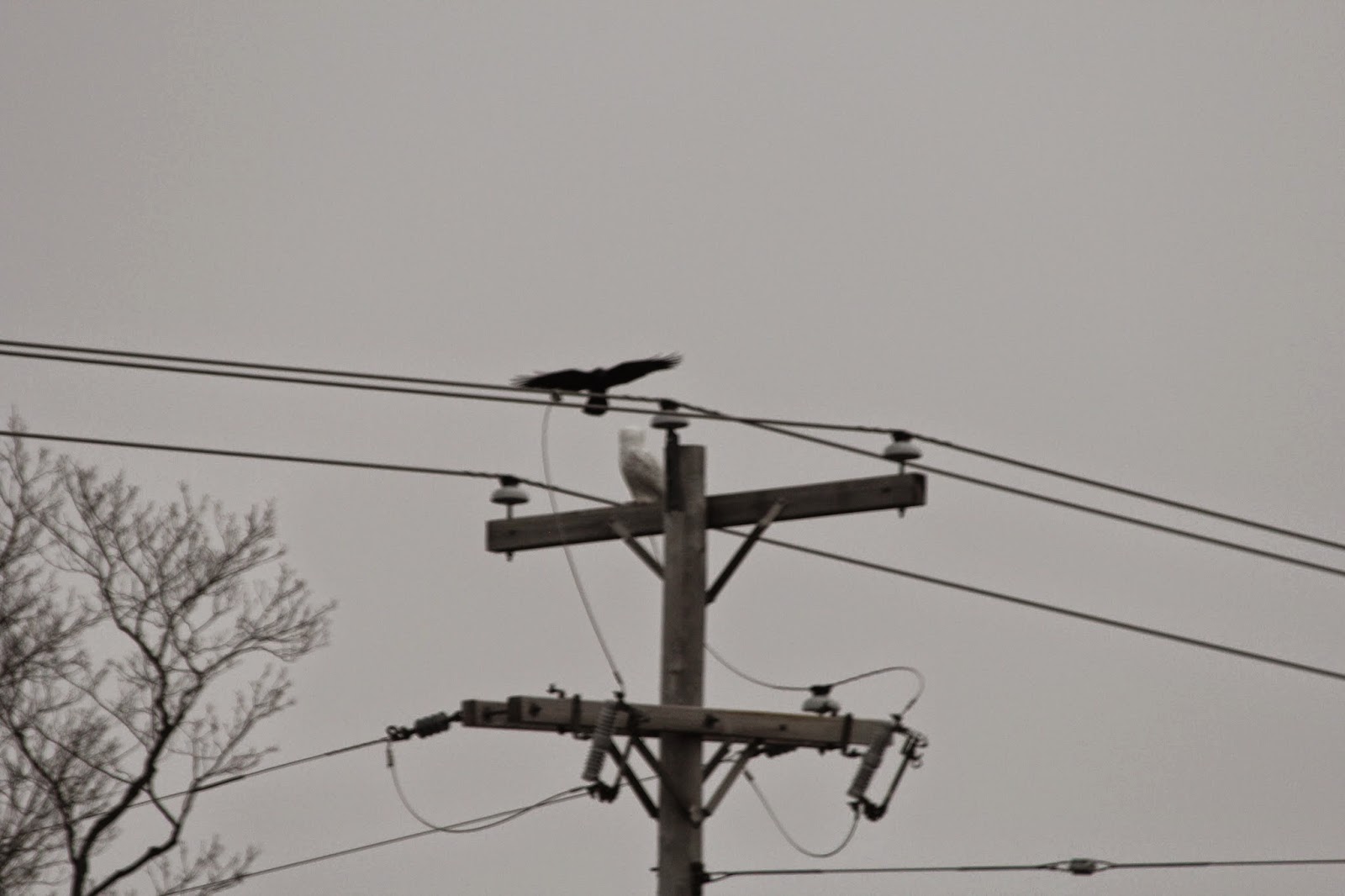
The local group of crows did not like the presence of the owl as much as we did.  When we left, the owl was still sitting atop the pole, and the crows were sitting nearby watching closely


Friday, October 31, 2014

Creatures of Halloween

Happy Halloween!

Halloween is a great time to celebrate all creatures that can seem creepy, spooky, or icky.

Like Spiders,


Toads,


Millipedes,


Salamanders,


Snakes,


Owls,


and Crows!


As a bonus how about a deadly plant (Bittersweet Nightshade)


and a poisonous Amanita mushroom!