Showing posts with label animals. Show all posts

Monday, January 15, 2018

IMG_0115 for 01/15 (A random collection of photos that all have the same name)

The following photographs have nothing in common, except their file names.  Each of these photos is titled IMG_0115.  I don't do a good job of labeling photos as I add them to my computer.  Each of the pictures goes into a separate file according to the date that the picture was taken, but the individual pictures all have the name that the camera assigned to them.

I actually thought of this idea of posting several of the pictures a few months ago while I was searching for an image on my computer.  I was writing a new blog post and wanted to use a certain photograph, but I couldn't remember which file it was saved in.  Fortunately I had used the file previously in another blog post.  When I use an image on this blog the link to the image contains the name of the file so I was able to look at that link and then do a search on my computer for the original file.  I found the file that I wanted, but I also found several dozen more images with the same name.

With that experience, I decided that I would share several photos that share the same name.  Why did I pick IMG_0115 as the title to share?  Today's date is January 15th, or if you are expressing it as a number in the format MM/DD it is 01/15.  So IMG_0115 it is.


IMG_0115 - Devil's Tower as seen from the base of its boulder field (July 2017)

IMG_0115 - Mt. Rushmore (July 2017)

IMG_0115 - Red Admiral butterfly  (May 2017)

IMG_0115 - Yellow Trout Lily (April 2017)

IMG_0115 - Trail clearance at Audubon Woods Preserve (April 2017)
 
IMG_0115 - Rural sunrise (January 2017)
The rest of the photos can be found below the break.

Thursday, October 5, 2017

Public Event - Creatures of the Night program (11 October 2017)


Come join the Chippewa Valley Audubon Club at our next monthly meeting on Wednesday 11 October 2017 at the Veterans Memorial Library in Mt. Pleasant (301 S. University Avenue).  Our program this month will a be a presentation of "Creatures of the Night" featuring live nocturnal animals.  This program is being presented by the Howell Nature Center.  Please note that this event starts at 6:00PM rather than our usual start time of 7:00.

Wednesday, July 26, 2017

Go to the Fair - Isabella County Fair (through Saturday July 29th)

This week (24 - 29 July 2017), the Isabella Conservation District has a booth at the Isabella County Fair.  Today Shara (Mrs. LeValley) joined me at the fair for a few hours and we took time to walk around all of the exhibits and animal barns.

Shara with a new friend


Until I moved away to college (at age seventeen), I lived on and around farms.  Every year we would go to the county fair - visiting the merchant buildings (where local businesses always gave things away to kids and adults), checking out the arts & crafts and other exhibits, climbing on new tractors and other farm machinery, riding carnival rides, and more!

The Ferris Wheel

One of the highlights was visiting the different animal barns.  Although I never showed animals at the fair many of my friends did.  I always saw people that  I knew when we went to the fair.

The animal buildings at the fair are still a highlight for me.  Now, when I go to the fair, I see the children of friends and co-workers exhibiting animals.  I also see lots of students from classrooms that I visit.  The students always want to tell me about their animals (especially if they won prizes).

Here are a few pics of animals from the fair.

A stylish sheep

Being a hog is tiring

A pen of goat kids
 
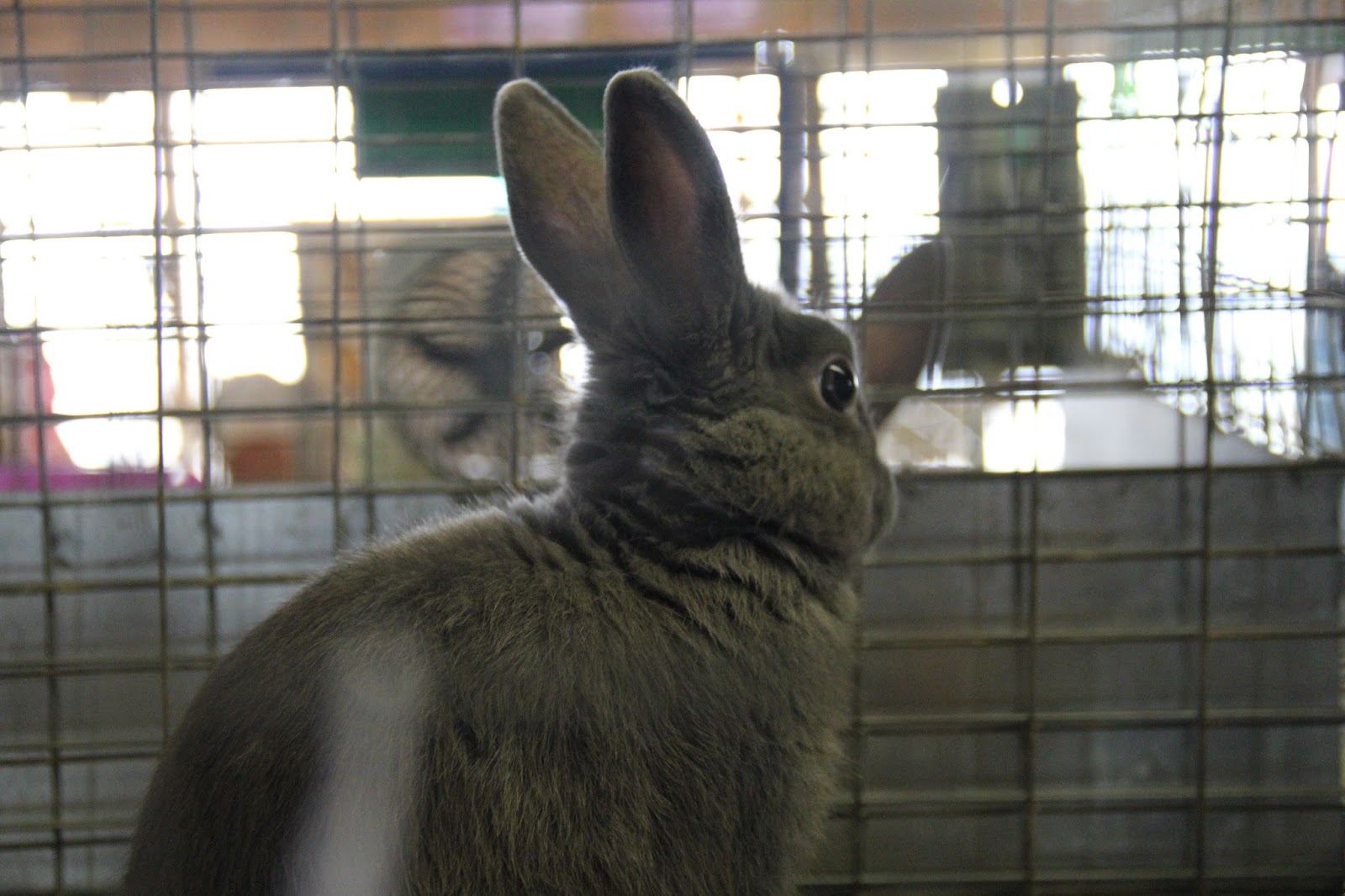
Rabbits are one of the most popular animals to show

Shara conversing with a prize-winning pen of chickens

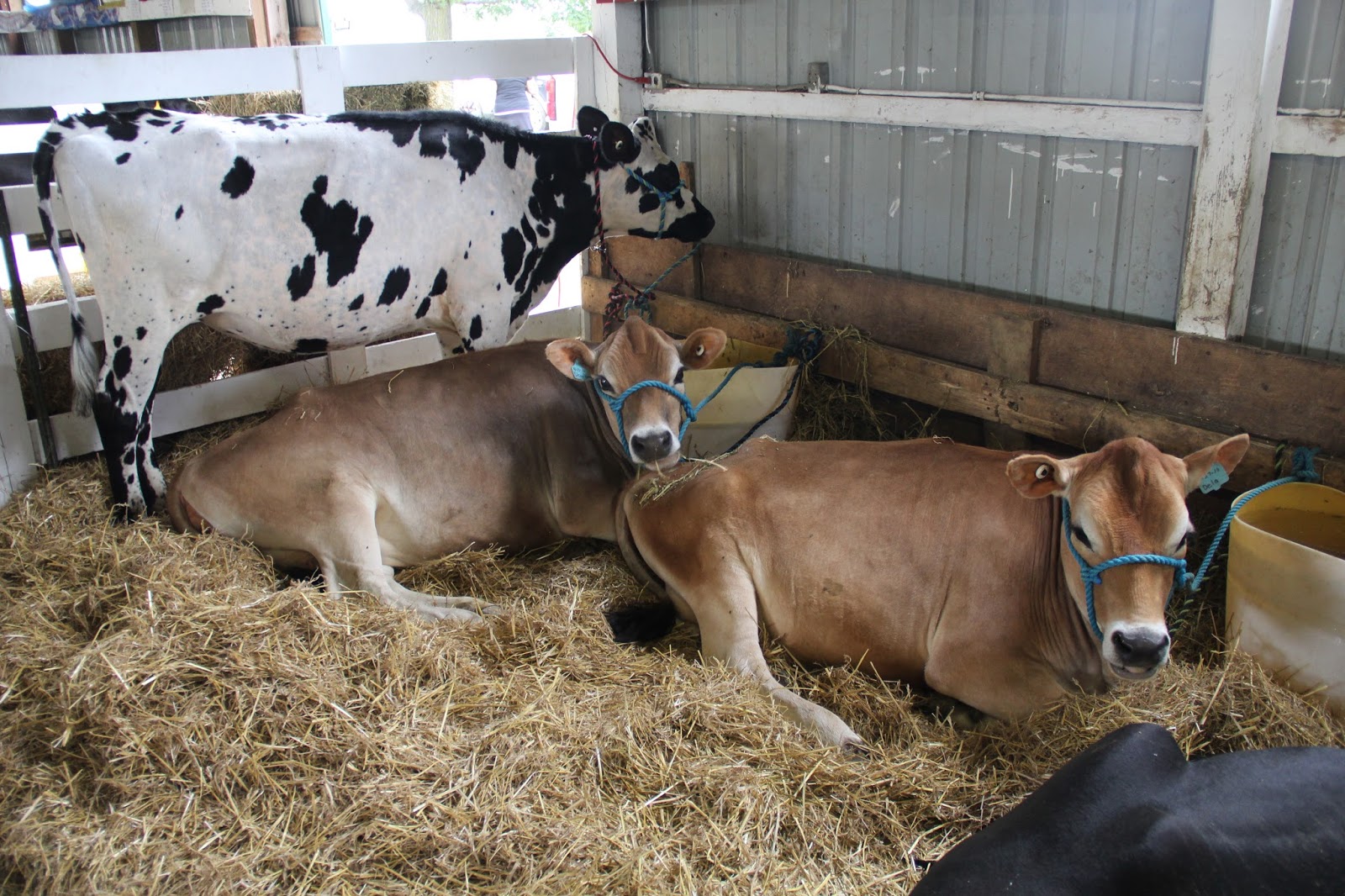
Dairy feeders

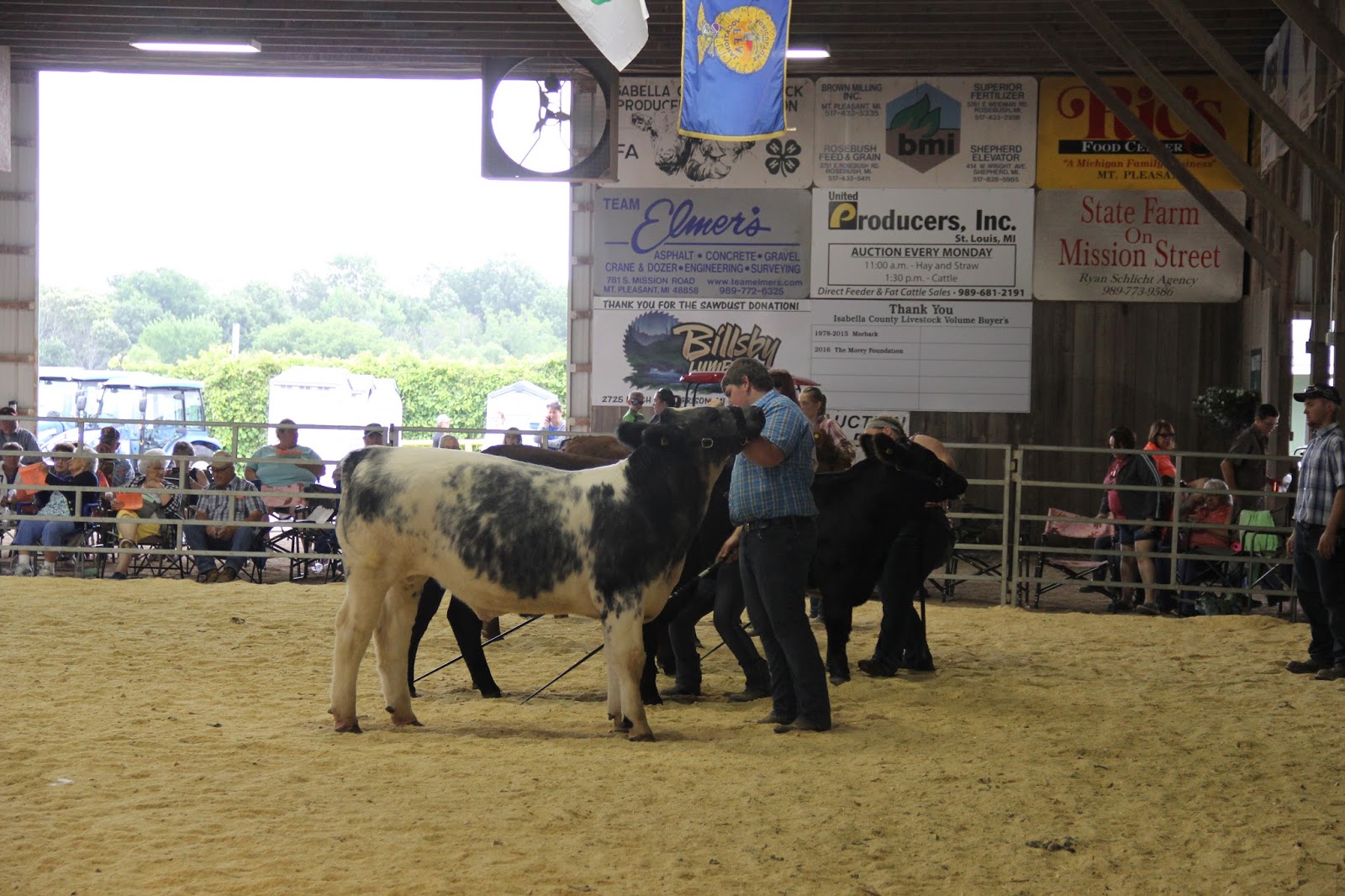
Teens showing beef cattle

I think everyone should visit their local county fair.  With less and less people growing up around farms and being connected to agriculture, this is one of the few opportunities that many people have to interact with farm animals (or even see them up close).  For the kids that exhibit animals, the fair provides an opportunity to develop responsibility as they raise and then show their animals.  Many of the animals are then sold at the fair, earning the kids money for their hard work.  Local businesses and individuals will often pay big bucks for animals especially champions.

If you visit the Isabella County fair, stop into the Merchant's Building and say hello to me (or other conservation district staff), eat at the 4-H food stand (the food is good and the money goes to support 4-H and the fair), and be sure to see all of the animals.

If you can't visit the Isabella County Fair, visit one of the other county fairs held across the state between now and September.

Wednesday, December 16, 2015

Native Species Profile - Brown Snake (Storeria dekayi)

Michigan is home to seventeen species of snakes.  Most of them are rarely encountered.  In the past two years, I have seen only six of the seventeen species in the wild (Common Garter Snake, Butler's Garter Snake, Northern Ribbon Snake, Northern Water Snake, Eastern Hognose Snake, and Brown Snake).  Of those six species, the two that I have seen most frequently are the Common Garter Snake and the Northern Ribbon Snake.

The third most frequent snake that I encounter is the Brown Snake (Storeria dekayi).  As the name implies, the Brown Snake is normally colored some shade of brown with some individuals being gray-brown or tan.  Other distinctive markings include a cream or pink belly and two rows of black dots on opposite sides of the back.  The color between the two rows of black markings is often lighter than on its sides.  Young Brown Snakes often have light gray or white ring around their necks.

Brown Snake - note brown color, row of black dots, and light color on back

Brown Snakes are typically generally small, with most individuals being between 9 and 15 inches long.  Rarely they will approach two feet in length.

A young Brown Snake resting inside my ballcap

Because of their small size, Brown Snakes concentrate on eating small animals.  Their typical diet includes worms, slugs, and snails.  They have also been known to eat grubs, beetles, and small salamanders.  I would expect that large individuals may also eat small frogs and other small vertebrates.

Brown Snake are small - normally measuring less than 15 inches.

Brown Snakes can be found in a variety of habitats including woodlands, wetlands, and suburban areas.  One way to attract Brown Snakes to a property is to provide them with boards or other suitable objects to hide under.  In Michigan they can be found throughout the Lower Peninsula and parts of the Upper Peninsula.  Overall they can be found throughout the United States east of the Rocky Mountains,  southern Canada, and northern Mexico.


Basic Information

Brown Snake
Storeria dekayi

Size:  9-23” long 

Habitat:  wetlands, fields, prairies, forests, agricultural lands, suburban areas, etc.
Eats:  worms, slugs, snails, grubs, small salamanders

Thursday, August 6, 2015

Sometimes Nature Come to You...

Tuesday evening, Shara and I were sitting on our porch swing when she noticed this dragonfly hanging out on the porch ceiling.

Shadow Darner (Aeshna umbrosa) - dorsal view

Shadow Darner (Aeshna umbrosa) - lateral view

After much consulting of field guides and the internet,  I decided that this was probably a Shadow Darner (Aeshna umbrosa) - this was later confirmed by a local expert (Thanks, Stan!)  This species is common across much of North America.  This is the first darner that I have found at our house.  We commonly have meadowhawk dragonflies and several species of damselflies, but no large odonates.

Our neighbors probably already think that we are a bit odd, a viewpoint that we confirmed by bringing a stepstool out onto the porch to take photographs of this dragonfly perched on the ceiling.  Personally, I prefer to think of myself not as odd, but rather as "eccentric"

Monday, July 27, 2015

Like a moth to a flame...

Disclaimer:  There were no actual flames used in the writing of this post. Moths were attracted using lights, not flames.

Last week was National Moth Week

On Saturday night (25 JUL) a group of eleven members of the Chippewa Valley Audubon Club gathered at Mission Creek Woodland Park for a moth hunt. 

For many people the word "hunt" implies active pursuit - visions of specially trained dogs, and small bore shotguns; the smell of waxed canvas, gun oil, and leather; hours of walking and then seconds of pulse-pounding excitement as the moths are flushed from cover by the dogs! 

This "hunt" is nothing like that.

For those that have never hunted moths, this actually more of a moth "wait".  We set up a series of lights and sheets and stand around waiting for moths and other insects to appear out of the darkness.

Waiting for moths

This is the second time that we have attempted this activity.  When we did it at the end of June in 2014, we mostly attracted a bunch of nondescript small brown moths that were very hard to identify.  We had a lot of that again this year, but we also had several distinctive species that we were able to identify based on their characteristics.

One of the first moths to show up at the lights was the Painted Lichen Moth (Hypoprepia fucosa).  Several of these moths showed up over the course of the evening.


Painted Lichen Moth

The most distinctive moth of the evening was the Clymene Moth (Haploa clymene). This moth was easily identified by the cross-shaped pattern on its wings.  Although it can't be seen in this photograph, this moth has bright yellow underwings.


Clymene Moth (Haploa clymene)

Another moth that we identified in the field was the Cherry Scallop Shell (Rheumaptera prunivorata).

Cherry Scallop Shell moth

The next moth is one that I photographed, but did not identify in the field.  A quick internet search reveals this to be a Lesser Maple Spanworm (Speranza pustularia).  The small brown spots on the leading edge of the wings are the identifying characteristic of this species.

Lesser Maple Spanworm moth - note distinctive brown spots on edge of forewing

We were able to identify several other species, but unfortunately I did not get photographs of all of them: Grapevine Looper (Eulithis sp.), Grapeleaf Roller (Desmia sp.), Emeralds (various genera).

Moths were not the only animals attracted by the lights.  We had a single female dobsonfly or fishfly that showed up.


One of the kids at the moth hunt found a green-phase Grey Tree Frog (Hyla versicolor).  These frogs are able to change color based on habitat.  This one just happened to be green when it was found.

A green Grey Tree Frog (Hyla versicolor)

My favorite photograph of the night was of a daddy long-legs or harvestman silhouetted against the sheet.  Although these arachnids resemble spiders and are often confused with them, they are actually in a separate Order (Opiliones).

Daddy Long-legs at night - not a spider.

If you missed out on this moth hunt, you have another chance.  This Friday (31 July 2015) I will be leading another moth expedition.  This time it will be at the Chippewa Watershed Conservancy's Sylvan Solace Preserve.  This hunt is being done to commemorate a "blue moon".  The moon will not actually turn blue.  the term is used to describe a month with a second full moon.  For more information and to register for this event please visit the CWC website.  The event is free, but a donation to the CWC is encouraged.

Friday, May 29, 2015

Another Polyphemus Moth Earns Her Wings

One evening late last summer (September 6th, 2014), as I walked out the back door, I noticed something interesting on the lawn - a large green caterpillar.  Specifically, it was a Polyphemus Moth (Antheraea polyphemus) caterpillar.  Earlier in the summer, we had released an adult female Polyphemus that we had reared from a caterpillar the previous summer (2013).  Although we have absolutely no proof, it's cool to think that the caterpillar that I found in our yard was one of the offspring of the moth that we released.

The summer 2014 Polyphemus Caterpillar - photo by Shara LeValley


The caterpillar went into a cocoon after less than twenty-four hours.  It remained in that cocoon for the next 234 days!  Last night when we came home from work we realized that it had finally emerged.  The moth that emerged was another female - this one was in such a hurry that she actually laid a few eggs inside the enclosure.  Without breeding these eggs will never hatch.

After dinner we took her down the street to a local park for release. 

Polyphemus Moth in hand

Female Polyphemus Moth - the false eye spots are probably used to deter predators


We each snapped a few photographs and then placed her up in a willow tree.  With luck she will attract a mate and produce a new generation this summer.

Upon returning home we took a closer look at the cocoon that she emerged from.  Its hard to believe that that moth with a swollen abdomen the width of one of my fingers crawled out of a hole a lillt larger than the diameter of a pencil, but she did.

The cocoon was attached between a leaf and the side of a mush container.  You can see some of the eggs that she deposited before release.

The hole in the end of the cocoon from which the moth emerged

Monday, May 18, 2015

2015 Isabella County Environmental Education Day

Last Friday the Isabella Conservation District hosted our annual Environmental Education Day.  This was the sixth year that we have put on this event.  We offer this event to every Third Grade classroom in Isabella County - this year we had twenty-nine classroom attend.  The planning for this event takes several months and the few days prior to the even are full of last-minute preparations.  This is why I only published two posts last week.

We couldn't host this event without the participation of dozens of volunteers.  Starting about six months before the Environmental Education Day I start contacting groups that have presented in previous years.  I try to end up with about 20 different activities for the students.  Most of the organizations/individuals that volunteer their time have been supporting this event since year one.

On Wednesday and Thursday I spent hours getting things ready for Friday.  On Friday, I arrived at Chipp-A-Waters Park before 7:00AM to open the gates, set up canopies, set up our (Isabella Conservation District) activities, and direct people to their locations as they arrive.  The two hours before the students arrive are my busiest, most stressful, hours of the year.  Once everyone has set up and the students arrive I am able to relax considerably.

Here are a few photographs from Friday.  Despite rainy weather throughout the day, everything went according to plans and the students had a great time learning new things.

Thursday, March 26, 2015

100 Species to Know By Sight - #12 Eastern Chipmunk

Species on #12 on my list of species that every kid (and adult) in Mid-Michigan should be able to identify by sight is the Eastern Chipmunk (Tamias striatus).  The Eastern Chipmunk is one of eight species of squirrels that call Mid-Michigan home.  There is one other species of Chipmunk that can be found in Michigan, the Least Chipmunk (Tamias minimus), but its range in Michigan is limited to the Upper Peninsula.

Eastern Chipmunk peering from behind a log


The Eastern Chipmunk is a ground squirrel.  It digs extensive burrows and can be found in hardwood and coniferous forests, along forest edges, and in suburban areas.  Despite being a ground squirrel, the Eastern Chipmunk is an excellent climber and will climb trees.

A "tame" Eastern Chipmunk as a state park campground

Eastern Chipmunk identification is easy.  The Eastern Chipmunk is an overall reddish-brown color on its upper parts.  Its upper back is lined with five dark brown stripes alternating with light brown stripes that run from the shoulders to the lower back where they fade out.  The tail typically is covered with the same reddish-brown fur as the body with longer black-tipped guard hairs giving it grayish appearance.  This tail is often held upright as the chipmunk runs.


Eastern Chipmunk - the same campground chipmunk as in the above photo


Another feature of the Eastern Chipmunk that you might notice is its cheek pouches.  Food that is not consumed immediately is cached for later use.  Chipmunks stuff this food into expansive pouches in their cheeks in order to carry it back to their caches.  If a Chipmunk has filled pouches it looks as if its face is swollen.

Eastern Chipmunk - note the filled cheek pouches

Eastern Chipmunk - the same chipmunk showing the filled cheeks from the side

Tuesday, February 24, 2015

Dead Bees in Honeycomb

Last week one of the ladies that works in our building brought me a section of honeycomb.  She said that bees began building it on the exterior of her house over the summer and then mysteriously disappeared after a couple of weeks.  The comb was in a protected area under the eaves of her home and was inaccessible until high winds blew it down last week. 


When she brought me the comb it was obvious that the bees had not all disappeared.  Instead, many of them could be found dead, facing headfirst into the comb.


After doing a little research I found out that finding a comb like this is an indication that the bees starved.  This is usually found in hives that did not have enough honey stores to survive the winter, but starvation among honeybees can happen at any time of the year.  It is possible in summer when periods of drought cause flowers to temporarily shut down pollen and nectar production.

I wanted to preserve the comb with the dead bees inside it, but unfortunately many of the bees were decaying and smelled rather funky.  So I spent the better part of an hour plucking individual bees from the cells of the honeycomb with a pair of tweezers.  Some of the bees came out whole, while other broke into pieces and had to be teased out carefully.

At the end this is what I ended up with.


I plan on making a frame for the comb, with plexiglass on both sides so you can see the structure of the comb with the light shining through it.


Friday, October 31, 2014

Creatures of Halloween

Happy Halloween!

Halloween is a great time to celebrate all creatures that can seem creepy, spooky, or icky.

Like Spiders,


Toads,


Millipedes,


Salamanders,


Snakes,


Owls,


and Crows!


As a bonus how about a deadly plant (Bittersweet Nightshade)


and a poisonous Amanita mushroom!